
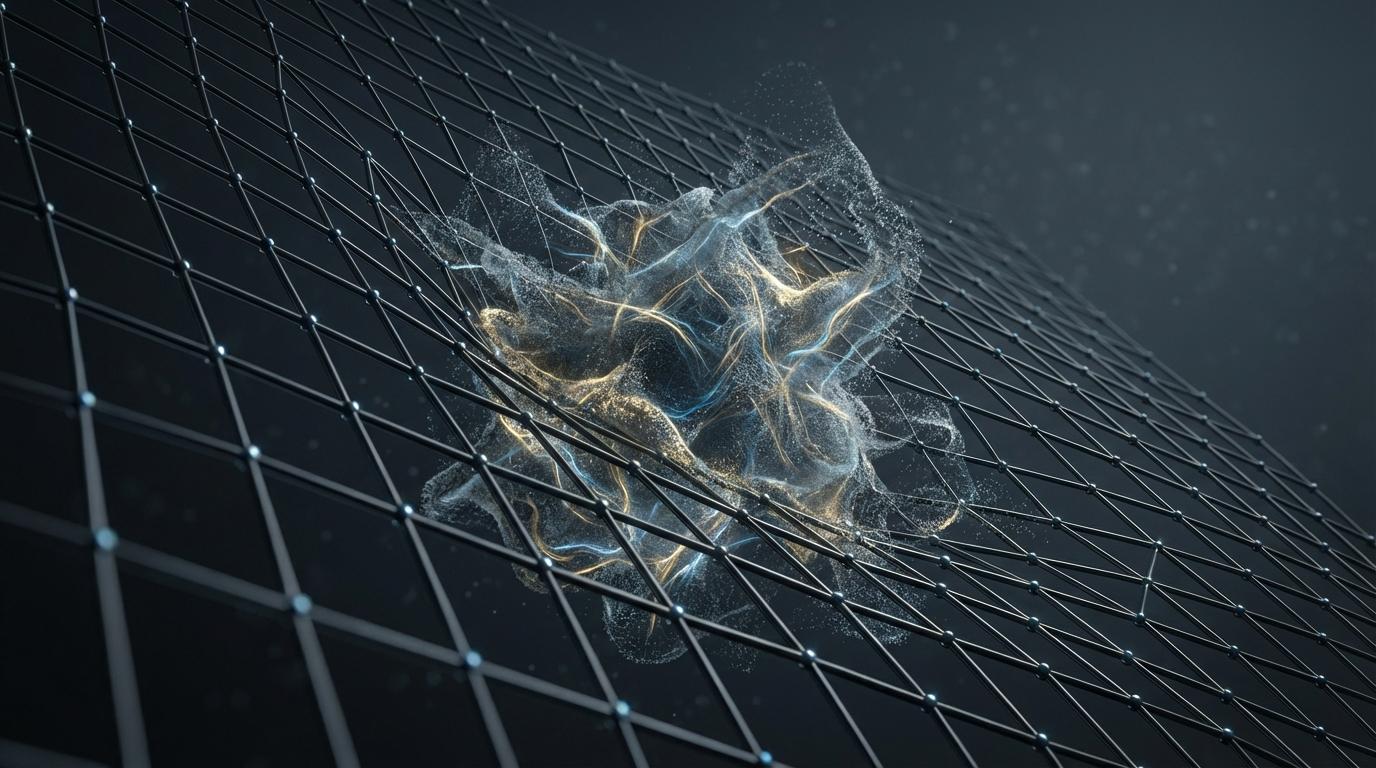
1. Introduction: The Universe’s Pixel
Just as the digital screen in front of you has pixels, a fundamental limit to its resolution, does our universe also have an ultimate, indivisible unit? In physics, this ultimate minimum unit is known as the ‘Planck length.’ This isn’t merely a technological limitation we might one day overcome; it’s a fundamental barrier where the very laws of physics as we know them forbid us from looking any further.
2. Background: The Smallest Ruler in the Cosmos
The Planck length is approximately 1.6 x 10⁻³⁵ meters, the smallest meaningful unit of length in theoretical physics. This value was proposed by Max Planck and is derived from a combination of three of the universe’s most fundamental constants: the speed of light (c), the gravitational constant (G), and the reduced Planck constant (ħ). This forms the basis of the ‘Natural Units’ system, a set of measurements rooted not in human standards, but in the intrinsic properties of the universe itself.
3. The Core Issue: A Clash of Titans
The reason we cannot peer beyond the Planck length stems from a fundamental conflict between the two pillars of modern physics: Quantum Mechanics and General Relativity.
The Observer’s Dilemma: Heisenberg’s Uncertainty Principle
According to the Uncertainty Principle of quantum mechanics, the more precisely you try to measure a particle’s position, the more uncertain its momentum (and thus energy) becomes. To “see” something, we must interact with it, typically by bouncing a particle like a photon off it.
- To see smaller objects, you need light with a shorter wavelength. This is analogous to increasing the magnification of a microscope.
- Light with a shorter wavelength has higher energy. (Energy is inversely proportional to wavelength).
- Therefore, to observe a region as small as the Planck length, one would need to concentrate an unimaginably high amount of energy into that tiny space.
Gravity’s Betrayal: Einstein’s General Relativity
This is where General Relativity enters the picture. According to Einstein’s famous equation, E=mc², energy is equivalent to mass.
- The tremendous energy concentrated to observe the Planck length is equivalent to an immense mass.
- General Relativity dictates that when a massive amount of mass-energy is concentrated in an extremely small space, spacetime itself curves dramatically.
- Ultimately, this mass-energy would collapse under its own gravity, forming a black hole.
The paradox is that the very act of trying to observe the Planck scale creates a black hole that hides the target. The event horizon of this newly formed black hole would actually be larger than the Planck length itself, effectively cloaking the region from any possible observation.
4. Deeper Analysis: Is Spacetime Pixelated?
The Planck length is often analogized to a ‘pixel of space,’ but whether space is truly discrete is a subject of intense debate among physicists.
- A Limit of Observation or a True Minimum?: Mainstream theories assume that spacetime is smooth and continuous. From this perspective, the Planck length is not a physical pixel but rather the point where our current theories (QM and GR) break down—a theoretical limit to observation.
- Quantum Foam: An alternative concept, proposed by physicist John Wheeler, is ‘quantum foam.’ This hypothesis suggests that at the Planck scale, spacetime is not smooth at all. Instead, it is a chaotic, turbulent sea of tiny spacetime bubbles constantly popping in and out of existence due to quantum fluctuations.
5. Future Outlook: The Quest for Quantum Gravity
The existence of the Planck length strongly indicates the need for a Theory of Quantum Gravity—a unified theory that harmonizes the quantum mechanics of the micro-world with the general relativity of the macro-world.
- String Theory: Proposes that all fundamental particles are not points but tiny, vibrating ‘strings’ on the scale of the Planck length. It is a leading candidate for mathematically unifying gravity and quantum mechanics.
- Loop Quantum Gravity (LQG): In contrast to String Theory, LQG posits that spacetime itself is quantized, composed of discrete ‘atoms of spacetime’ at the Planck scale. In this view, space is genuinely pixelated, and the Planck length is its fundamental unit.
Directly testing these theories is currently impossible, as even our most powerful particle accelerators cannot reach the energies required. Instead, scientists search for indirect evidence in cosmic phenomena like the cosmic microwave background or gravitational waves.
In conclusion, the Planck length represents not just an unseen realm, but the very boundary where all known laws of physics cease to apply. To understand what lies beyond is to embark on a journey to answer one of the most fundamental questions of all: what are space and time made of? It is the end of the road for known physics and the starting point for the next great revolution in our understanding of the cosmos.
플랑크 길이 이하를 들여다볼 수 없는 이유: 우주 해상도의 최종 한계
1. 우주를 구성하는 최소 단위, ‘픽셀’이 존재할까?
우리가 매일 마주하는 디지털 화면이 더 이상 쪼갤 수 없는 ‘픽셀(Pixel)’로 이루어져 있듯, 우리가 발 딛고 사는 이 우주에도 근본적인 해상도의 한계, 즉 궁극의 최소 단위가 존재할까요? 물리학은 ‘플랑크 길이(Planck Length)’라는 개념을 통해 바로 이 질문에 답합니다. 하지만 이는 단순히 인류의 기술력이 부족해 도달하지 못하는 영역이 아닙니다. 플랑크 길이는 우주의 물리 법칙 자체가 그 너머를 들여다보는 행위를 원천적으로 금지하는, 근본적인 장벽에 가깝습니다.
2. 우주의 가장 작은 자: 플랑크 길이의 탄생
플랑크 길이는 약 1.6 x 10⁻³⁵ 미터로, 이론물리학에서 의미를 갖는 가장 작은 길이 단위입니다. 이 개념은 양자역학의 아버지 막스 플랑크(Max Planck)로부터 시작되었습니다. 그는 우주를 지배하는 가장 근본적인 세 가지 상수, 즉 광속(c), 중력 상수(G), 그리고 **플랑크 상수(ħ)**를 조합하면 인간의 기준(미터, 킬로그램 등)이 아닌, 우주 그 자체에 내재된 절대적인 단위계를 만들 수 있음을 발견했습니다. 이것이 바로 ‘자연 단위계(Natural Units)’이며, 플랑크 길이는 이 단위계의 핵심적인 길이 단위입니다.
3. 법칙들의 충돌: 왜 우리는 그 너머를 볼 수 없는가?
플랑크 길이보다 작은 영역을 관측할 수 없는 이유는 현대 물리학의 두 거대한 기둥인 양자역학과 일반 상대성 이론이 이 스케일에서 정면으로 충돌하기 때문입니다.
관측의 딜레마 – 하이젠베르크의 불확정성 원리
양자역학의 불확정성 원리에 따르면, 어떤 입자의 위치를 더 정확하게 측정하려 할수록 그 운동량(에너지)은 더욱 불확실해집니다. 무언가를 ‘본다’는 것은 빛(광자)과 같은 입자를 대상에 쏘아 그 신호를 포착하는 행위입니다.
- 더 작은 것을 보려면, 더 짧은 파장의 빛이 필요합니다. 이는 현미경의 배율을 높이는 원리와 같습니다.
- 파장이 짧은 빛은 더 높은 에너지를 가집니다. (에너지 ∝ 1/파장)
- 따라서, 플랑크 길이만큼 지극히 작은 영역을 관측하려면, 상상을 초월할 정도로 엄청난 에너지를 가진 입자를 그 좁은 공간에 집중시켜야만 합니다.
중력의 배신 – 아인슈타인의 일반 상대성 이론
바로 이 지점에서 아인슈타인의 일반 상대성 이론이 등장해 모든 것을 뒤틀어 버립니다. 그의 유명한 공식 E=mc²에 따르면, 에너지는 곧 질량과 같습니다.
- 플랑크 길이를 보기 위해 한 점에 집중시킨 막대한 에너지는 동시에 엄청난 질량으로 작용합니다.
- 일반 상대성 이론에 따르면, 극도로 좁은 공간에 거대한 질량(에너지)이 집중되면 그 지점의 시공간은 극단적으로 휘어집니다.
- 결국, 이 질량-에너지는 자신의 중력을 이기지 못하고 스스로 붕괴하여 **블랙홀(Black Hole)**을 형성하고 맙니다.
이는 심오한 역설을 만들어냅니다. 플랑크 길이 스케일을 들여다보려는 관측 행위 자체가, 관측 대상을 영원히 숨겨버리는 블랙홀을 생성하는 것입니다. 심지어 이때 생성된 블랙홀의 사건의 지평선(외부에서 내부를 볼 수 없는 경계) 크기는 우리가 관측하려던 플랑크 길이보다 오히려 더 큽니다. 우주가 스스로 자신의 가장 깊은 비밀을 엿보는 것을 허락하지 않는 셈입니다.
4. 더 깊은 질문: 공간은 정말 ‘깨져’ 있는가?
플랑크 길이는 종종 ‘공간의 픽셀’이라는 비유로 설명되지만, 과연 공간이 정말로 불연속적인지에 대해서는 학계의 의견이 분분합니다.
- 관측의 한계인가, 실제 최소 단위인가?: 현재 주류 이론(양자역학과 일반 상대성 이론)은 시공간이 부드럽고 연속적이라고 가정합니다. 이 관점에서 플랑크 길이는 물리 법칙이 붕괴하는 ‘이론적 한계점’이지, 공간 자체가 플랑크 길이 단위로 쪼개져 있다는 의미는 아닙니다.
- 양자 거품 (Quantum Foam): 물리학자 존 휠러(John Wheeler)가 제안한 ‘양자 거품’ 가설은 다른 그림을 제시합니다. 이 가설에 따르면 플랑크 스케일에서 시공간은 부드러운 평면이 아니라, 양자 요동에 의해 수많은 미니 블랙홀과 웜홀이 끊임없이 생겨나고 사라지는 혼돈의 상태일 것이라고 주장합니다.
5. 미래를 향한 과제: 양자 중력 이론을 찾아서
플랑크 길이의 존재는 현대 물리학의 가장 큰 숙제인 양자 중력(Quantum Gravity) 이론의 필요성을 강력하게 시사합니다. 이는 미시 세계의 양자역학과 거시 세계의 일반 상대성 이론을 하나로 통합하려는 궁극의 이론입니다.
- 끈 이론 (String Theory): 모든 기본 입자를 점이 아닌, 플랑크 길이 규모로 진동하는 ‘끈’으로 설명하며, 양자역학과 중력을 수학적으로 통합할 강력한 후보로 꼽힙니다.
- 루프 양자 중력 (Loop Quantum Gravity): 시공간 자체가 불연속적이며, 플랑크 길이 크기의 ‘시공간 원자’들로 구성되어 있다고 주장합니다. 이 이론에 따르면 공간은 정말로 ‘깨져’ 있으며, 플랑크 길이는 그 진정한 최소 단위가 됩니다.
현재 인류의 기술로는 이 이론들을 직접 검증하는 것이 불가능에 가깝습니다. 입자 가속기로도 플랑크 길이에 해당하는 에너지에는 도달할 수 없기 때문입니다. 과학자들은 대신 우주 마이크로파 배경 복사나 중력파 등 거대한 우주 현상 속에 숨겨진 미세한 흔적을 통해 이 이론들의 실마리를 찾고자 노력하고 있습니다.
결론적으로, 플랑크 길이는 우리가 볼 수 없는 미지의 영역이자, 현재 우리가 아는 모든 물리 법칙이 붕괴하는 종착역입니다. 그 너머를 이해하는 것은 ‘공간과 시간은 무엇으로 이루어져 있는가’라는 우주의 가장 근본적인 질문에 대한 답을 찾는 위대한 여정이며, 21세기 물리학이 나아갈 가장 중요한 이정표이기도 합니다.
답글 남기기