
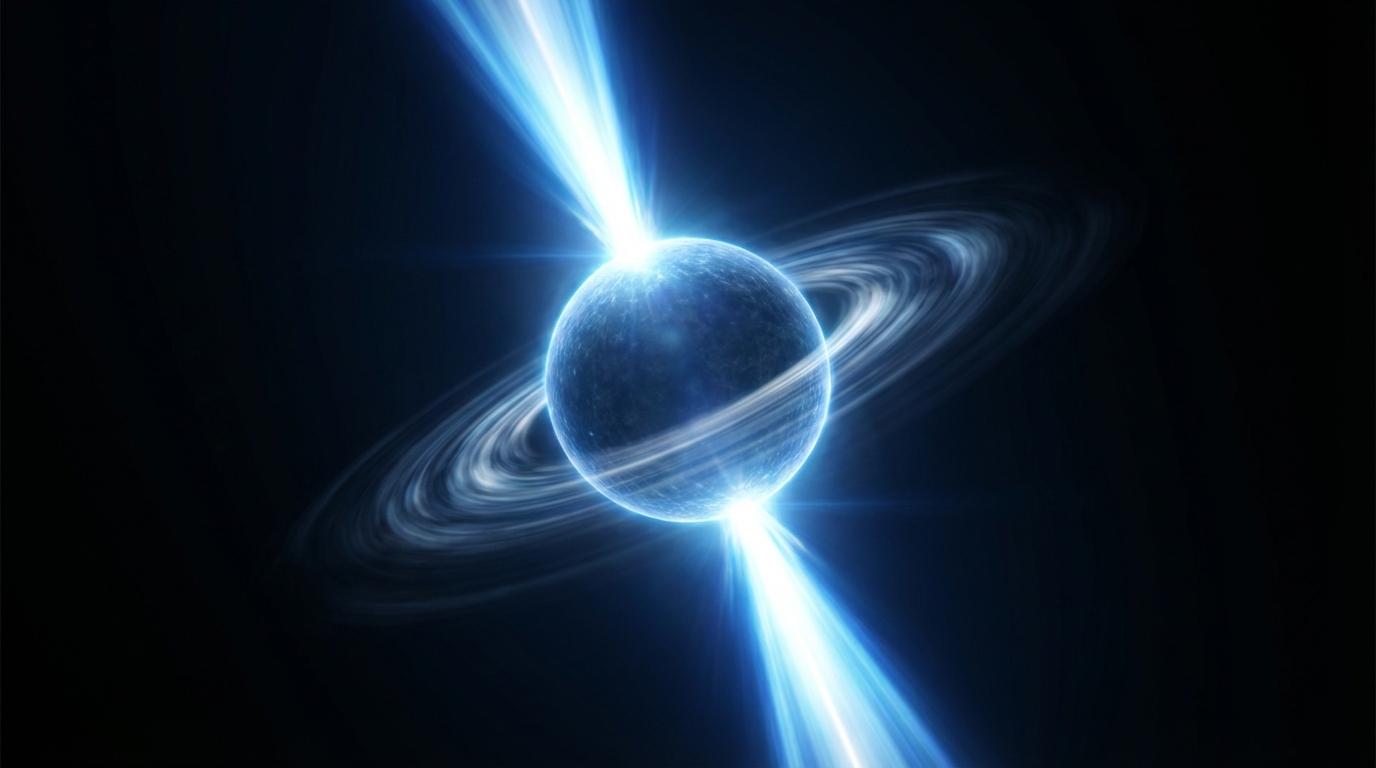
In the vast cosmos, there exist celestial objects that defy our imagination. Among them, the neutron star stands out as the densest and one of the most bizarre objects next to black holes. Imagine crushing a mass greater than our sun into a sphere the size of a city. This tiny star boasts a phenomenal rotational speed, spinning hundreds of times per second. Like a cosmic ballerina, how is such an incredible velocity possible? This post will delve deep into the birth of neutron stars, the secrets behind their astonishing rotation, and the future of their study.
The Cosmic Blueprint: What is a Neutron Star?
A neutron star is the collapsed core left behind after a massive star, about 8 to 20 times the mass of our sun, undergoes a supernova explosion at the end of its life. The immense pressure of the explosion crushes protons and electrons together to form neutrons, creating what is essentially a giant ball of neutrons.
The most striking feature of this celestial body is its mind-boggling density. With a diameter of only about 20 kilometers—roughly the size of a city like Seoul—it packs a mass 1.4 to 2 times that of our sun. A single sugar cube-sized piece of a neutron star would weigh hundreds of millions of tons. This extreme environment endows neutron stars with unique characteristics: powerful gravity, an intense magnetic field, and extremely rapid rotation.
The Physics of the Spin: The Law of Conservation of Angular Momentum
The reason neutron stars spin at such frantic speeds can be explained by a fundamental principle of physics: the Law of Conservation of Angular Momentum. This law states that for a rotating object, its angular momentum remains constant unless acted upon by an external force.
To understand this, picture a figure skater spinning. When the skater extends their arms, they spin slowly. But as they pull their arms in close to their body, their rotational speed increases dramatically. By reducing the radius of their mass distribution, their velocity must increase to keep the total angular momentum the same.
A neutron star follows the exact same principle, but on a cosmic scale:
- Before Collapse: As a giant star, it had a massive radius spanning millions of kilometers and was rotating relatively slowly.
- After Collapse: Following a supernova, its core collapses catastrophically, shrinking its radius to a mere 10-20 kilometers.
This dramatic contraction, far more extreme than a skater pulling in their arms, forces the rotational speed to increase to an unimaginable degree to conserve angular momentum. This process gives a newborn neutron star its phenomenal spin, rotating tens to hundreds of times every second.
The Lighthouse Effect: Observing Pulsars
Not all rapidly spinning neutron stars are visible to us. Some possess powerful magnetic fields, and if the magnetic axis is not aligned with the rotational axis, beams of radiation are emitted from the magnetic poles. As the star spins, these beams sweep across space like a lighthouse beacon. When one of these beams happens to sweep past Earth, we detect a regular, repeating signal, or “pulse.” These objects are called “pulsars.”
The current scientific consensus is that pulsars are rapidly rotating neutron stars. The fastest-spinning neutron star discovered to date is PSR J1748-2446ad, which has been observed to rotate an astonishing 716 times per second, or about 43,000 times per minute. This means its surface at the equator is moving at about 24% of the speed of light.
Pushing the Limits: Is There a Maximum Spin Speed?
So, can a neutron star spin infinitely fast? There is a clear physical limit. If the rotation becomes too fast, the centrifugal force at the equator would overcome the star’s immense gravity, causing it to break apart and fling its matter into space.
The theoretically calculated maximum spin rate for a neutron star is around 1,500 rotations per second. However, the fastest neutron star observed so far spins at less than half this theoretical limit. Scientists have proposed several hypotheses to explain why neutron stars don’t seem to reach their theoretical maximum speed:
- Gravitational Wave Emission: A rapidly spinning neutron star that is not perfectly spherical could emit gravitational waves—ripples in spacetime. This process would carry away energy, causing the star’s rotation to gradually slow down.
- Magnetic Braking: The star’s powerful magnetic field can interact with surrounding matter and plasma, creating a drag that acts as a brake on its rotation.
The Future: An Extreme Physics Laboratory
Neutron stars are the ultimate laboratories for testing the laws of physics under the most extreme conditions. Studying their state of matter, intense gravity, and super-dense environment holds the key to answering some of the most fundamental questions in modern physics.
- Gravitational-Wave Astronomy: Since the 2017 detection of gravitational waves from the collision of two neutron stars (GW170817), research using this new astronomical tool has flourished. It provides groundbreaking data for understanding the internal structure and equation of state of neutron stars.
- Fast Radio Burst (FRB) Research: Neutron stars, particularly a type with ultra-powerful magnetic fields called “magnetars,” are considered a leading candidate for the origin of Fast Radio Bursts—intense, millisecond-long bursts of radio waves from deep space. The study of FRBs is opening a new window into the activity and evolution of neutron stars.
The frantic spin of a neutron star is not just a cosmic curiosity; it is the inevitable outcome of the magnificent death of a massive star, sculpted by the fundamental laws of physics. With new observational tools like gravitational-wave observatories, humanity will continue to unravel the secrets of these phenomenal objects, deepening our understanding of the universe and matter itself.
중성자별, 우주의 등대는 왜 미친듯이 춤추는가
우주에는 우리의 상상을 초월하는 극한의 천체들이 존재합니다. 그중에서도 ‘중성자별(Neutron Star)’은 블랙홀 다음으로 가장 밀도가 높고 기이한 현상을 보여주는 천체로 꼽힙니다. 도시 하나만 한 크기에 태양보다 무거운 질량을 쑤셔 넣은 이 작은 별은, 1초에 수백 번씩 회전하는 경이로운 자전 속도를 자랑합니다. 마치 우주의 발레리나처럼, 어떻게 이런 초고속 회전이 가능한 것일까요? 이 글에서는 중성자별의 탄생부터 그 놀라운 회전의 비밀, 그리고 미래의 연구 방향까지 심도 있게 탐구해 보겠습니다.
우주의 청사진: 중성자별이란 무엇인가?
중성자별은 태양보다 8배에서 20배가량 무거운 별이 진화의 마지막 단계에서 초신성 폭발을 일으킨 후 남겨진 중심핵입니다. 폭발의 엄청난 압력으로 인해 원자를 구성하던 양성자와 전자가 합쳐져 대부분이 중성자로 변해버린, 말 그대로 ‘중성자 덩어리’입니다.
이 천체의 가장 큰 특징은 상상을 초월하는 밀도입니다. 직경은 고작 20km 내외로 서울시 정도의 크기지만, 질량은 태양의 1.4배에서 2배에 달합니다. 이로 인해 중성자별의 물질은 각설탕 하나 크기만으로도 수억 톤에 달하는 무게를 가집니다. 이러한 극단적인 환경 때문에 중성자별은 강력한 중력과 자기장, 그리고 아주 빠른 자전이라는 독특한 특성을 갖게 됩니다.
회전의 물리학: 각운동량 보존 법칙
중성자별이 미친듯한 속도로 회전하는 이유는 ‘각운동량 보존 법칙(Law of Conservation of Angular Momentum)’이라는 물리학의 기본 원리로 설명할 수 있습니다. 이는 외부에서 힘이 가해지지 않는 한, 회전하는 물체의 운동량(각운동량)은 항상 일정하게 유지된다는 법칙입니다.
이해를 돕기 위해 피겨 스케이팅 선수가 회전하는 모습을 떠올려 봅시다. 선수가 팔을 넓게 벌리고 천천히 돌다가 팔을 몸에 붙이면 회전 속도가 급격히 빨라집니다. 이는 팔을 오므리면서 질량의 분포 반경이 줄어들자, 각운동량을 보존하기 위해 회전 속도가 대신 증가하는 것입니다.
중성자별도 이와 똑같은 원리를 따릅니다.
- 붕괴 전: 거대한 항성이었던 시절, 별은 수백만 km에 달하는 거대한 반경을 가지고 서서히 자전하고 있었습니다.
- 붕괴 후: 초신성 폭발 후 중심핵이 붕괴하면서 반경이 불과 10~20km로 급격하게 줄어듭니다.
피겨 스케이팅 선수가 팔을 오므리는 것과는 비교도 할 수 없을 정도로 극적인 수축이 일어나면서, 각운동량을 보존하기 위해 회전 속도는 상상 이상으로 빨라지는 것입니다. 이 과정 덕분에 갓 태어난 중성자별은 1초에 수십에서 수백 번 회전하는 경이로운 속도를 갖게 됩니다.
등대 효과: 펄서의 관측
빠르게 회전하는 모든 중성자별이 우리에게 관측되는 것은 아닙니다. 그중 일부는 강력한 자기장을 뿜어내는데, 이때 자기장의 축이 자전축과 일치하지 않으면 마치 등대 불빛처럼 전파 빔(Beam)이 주기적으로 우주 공간을 휩쓸게 됩니다. 이 빔이 지구를 스쳐 지나갈 때마다 우리는 규칙적인 신호(Pulse)를 감지하게 되는데, 이러한 천체를 ‘펄서(Pulsar)’라고 부릅니다.
현재 과학계의 정설은 펄서가 바로 빠르게 회전하는 중성자별이라는 것입니다. 현재까지 발견된 가장 빠르게 회전하는 중성자별은 ‘PSR J1748-2446ad’로, 1초에 무려 716번, 1분에는 약 43,000번 회전하는 것으로 관측되었습니다. 이는 표면이 빛의 속도의 약 24%에 달하는 속도로 움직이는 것을 의미합니다.
한계에 대한 고찰: 어디까지 빨라질 수 있는가?
그렇다면 중성자별은 무한정 빠르게 회전할 수 있을까요? 여기에는 분명한 물리적 한계가 존재합니다. 만약 회전 속도가 너무 빨라지면, 적도 지역에서 발생하는 원심력이 별 자체의 엄청난 중력을 이겨내고 물질을 우주 공간으로 흩뿌리며 찢어지게 될 것입니다.
이론적으로 계산된 중성자별의 자전 속도 한계는 초당 약 1,500회 정도입니다. 하지만 현재까지 관측된 가장 빠른 중성자별의 회전 속도는 이의 절반에도 미치지 못합니다. 과학자들은 왜 중성자별이 이론적 한계 속도까지 도달하지 못하는지에 대해 여러 가설을 제시합니다.
- 중력파 방출: 비대칭적인 형태로 빠르게 회전하는 중성자별은 시공간에 미세한 물결인 중력파를 방출하여 에너지를 잃고, 이로 인해 회전 속도가 점차 느려진다는 가설입니다.
- 자기장 제동: 강력한 자기장이 주변 물질과 상호작용하며 회전 속도를 늦추는 역할을 할 수 있습니다.
미래 전망: 극한의 물리 실험실
중성자별은 우주에서 가장 극단적인 물리 법칙의 실험실입니다. 이곳의 물질 상태, 강력한 중력, 초고밀도 환경을 연구하는 것은 현대 물리학의 근본적인 질문에 답을 줄 수 있는 열쇠입니다.
- 중력파 천문학: 2017년 두 개의 중성자별이 충돌하며 발생한 중력파(GW170817)가 관측된 이후, 중력파를 이용한 중성자별 연구가 활발히 진행되고 있습니다. 이는 중성자별 내부 구조와 상태 방정식을 이해하는 데 획기적인 데이터를 제공합니다.
- 고속 전파 폭발(FRB) 연구: 우주에서 순간적으로 발생하는 강력한 전파인 FRB의 기원 중 하나로 중성자별, 특히 ‘마그네타(Magnetar)’라고 불리는 초강력 자기장을 가진 중성자별이 지목되고 있습니다. FRB 연구는 중성자별의 활동성과 진화 과정을 이해하는 새로운 창을 열어주고 있습니다.
중성자별의 미친듯한 회전은 단순한 우주의 기행이 아니라, 거대한 별의 장엄한 죽음과 물리 법칙이 빚어낸 필연적인 결과입니다. 인류는 중력파 망원경과 같은 새로운 관측 도구를 통해 이 경이로운 천체의 비밀을 계속해서 파헤쳐 나갈 것이며, 그 과정에서 우주와 물질에 대한 우리의 이해는 더욱 깊어질 것입니다.
답글 남기기