
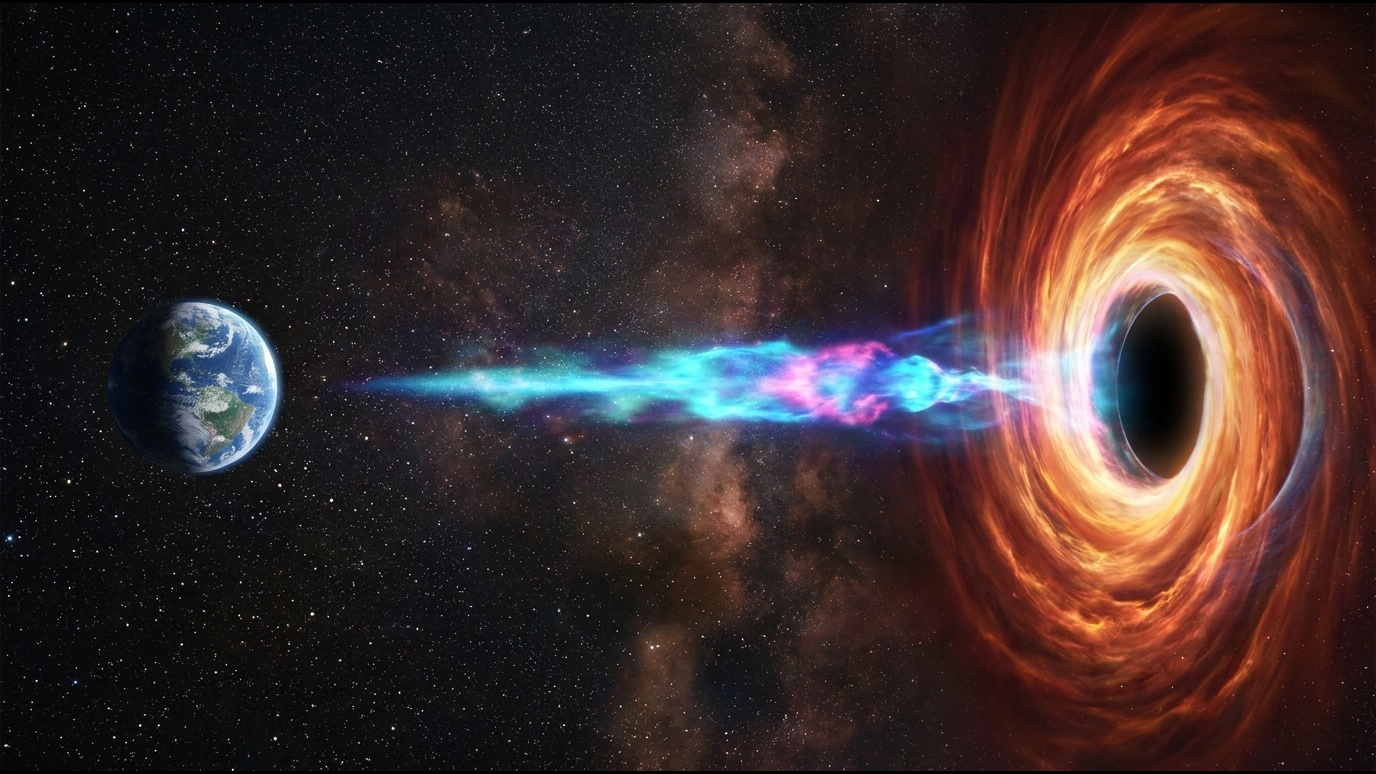
In the popular imagination, a black hole is the ultimate symbol of cosmic gluttony: a gravitational abyss from which not even light can escape. Yet some of the brightest, most violent beacons in the observable universe are powered directly by these dark engines. Before matter crosses the point of no return at the event horizon, a spinning black hole can channel a fraction of that infalling gas into twin, razor-thin beams of magnetized plasma and fire them outward along its rotational axis at more than 99.9% the speed of light. When the rotational axis of such a relativistic jet happens to align directly with our line of sight, astronomers call the object a blazar. Looking into a blazar is the astrophysical equivalent of staring straight down the barrel of a cosmic particle accelerator spanning thousands of light-years.
This raises a haunting, deeply physical question: What would actually happen if Earth were caught in the crosshairs of a black hole’s relativistic jet? Would our planet be vaporized instantly like an extrasolar target in science fiction, or would the catastrophe unfold through a far more insidious chain of atmospheric and biochemical collapse? Answering this question requires moving beyond cinematic tropes to examine the electrodynamics of spinning spacetime, the inverse-square geometry of intergalactic distances, and the fragile photochemistry of Earth’s stratosphere. Doing so reveals not only how the universe’s most extreme engines operate, but also how planetary habitability hangs on a delicate equilibrium within our galactic neighborhood.
1. The Blandford-Znajek Engine: How Darkness Forges a Cosmic Laser
To understand what strikes a planet in the path of a black hole jet, we must first understand how an object defined by inward gravitational collapse can launch an outward beam of staggering power. The answer lies not inside the event horizon, but just outside it, within a region of dragged spacetime known as the ergosphere. According to Albert Einstein’s general theory of relativity, a spinning (Kerr) black hole does not merely curve space; it twists the very fabric of spacetime around itself like a rotating sphere submerged in thick honey, a phenomenon known as frame-dragging.
As gas and dust from the surrounding galaxy spiral toward the black hole, they flatten into a superheated, turbulent accretion disk threaded by intense magnetic fields. In 1977, astrophysicists Roger Blandford and Roman Znajek demonstrated that as frame-dragging whips these magnetic field lines around the spinning black hole, it winds them into a tightly coiled helical tower along the black hole’s polar axis. Acting like a colossal electromagnetic dynamo, the Blandford-Znajek mechanism extracts rotational energy directly from the spinning black hole itself, converting angular momentum into an outward Poynting flux of electromagnetic energy.
Electrons, positrons, and protons caught in this magnetic helix are accelerated to ultra-relativistic velocities, reaching Lorentz factors of tens to hundreds. Because these charged particles are traveling at nearly the speed of light in vacuum, Einstein’s special relativity introduces a dramatic optical and energetic effect called relativistic beaming (or Doppler boosting). Instead of radiating energy isotropically in all directions, the moving plasma focuses its emitted photons (spanning radio waves, X-rays, and high-energy Tera-electronvolt (TeV) gamma rays) into a narrow forward cone of angular width roughly inversely proportional to the Lorentz factor ($\theta \sim 1/\gamma$). What leaves the black hole’s vicinity is therefore a tightly collimated dual stream: a lethal electromagnetic flash of gamma-ray and X-ray photons traveling at the exact speed of light, closely trailed by a relativistic beam of cosmic-ray protons, heavier nuclei, and high-energy neutrinos.
2. Distance Dictates Destiny: Extragalactic Blazars vs. Galactic Microquasars
Whether a black hole jet acts as an harmless astronomical curiosity or an existential planetary sterilizer depends almost entirely on one variable: distance. In truth, Earth is already being struck by black hole jets every single second. Astronomers have cataloged thousands of blazars (such as Markarian 421, 3C 279, and the famous neutrino-emitting blazar TXS 0506+056) whose relativistic jets point directly at our solar system. Even more remarkably, observations of the giant radio galaxy PBC J2333.9-2343 revealed that a supermassive black hole’s jet can realign by nearly 90 degrees over cosmic timescales, shifting from a sideways radio galaxy into an Earth-pointing blazar.
Why haven’t these cosmic blowtorches harmed us? Because they reside in the cores of distant galaxies hundreds of millions to billions of light-years away. Even a tightly collimated jet with an opening angle of just one degree expands across millions of light-years by the time it crosses intergalactic space. When high-energy gamma rays or ultra-high-energy cosmic rays from TXS 0506+056 (located 4.5 billion light-years away) finally arrive at Earth, their flux is so diluted that they merely trigger isolated microscopic air showers in our upper atmosphere: flashes of Cherenkov light detectable only by specialized observatories like the IceCube Neutrino Observatory or the Cherenkov Telescope Array.
The scenario changes drastically, however, if we bring the black hole closer. Suppose the supermassive black hole at the heart of our own Milky Way, Sagittarius A* ($4.3 \times 10^6$ solar masses, located about 26,000 light-years away), were to devour a massive molecular cloud and ignite a full-fledged quasar jet. Fortunately, Sagittarius A*’s spin axis is tilted well away from the Galactic plane where Earth orbits. Yet if a hypothetical merger or tidal disruption event reoriented a supermassive jet directly through the Galactic disk toward Earth from 26,000 light-years away, or if a stellar-mass black hole binary (a “microquasar” like Cygnus X-1 or SS 433) or a collapsing massive star (collapsar) launched a relativistic gamma-ray burst (GRB) beam toward us from within a few thousand light-years, the geometric dilution would no longer save us.
3. Anatomy of a Planetary Strike: Stratospheric Ionization and the Ozone Collapse
If a relativistic jet from a nearby galactic black hole or a newborn stellar-mass black hole within a few thousand light-years swept across Earth, the planet would not explode into rubble. Even the most powerful astrophysical jet carries far less total energy across the tiny cross-section of an Earth-sized target at interstellar distances than the gravitational binding energy required to shatter a rocky planet ($\sim 2 \times 10^{32}\text{ J}$). Instead, the catastrophe plays out in the upper atmosphere, turning Earth’s protective gaseous shield into a chemical weapon against the biosphere.
The assault unfolds in two distinct phases:
First comes the Photonic Shockwave. Traveling at the speed of light, the intense beam of gamma rays and hard X-rays arrives first. Fortunately, Earth’s atmosphere has a column density equivalent to about 10 meters of water, which prevents gamma-ray photons from reaching the ground directly. However, in stopping those photons, the stratosphere absorbs an immense deposition of ionizing energy. High-energy photons shatter the strong triple covalent bonds of molecular nitrogen ($\text{N}_2$) and double bonds of molecular oxygen ($\text{O}_2$) at altitudes between 15 and 50 kilometers. Within seconds to minutes, free nitrogen atoms react with oxygen to form vast quantities of nitrogen oxides ($\text{NO}$ and $\text{NO}_2$, collectively termed $\text{NO}_x$).
These nitrogen oxides initiate a relentless catalytic cycle that devours stratospheric ozone ($\text{O}_3$): a nitric oxide molecule strips an oxygen atom from ozone ($\text{NO} + \text{O}_3 \rightarrow \text{NO}_2 + \text{O}_2$), and the resulting nitrogen dioxide reacts with free atomic oxygen to regenerate nitric oxide ($\text{NO}_2 + \text{O} \rightarrow \text{NO} + \text{O}_2$), ready to destroy another ozone molecule. Astrophysical atmospheric modeling shows that a nearby relativistic gamma-ray beam could wipe out 40% to 75% of Earth’s global ozone layer within weeks, with localized polar depletion exceeding 90%. At the same time, the thick brownish-orange veil of $\text{NO}_2$ gas would visibly darken the sky, blocking a measurable fraction of visible sunlight while eventually raining out as global nitric acid rain ($\text{HNO}_3$), acidifying surface waters and soils.
Second comes the Hadronic and Muon Deluge. Travelling just behind the photons at $99.99%$ the speed of light, the jet’s ultra-relativistic cosmic rays (protons and atomic nuclei) slam into the upper atmosphere. These TeV-to-PeV particles collide with atmospheric nuclei to produce cascading showers of pions, which rapidly decay into high-energy muons. Unlike electrons or photons, muons are highly penetrating leptons; they slice right through the atmosphere, the ocean surface, and even hundreds of meters of solid rock, delivering lethal doses of ionizing radiation to organisms on land and in shallow seas alike.
4. Deep-Time Forensics: Did a Relativistic Jet Trigger a Past Mass Extinction?
Once the ozone shield collapses and the nitrogen dioxide smog settles out as acid rain, the true silent killer takes over: our own Sun. Stripped of stratospheric ozone, Earth’s surface is flooded by solar ultraviolet-B (UV-B) and ultraviolet-C (UV-C) radiation, which are wavelengths energetic enough to break DNA strands, inhibit photosynthesis, and sterilize exposed cells. Crucially, UV-B penetrates tens of meters into clear ocean water, devastating marine phytoplankton, the microscopic primary producers that form the foundation of the global marine food web and generate roughly half of Earth’s oxygen.
This exact kill mechanism has led astrobiologists and paleontologists, notably Adrian Melott and Brian Thomas, to propose the Late Ordovician Gamma-Ray Burst Hypothesis. Roughly 445 million years ago, Earth experienced the first of the “Big Five” mass extinctions, wiping out approximately 85% of all marine species. Intriguingly, paleontological records show that trilobites and other marine organisms whose juvenile larvae drifted in shallow surface waters suffered vastly higher extinction rates than deep-water benthic species living on the dark ocean floor, precisely the depth-selective mortality gradient expected from an intense spike in solar UV radiation following an ozone collapse, followed by global cooling triggered by atmospheric nitrogen dioxide opacity.
In the most extreme (and statistically hyper-rare) thought experiment, suppose a rogue stellar-mass black hole or an active galactic core passed within a few light-years of our Solar System and locked its plasma jet directly onto Earth: the thermal and ram pressure of the relativistic beam would strip away the magnetosphere, boil the upper atmosphere into space via hydrodynamic escape, and scorch the facing hemisphere into molten silicate slag. Fortunately, stellar dynamics and galactic architecture make such a point-blank encounter virtually impossible over the lifetime of the Sun.
Conclusion: Cosmic Architecture as a Strategic Shield for Civilization
When we synthesize the physics of relativistic jets with planetary atmospheric chemistry, a profound strategic insight emerges: planetary habitability is not merely a local property of a star and a rocky world, but a structural property of galactic geography. Humanity exists today because our Solar System orbits in a relatively quiet suburban spiral arm of the Milky Way, roughly 26,000 light-years removed from the gravitational maelstrom of the galactic core, and in a mature epoch of cosmic history where quasar activity has largely subsided compared to the violent “Cosmic Noon” billions of years ago.
For a technological civilization contemplating long-term survival, black hole jets redefine the boundaries of Planetary Defense. While kinetic impactors like NASA’s DART mission can deflect rogue asteroids, no physical shield can deflect a beam of gamma rays and relativistic protons traveling at the speed of light; by the time we see the flash, the radiation is already washing over our ionosphere. Instead, our defense against high-energy astrophysical hazards lies in multi-messenger early warning and biospheric resilience: monitoring compact binary inspirals via gravitational-wave detectors, mapping nearby massive stars and microquasars across the Milky Way, and building subterranean and closed-loop ecological infrastructures capable of enduring multi-year stratospheric ozone collapse. Staring down the barrel of a distant blazar reminds us that while the cosmos commands engines of unimaginable destructive scale, understanding their exact physics transforms existential dread into strategic foresight.
블랙홀 하면 흔히 빛조차 빠져나오지 못하는 절대적인 어둠과 삼킴의 심연을 떠올립니다. 그런데 역설적이게도 우주에서 가장 밝고 격렬한 에너지를 뿜어내는 천체들은 바로 이 칠흑 같은 중력 엔진이 가동합니다. 물질이 사건의 지평선(Event Horizon)이라는 경계를 넘기 직전, 빠르게 회전하는 블랙홀은 유입되는 가스의 일부를 양극 회전축을 따라 좁고 강력한 플라스마 빔으로 압축해 광속의 99.9% 이상으로 쏘아 올립니다. 천체물리학에서는 이를 ‘상대론적 제트(Relativistic Jet)’라 부릅니다. 이 거대한 입자 가속기의 총구가 우연히 지구의 시선 방향과 정확히 맞물릴 때, 우리는 그 천체를 ‘블레이자(Blazar)’라고 부릅니다. 블레이자를 관측한다는 건 수천 광년 길이로 뻗어 나오는 우주 입자포의 총구 정면을 똑바로 들여다보는 셈입니다.
여기서 과학적 호기심과 실존적 공포가 교차하는 질문이 하나 떠오릅니다. 만약 지구가 블랙홀이 뿜어내는 상대론적 제트의 사선 안에 들어가 직격을 맞는다면 어떤 일이 벌어질까요? SF 영화처럼 행성이 단숨에 증발할까요, 아니면 대기와 생태계의 화학 사슬이 차례로 무너지는 조용하고 치명적인 재앙이 찾아올까요? 답을 찾으려면 회전하는 시공간의 전자기역학과 은하 간 거리의 기하학적 감쇠 법칙은 물론, 지구 성층권의 광화학 반응까지 정밀하게 따라가 보아야 합니다. 이 물리적 과정을 추적하다 보면 우주 최강의 엔진이 작동하는 원리뿐만 아니라 인류 문명이 얼마나 절묘한 은하계적 방어선 위에서 번영하고 있는지도 자연스레 드러납니다.
1. 어둠이 빚어내는 우주의 레이저와 블랜포드-즈나제크 엔진
모든 것을 집어삼키는 블랙홀이 어떻게 밖으로 그토록 막대한 에너지를 쏘아 올릴 수 있을까요? 비밀은 사건의 지평선 바로 바깥쪽에서 시공간의 회전에 끌려 돌아가는 영역인 ‘작용권(Ergosphere)’에 숨어 있습니다. 일반 상대성 이론에 따르면 회전하는 커 블랙홀(Kerr Black Hole)은 주변 공간을 휘게 만들 뿐 아니라, 꿀 속에서 도는 구슬처럼 시공간 자체를 회전 방향으로 비틀어 끌고 갑니다. 이른바 ‘틀 끌림(Frame-dragging)’ 현상입니다.
주변 가스와 먼지가 블랙홀로 추락할 때 물질은 마찰열로 뜨겁게 달궈진 강착원반(Accretion Disk)을 이루며 강력한 자기장을 머금습니다. 1977년 로저 블랜포드와 로만 즈나제크가 규명한 ‘블랜포드-즈나제크 메커니즘’에 따르면 블랙홀의 틀 끌림 현상이 강착원반의 자기장선을 회전축을 따라 나선형 기둥 모양으로 강하게 꼬아 올립니다. 이 거대한 전자기 다이나모 작용이 블랙홀의 회전 에너지를 직접 뽑아내 막대한 전자기 에너지 흐름(포인팅 플럭스)으로 바꿉니다.
나선형 자기장에 붙잡힌 전자와 양전자, 양성자는 극한의 속도로 가속돼 로렌츠 인자($\gamma$)가 수십에서 수백에 이르는 영역으로 들어섭니다. 입자가 광속에 가깝게 달릴 때는 특수 상대성 이론에 따른 ‘상대론적 비밍(Relativistic Beaming)’ 현상이 나타나면서 방출되는 복사 에너지가 운동 방향 정면의 좁은 원뿔 각도($\theta \sim 1/\gamma$) 안에 날카롭게 모입니다. 이렇게 블랙홀 양극에서 발사되는 제트는 이중 구조의 창과 같습니다. 맨 앞에는 빛의 속도로 날아가는 고에너지 감마선과 엑스선 섬광이 서고, 바로 그 뒤를 광속의 99.99%로 질주하는 초고에너지 우주선(양성자 및 원자핵)과 중성미자 플라스마 폭풍이 뒤따릅니다.
2. 외부 은하의 블레이자와 우리 은하 내부의 위협을 가르는 거리
이 가공할 제트가 행성 전체를 소독해 버리는 재앙이 될지, 아니면 망원경에나 잡히는 미약한 신호에 그칠지를 가르는 변수는 단 하나입니다. 바로 ‘거리’입니다. 놀랍게도 지구는 이미 지금 이 순간에도 수많은 블랙홀 제트에 맞고 있습니다. 천문학계는 마카리안 421과 3C 279를 비롯해 2017년 남극 아이스큐브(IceCube) 관측소가 사상 최초로 고에너지 우주 중성미자의 발원지로 확인한 ‘TXS 0506+056’까지, 제트 총구가 지구를 정면으로 겨누는 블레이자 수천 개를 관측해 왔습니다. 6억 5천만 광년 떨어진 전파은하 ‘PBC J2333.9-2343’은 원래 우리 시선과 수직으로 제트를 뿜던 천체였는데, 최근 중심 블랙홀의 제트 방향이 약 90도 회전하면서 지구를 정면으로 겨누는 블레이자로 바뀐 사실이 밝혀지기도 했습니다.
수천 개의 제트가 지구를 겨누는데도 우리가 무사한 까닭은 이 천체들이 수억에서 수십억 광년 떨어진 외부 은하에 자리 잡았기 때문입니다. 퍼짐 각도가 1도 안팎에 불과한 좁은 제트라도 수십억 광년의 공간을 가로지르면 빔의 단면적은 수백만 광년 규모로 넓어집니다. 45억 광년 밖 TXS 0506+056에서 출발한 테라전자볼트(TeV)급 감마선과 우주선이 지구 대기권에 닿을 때쯤이면 에너지 밀도가 극도로 옅어져, 성층권 상부에서 미세한 대기 샤워와 미약한 체렌코프 빛만 일으킬 뿐 지상 생태계에는 아무런 해도 끼치지 못합니다.
하지만 발원지가 우리 은하 안으로 들어오면 이야기가 전혀 달라집니다. 지구에서 약 2만 6천 광년 떨어진 우리 은하 중심부에는 태양 질량 430만 배의 초대질량 블랙홀 ‘궁수자리 A*’가 있습니다. 다행히 지금 궁수자리 A*는 휴면 상태에 가깝고 회전축도 은하 원반면과 어긋나 있습니다. 그러나 거대 가스 구름이 유입되거나 은하가 병합되면서 중심 블랙홀의 제트가 은하 원반 방향인 지구를 조준해 발사된다면 어떨까요? 혹은 지구에서 수천 광년 이내의 가까운 거리에서 항성질량 블랙홀 쌍성계(마이크로퀘이사)나 초거성의 붕괴로 태어난 신생 블랙홀이 초강력 ‘감마선 폭발(GRB)’ 형태의 제트를 지구로 쏜다면, 거리에 따른 기하학적 희석 효과는 더 이상 지구를 지켜 주지 못합니다.
3. 성층권 이온화와 오존층의 화학적 붕괴
우리 은하 안쪽 수천 광년 거리에서 발사된 블랙홀 제트가 지구를 휩쓸고 지나가면 어떤 연쇄 반응이 벌어질까요? 흔한 오해와 달리 지구가 물리적으로 깨지거나 증발하지는 않습니다. 수천 광년 거리에서 날아온 제트 가운데 지구 단면적에 부딪히는 에너지는 지구의 중력 결합 에너지(약 $2 \times 10^{32}\text{ J}$)보다 훨씬 작기 때문입니다. 대신 재앙은 지구의 생명 유지 장치인 ‘성층권 대기 화학’을 무너뜨리는 방식으로 찾아옵니다.
첫 번째 타격은 빛의 속도로 도달하는 **광자 충격파(감마선 및 경엑스선 폭격)**입니다. 지구 대기권의 질량 기둥 밀도는 물 약 10미터 두께와 맞먹어서 감마선이 지표면을 직접 뚫고 내려오지는 못합니다. 그 대신 고도 15~50킬로미터의 성층권이 막대한 이온화 에너지를 고스란히 떠안습니다. 고에너지 광자는 대기 중 질소($\text{N}_2$)의 삼중 결합과 산소($\text{O}_2$)의 이중 결합을 단숨에 끊어 놓습니다. 불과 몇 분 사이에 자유 질소 원자가 산소와 결합하면서 성층권 전역에 막대한 양의 질소산화물($\text{NO}$ 및 $\text{NO}_2$, 통칭 $\text{NO}_x$)이 만들어집니다.
이 질소산화물이 오존층($\text{O}_3$)을 파괴하는 촉매 연쇄 반응을 일으킵니다. 일산화질소($\text{NO}$)가 오존에서 산소 원자를 빼앗아 이산화질소($\text{NO}_2$)와 산소 분자로 바꾸고, 이산화질소는 다시 산소 원자와 반응해 일산화질소로 되돌아가며 오존 분자를 끝없이 분해합니다. 대기 모델링에 따르면 수천 광년 거리의 제트에 수십 초만 노출돼도 몇 주 안에 전 지구 오존층의 40~75%가 사라지며, 극지방에서는 90% 이상이 파괴됩니다. 하늘을 뒤덮은 적갈색 이산화질소 스모그는 태양 가시광선을 가려 기온을 떨어뜨리고, 마침내 전 지구적인 질산 산성비($\text{HNO}_3$)로 쏟아져 내리면서 토양과 해양 표층수를 산성으로 바꿉니다.
두 번째 타격은 광자 바로 뒤를 이어 도착하는 하드론 및 뮤온(Muon) 입자 폭풍입니다. 제트에 실려 온 TeV~PeV급 초고에너지 우주선 양성자가 대기 상층부 원자핵과 부딪히면 수많은 파이온 입자가 생겨나고, 곧바로 고에너지 ‘뮤온’으로 붕괴합니다. 감마선과 달리 뮤온은 투과력이 극도로 높은 렙톤 입자입니다. 하늘에서 쏟아지는 뮤온의 비는 대기를 그대로 뚫고 내려와 지상 생물의 DNA를 파괴할 뿐 아니라 수백 미터 깊이의 바닷속과 암반 지하까지 관통하며 치명적인 방사선 피폭을 일으킵니다.
4. 4억 4,500만 년 전 오르도비스기 대멸종의 용의자
성층권의 오존 방패가 걷히고 질소산화물 안개가 산성비로 씻겨 내려간 뒤에는 진짜 살인마가 모습을 드러냅니다. 바로 우리가 매일 마주하는 ‘태양’입니다. 오존 필터가 사라진 지표면으로 DNA 사슬을 끊고 광합성을 마비시키는 태양 자외선(UV-B 및 UV-C)이 평소의 수십 배 강도로 쏟아져 내립니다. 특히 자외선-B는 바닷물 속 수십 미터 깊이까지 파고들기 때문에 해양 먹이사슬의 기초를 지탱하고 지구 산소의 절반을 만들어 내는 식물성 플랑크톤을 전멸시킵니다.
캔자스 대학교 에이드리언 멜럿 교수 연구진은 이 메커니즘을 바탕으로 지구 역사상 첫 번째 대멸종인 **‘오르도비스기 말 대멸종(약 4억 4,500만 년 전)’**을 설명하는 가설을 내놓았습니다. 당시 해양 생물 종의 약 85%가 절멸했는데, 화석 기록을 보면 유생 시기에 얕은 바다 표층을 떠다니던 삼엽충과 표층 생물은 멸종률이 극도로 높았던 반면 깊은 해저 바닥에 살던 저서생물은 높은 생존율을 보였습니다. 근거리 블랙홀 제트(감마선 폭발)가 지구를 강타해 오존층을 무너뜨려 표층 바다를 자외선으로 살균하고, 뒤이어 이산화질소 스모그가 태양열을 가려 빙하기를 불러왔다는 시나리오와 정확히 들어맞습니다.
물론 극단적인 사고실험으로 떠돌이 블랙홀이 태양계에서 몇 광년 안쪽까지 다가와 제트를 지구에 직접 쏜다면 결과는 차원이 다릅니다. 그 거리에서는 제트의 열에너지와 동압(Ram Pressure) 자체가 지구 자기권을 벗겨 내고 상층 대기를 증발시키며, 제트를 정면으로 맞은 반구의 지각을 녹여 마그마 바다로 만들어 버립니다. 다행히 우리 은하의 항성 밀도와 역학적 구조 덕분에 그처럼 코앞에서 제트 직격을 맞을 확률은 태양의 남은 수명 동안 사실상 0에 가깝습니다.
Conclusion: 은하의 지리학이 인류 문명에 부여한 전략적 방어선
블랙홀 제트의 물리학과 지구 대기권의 광화학 반응을 나란히 놓고 보면 기존의 행성 거주가능성 개념을 넘어서는 거시적 시야가 열립니다. 생명이 번성할 조건은 중심별에서 적당한 거리(골디락스 존)에 놓인 암석 행성이라는 국소적 환경만으로 완성되지 않으며, 은하 전체의 지리적·시대적 구조(Galactic Architecture)가 함께 뒷받침해야 비로소 성립합니다. 오늘날 인류 문명이 존재할 수 있는 까닭도 태양계가 은하 중심부의 초대질량 블랙홀과 고밀도 항성 집단에서 약 2만 6천 광년 떨어진 평온한 나선팔 변두리에 자리 잡았고, 초기 우주의 격렬했던 퀘이사 활동기가 지나간 성숙하고 고요한 시대에 태어났기 때문입니다.
장기적인 존속을 고민하는 기술 문명에게 블랙홀 제트는 **‘행성 방위(Planetary Defense)’**의 범위를 한 단계 넓혀 놓습니다. 소행성 충돌은 다트(DART) 미션처럼 물리적 충격체를 보내 궤도를 바꿀 수 있지만, 빛의 속도로 날아오는 감마선과 제트는 관측하는 순간 이미 지구 대기에 닿아 있으므로 물리적으로 피하거나 요격할 방법이 없습니다. 우주적 고에너지 재앙에 대비하는 전략은 결국 다중신호 천문학에 기반한 조기 경보와 생태계 회복탄력성 확보로 귀결됩니다. 중력파와 중성미자 망원경으로 은하 내 블랙홀 쌍성계와 초거성의 붕괴 징후를 감시하고, 성층권 오존층이 수년간 무너지더라도 문명과 생태계를 지탱할 지하 및 폐쇄형 생명유지 인프라를 갖추는 일은 수십억 광년 밖 블레이자의 총구를 들여다보며 우주의 물리 법칙을 해독해 낸 문명만이 준비할 수 있는 다음 단계의 생존 전략입니다.
답글 남기기