
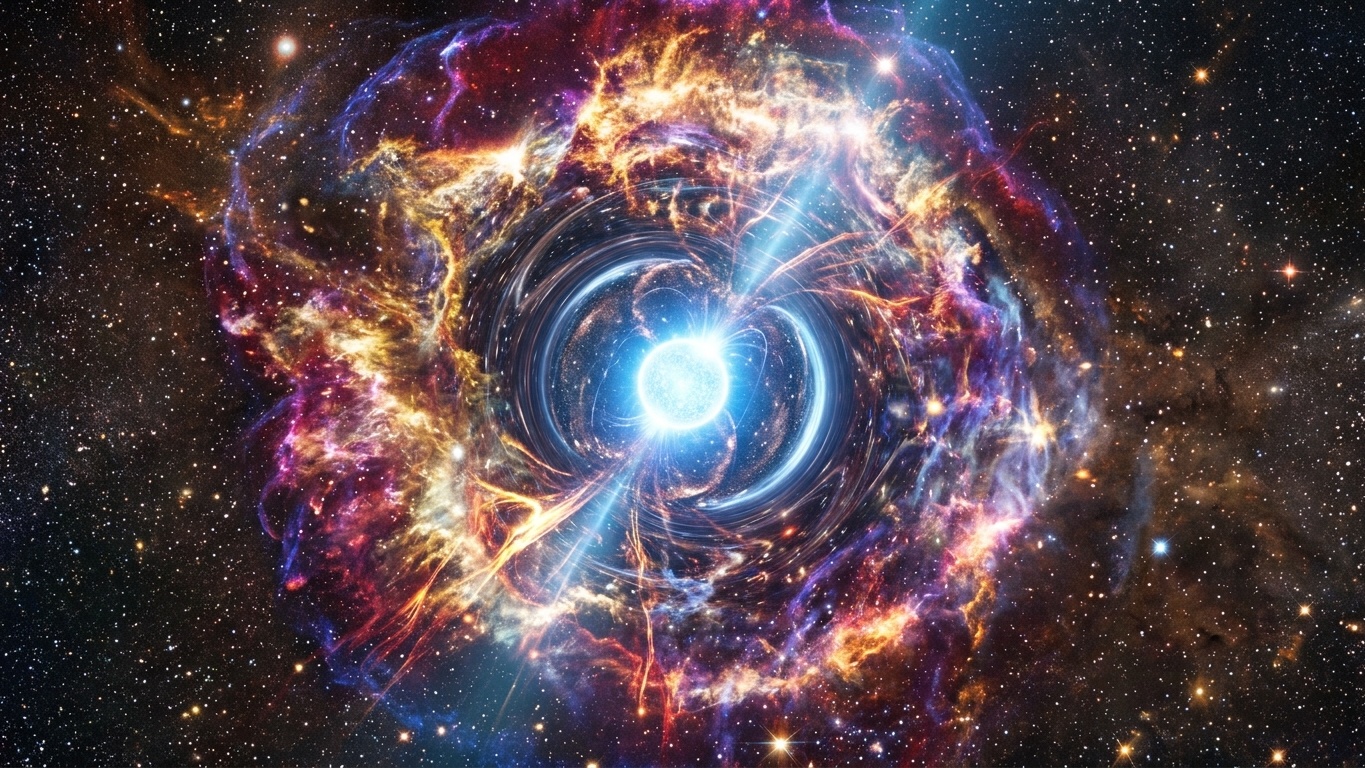
In the vast expanse of the cosmos, the death of a massive star does not mark a silent fade into oblivion, but rather an explosive genesis that pushes the laws of physics to their absolute limits. When a star exceeding eight to twenty-five times the mass of our Sun exhausts its thermonuclear fuel, the fragile equilibrium between outward radiation pressure and inward gravitational attraction catastrophically collapses. Within fractions of a second, an iron core with a mass greater than that of our entire Sun is compressed into a sphere merely 20 kilometers in diameter—roughly the size of a metropolitan city. This titanic event heralds the birth of a neutron star: an astrophysical object so dense that a single teaspoon of its material would weigh billions of tons on Earth.
Neutron stars are not merely exotic stellar corpses; they represent nature’s most extreme laboratories. At their cores, matter is crushed beyond atomic boundaries, forcing protons and electrons to fuse into a sea of degenerate neutrons governed by the strong nuclear force and quantum mechanical exclusion. The birth of a neutron star bridges microscopic quantum chromodynamics with macroscopic general relativity, forging heavy elements through violent cosmic collisions and acting as celestial clocks through rapid rotation. Understanding the formation mechanisms of these celestial cauldrons provides profound insights into fundamental nuclear physics, gravitational wave astrophysics, and the cosmic origin of the elements that structure our universe.
1. The Iron Catastrophe and the Chandrasekhar Threshold
The evolutionary trajectory of a massive star ($M \gtrsim 8 M_\odot$) is an unrelenting struggle against gravitational collapse, mediated by sequential stages of nuclear fusion. Over millions of years, the star progressively fuses hydrogen into helium, helium into carbon and oxygen, and sequentially burns neon, magnesium, oxygen, and silicon in concentric shells resembling an onion-skin structure. Each successive fusion stage yields less energy per nucleon and occurs at dramatically higher core temperatures and densities, culminating in silicon burning, which lasts only a matter of days.
The endpoint of this thermonuclear sequence is the synthesis of iron-56 ($^{56}\text{Fe}$) and nickel-56 ($^{56}\text{Ni}$). Among all atomic nuclei, the iron-group elements possess the highest nuclear binding energy per nucleon (approximately 8.8 MeV). Consequently, fusing iron does not release energy; instead, it is an endothermic reaction that consumes thermal energy from the stellar core. When the inert iron core accumulates mass and surpasses the critical threshold known as the Chandrasekhar mass limit:
$$M_{\text{Ch}} \approx 1.44 \left( \frac{2}{\mu_e} \right)^2 M_\odot \approx 1.4 M_\odot$$
the outward quantum mechanical pressure provided by relativistic degenerate electrons—governed by the Pauli Exclusion Principle—can no longer support the immense overburden of the star’s gravitational weight.
As the core temperature exceeds several billion Kelvin, high-energy gamma-ray photons initiate photodisintegration, tearing iron nuclei apart into helium nuclei (alpha particles) and free neutrons:
$$^{56}\text{Fe} + \gamma \longrightarrow 13,^4\text{He} + 4n – 124.4\text{ MeV}$$
This highly endothermic process drains critical thermal pressure from the core in milliseconds. Simultaneously, ultra-dense electrons are forced into atomic nuclei, undergoing electron capture (inverse beta decay), which removes the very electrons providing the degenerate support pressure. Deprived of both thermal and degeneracy support, the iron core enters a state of catastrophic, runaway gravitational collapse.
2. Relativistic Core Collapse and the Mechanics of Neutronization
Once gravitational instability takes hold, the core collapse proceeds at relativistic velocities, reaching up to 23% of the speed of light (approximately $70,000\text{ km/s}$). Within less than a quarter of a second, an iron core spanning several thousand kilometers collapses into a proto-neutron star with a radius of just tens of kilometers. During this hyper-dense implosion, the process of neutronization accelerates dramatically via electron capture:
$$p + e^- \longrightarrow n + \nu_e$$
Protons and electrons merge into neutrons, liberating an astronomical torrent of electron neutrinos ($\nu_e$).
When the density of the collapsing core surpasses the nuclear saturation density ($\rho_0 \approx 2.8 \times 10^{14}\text{ g/cm}^3$, or roughly 300 million tons per cubic centimeter), the repulsive short-range component of the strong nuclear force abruptly halts the collapse. At this subatomic threshold, nucleons resist further compression due to both neutron degeneracy pressure and strong-force repulsive potentials. The incompressible core rebounds violently—a phenomenon known as the “core bounce.”
This bounce launches a powerful supersonic shock wave outward through the infalling stellar mantle. However, as the shock wave dissociates the heavy nuclei in the outer core, it rapidly loses energy and stalls at a radius of 100 to 200 kilometers. The revival of this stalled shock is one of the most critical mechanisms in theoretical astrophysics, driven by the intense neutrino flux escaping the proto-neutron star (the Bethe-Wilson delayed neutrino-heating mechanism). Neutrinos deposit roughly 1% of their energy into the turbulent post-shock layer, reinvigorating the shock front and driving a Type II, Ib, or Ic core-collapse supernova explosion that blasts the star’s outer layers into interstellar space, leaving behind a pristine, newborn neutron star.
3. The Nuclear Equation of State and the Microphysics of Dense Matter
The structural integrity and macroscopic parameters of a neutron star are dictated by the Nuclear Equation of State (EOS), which mathematically relates pressure, energy density, and temperature in cold, ultra-dense nuclear matter. Because the core density exceeds that of ordinary atomic nuclei by several multiples, theoretical physicists employ general-relativistic stellar structure models described by the Tolman-Oppenheimer-Volkoff (TOV) equation:
$$\frac{dP}{dr} = -\frac{G M® \rho®}{r^2} \left( 1 + \frac{P®}{\rho® c^2} \right) \left( 1 + \frac{4\pi r^3 P®}{M® c^2} \right) \left( 1 – \frac{2 G M®}{r c^2} \right)^{-1}$$
The TOV equation represents the hydrostatic equilibrium of a spherically symmetric body in curved spacetime. It defines the maximum theoretical mass of a stable neutron star—the TOV limit—currently constrained to approximately $2.0 – 2.3 M_\odot$. If a stellar remnant exceeds this limit, no known quantum force can prevent its total collapse into a stellar-mass black hole.
The internal architecture of a mature neutron star is stratified into distinct thermodynamic and structural layers:
- Atmosphere and Ocean: A thin surface layer, only centimeters thick, composed of ionized plasma emitting thermal X-rays.
- Outer Crust: A solid crystalline lattice of ion nuclei (such as iron and nickel) embedded in a relativistic degenerate electron gas, extending roughly a few hundred meters.
- Inner Crust: Extending to a depth of about one kilometer, where the density reaches the “neutron drip” point ($\rho \sim 4 \times 10^{11}\text{ g/cm}^3$). Here, neutrons leak out of nuclei, forming an ambient neutron superfluid. Near the bottom of the crust, competition between Coulomb repulsion and nuclear attraction organizes nucleons into exotic geometrical configurations termed “nuclear pasta” (gnocchi, spaghetti, and lasagna phases).
- Outer Core: A liquid mixture of superfluid neutrons, superconducting protons, and relativistic electrons and muons, spanning several kilometers.
- Inner Core: At the deepest center, densities reach several times $\rho_0$. Here, ordinary hadrons may dissolve into deconfined quark matter (up, down, and strange quarks) or condense into exotic hyperons and pion/kaon condensates, representing an unmapped frontier of quantum chromodynamics (QCD).
4. Cosmic Laboratories: Extreme Rotation, Magnetism, and Multimessenger Alchemy
The formation of a neutron star concentrates the physical properties of its progenitor by astronomical factors through fundamental conservation laws. Due to the conservation of angular momentum:
$$L = I_1 \omega_1 = I_2 \omega_2$$
as the stellar core contracts from a radius of $10^6\text{ km}$ to $10\text{ km}$, its moment of inertia $I$ decreases by a factor of $10^{10}$, causing its rotational frequency $\omega$ to skyrocket. Newborn neutron stars can rotate hundreds of times per second, generating highly collimated beams of synchrotron radiation across electromagnetic bands. When these beams sweep past Earth, they are detected as pulsars—cosmic lighthouses of extraordinary chronometric precision.
Similarly, the conservation of magnetic flux ($\Phi_B = \int B \cdot dA = \text{constant}$) compresses the progenitor’s magnetic field lines into a compact area, amplifying the magnetic field strength from several hundred Gauss to over $10^{12}$ Gauss in standard pulsars, and up to $10^{15}$ Gauss in magnetars. In magnetars, the magnetic energy density is so colossal that it can fracture the star’s solid crust, releasing catastrophic soft gamma-ray repeater (SGR) giant flares and driving high-energy fast radio bursts (FRBs).
Beyond isolated existence, binary neutron star mergers represent the universe’s most prolific elemental foundries. When two neutron stars spiral into one another and merge, they distort the spacetime continuum, radiating powerful gravitational waves detected by laser interferometers such as LIGO, Virgo, and KAGRA (e.g., event GW170817). The ejecta from these mergers undergoes rapid neutron-capture nucleosynthesis (the r-process), forging the heaviest elements in the periodic table—including gold, platinum, and uranium. The subsequent radioactive decay of these heavy isotopes powers a transient astronomical event known as a kilonova, directly linking the genesis and lifecycle of neutron stars to the distribution of precious elements across the galaxy.
Conclusion: The Ultimate Crucible of Fundamental Physics
The genesis of a neutron star is more than the dramatic culmination of stellar death; it is the ultimate intersection where quantum mechanics, nuclear physics, and general relativity unite. Compressed to the precipice of gravitational annihilation, neutron stars reveal the fundamental behaviors of matter under conditions that can never be replicated in terrestrial particle accelerators. From the nuclear pasta residing in their crusts to the superfluid vortices and possible quark matter in their cores, every structural facet challenges and refines our understanding of nature’s strongest forces.
In the era of multimessenger astronomy, neutron stars serve as indispensable strategic assets for fundamental science. High-precision pulsar timing arrays are currently mapping nanohertz gravitational waves from supermassive black hole binaries, while space-based X-ray observatories like NASA’s NICER refine the nuclear equation of state by simultaneously measuring neutron star radii and masses. As humanity explores the frontiers of quantum technologies, relativistic computing, and deep-space autonomous navigation (via X-ray pulsar navigation, XNAV), the physical principles unlocked by the study of neutron stars will continue to illuminate the deepest mysteries of our universe and the limits of physical reality.
우리가 살아가는 일상적인 세계의 물리 법칙이 완전히 붕괴하고, 양자역학의 극한과 일반상대성이론의 시공간 곡률이 정면으로 충돌하는 우주의 가장 극적인 장소는 바로 중성자별(Neutron Star)의 탄생 현장입니다. 밤하늘을 수놓는 별들 중 태양 질량의 8배에서 25배를 넘어서는 거대한 항성이 생의 마지막 순간에 도달했을 때, 우주는 상상을 초월하는 격변을 겪습니다. 수백만 년 동안 지속되던 핵융합의 불꽃이 꺼지는 순간, 태양 전체의 질량을 능가하는 거대한 중심핵이 불과 1초도 안 되는 찰나에 서울시 크기 남짓한 직경 20킬로미터의 초고밀도 구체로 압축됩니다.
이 경이로운 압축의 산물인 중성자별은 단순한 천체 잔해를 넘어섭니다. 티스푼 하나의 물질이 지구상에서 수십억 톤의 무게를 지니는 이 극단적인 천체는, 원자핵 내부의 양성자와 전자가 강제로 융합하여 거대한 중성자 바다를 이룬 ‘거대한 단일 원자핵’과 같습니다. 중성자별의 생성 과정은 항성의 종말이자 새로운 물리적 실체의 탄생이며, 우주에서 가장 무거운 원소들이 빚어지는 연금술의 요람이기도 합니다. 본 글에서는 거대 항성의 붕괴 메커니즘부터 극단적인 핵 상태방정식, 그리고 현대 천체물리학과 미래 첨단 기술에 이르기까지 중성자별 탄생의 전 과정을 심도 있게 탐구합니다.
1. 철 핵의 형성과 찬드라세카르 한계: 붕괴의 서막
중성자별의 탄생 드라마는 질량이 큰 항성($M \gtrsim 8 M_\odot$) 내부에서 일어나는 점진적이고 치열한 핵융합 연쇄반응에서 시작됩니다. 거대 항성은 중심부의 수소를 태워 헬륨을 만들고, 헬륨이 고갈되면 탄소와 산소를, 이어 네온, 마그네슘, 규소(Silicon)를 차례로 연소시키며 중심을 향해 층층이 중첩된 양파 껍질(Onion-skin) 구조를 형성합니다. 각 연소 단계는 더 높은 온도와 압력을 요구하며 반응 속도는 기하급수적으로 빨라집니다. 수소 연소가 수백만 년 동안 지속되는 반면, 규소가 연소하여 철(Iron)을 생성하는 마지막 단계는 불과 며칠 만에 완료됩니다.
규소 연소의 최종 생성물은 철-56($^{56}\text{Fe}$)과 니켈-56($^{56}\text{Ni}$)입니다. 원자핵의 결합 에너지를 핵자 수에 따라 나타낸 그래프에서 철족 원소는 핵자당 결합 에너지가 약 8.8 MeV로 전 우주에서 가장 높은 정점에 위치합니다. 이는 철보다 가벼운 원소들은 융합할 때 에너지를 방출하지만, 철 원자핵은 추가적인 핵융합을 일으킬 때 에너지를 방출하지 않고 오히려 주변의 열에너지를 흡수하는 흡열 반응을 일으킨다는 것을 의미합니다. 항성의 중심핵에서 핵융합 엔진이 완전히 멈추는 순간입니다.
핵융합에 의한 외향 열복사압이 사라지면 중심핵을 지탱하는 유일한 물리적 방어선은 파울리 배타 원리(Pauli Exclusion Principle)에 기반한 ‘전자 축퇴압(Electron Degeneracy Pressure)’뿐입니다. 전자 축퇴압은 동일한 양자 상태에 둘 이상의 전자가 존재할 수 없다는 양자역학적 법칙에 의해 발생하는 저항 압력입니다. 그러나 중심핵에 축적된 철의 질량이 이론적 임계치인 찬드라세카르 질량 한계(Chandrasekhar Limit, 약 $1.44 M_\odot$)를 초과하는 순간, 상대론적 속도로 운동하는 전자들의 축퇴압조차 막강한 중력의 짓누름을 더 이상 견디지 못하게 됩니다.
중심핵의 온도가 수십억 켈빈(K)에 도달하면 고에너지 감마선 광자가 철 원자핵을 헬륨 핵(알파 입자)과 중성자로 깨뜨리는 광붕괴(Photodisintegration) 반응이 일어납니다:
$$^{56}\text{Fe} + \gamma \longrightarrow 13,^4\text{He} + 4n – 124.4\text{ MeV}$$
이 반응은 핵 내부의 열에너지를 막대하게 흡수하여 순간적인 냉각과 압력 강하를 유발합니다. 동시에 원자핵 내부의 양성자가 고에너지 전자를 포획하는 전자 포획이 급증하여 중심핵의 전자 밀도가 급감합니다. 중심핵의 지지 기반이 완전히 무너지면서 별은 불가역적인 자유낙하 상태의 중력 붕괴로 돌입합니다.
2. 상대론적 자유낙하와 중성자화: 찰나의 폭발 메커니즘
찬드라세카르 한계를 넘어선 중심핵의 붕괴는 인간의 시간 감각으로는 상상할 수 없을 만큼 순식간에 전개됩니다. 지름 수천 킬로미터에 달하던 거대한 철 핵이 광속의 약 23%(초속 약 70,000 km)에 달하는 가공할 속도로 중심을 향해 자유낙하합니다. 이 붕괴는 단 0.1초에서 0.2초 만에 완료됩니다.
초고압의 극한 환경에서 물질의 중성자화(Neutronization)가 폭발적으로 일어납니다. 원자 내부의 빈 공간이 무너지면서 전자들이 양성자의 핵 속으로 짓눌려 들어가 역베타 붕괴(Inverse Beta Decay)를 일으킵니다:
$$p + e^- \longrightarrow n + \nu_e$$
이 반응을 통해 양성자와 전자는 중성자로 변환되며, 상상을 초월하는 양의 전자 중성미자($\nu_e$)가 일시에 생성됩니다.
붕괴하는 중심핵의 밀도가 원자핵 자체의 밀도인 핵포화밀도($\rho_0 \approx 2.8 \times 10^{14}\text{ g/cm}^3$, 1입방센티미터당 약 3억 톤)에 도달하면 물리적 상황은 급변합니다. 페르미 입자인 중성자들이 파울리 배타 원리에 따른 ‘중성자 축퇴압(Neutron Degeneracy Pressure)’을 발휘하기 시작하며, 0.8 펨토미터 이하의 극미세 거리에서 작용하는 강한 핵력의 강력한 반발력(Repulsive Nuclear Force)이 작동합니다. 이로 인해 중심핵 물질은 사실상 압축 불가능한 강체처럼 단단해지며 붕괴를 극적으로 급정지시킵니다.
이 급정지는 중심부에서 바깥쪽으로 되튀어 나가는 거대한 충격파를 형성하는데, 이를 ‘중심핵 반등(Core Bounce)’이라 부릅니다. 반등된 충격파는 바깥에서 쏟아져 내리는 외피층 물질을 가르고 초음속으로 뻗어나가지만, 낙하하는 물질을 해리시키면서 에너지를 잃고 수백 킬로미터 지점에서 일시적으로 정체(Stall)됩니다. 이때 중심핵에서 방출된 막대한 중성미자들이 고밀도 환경에 갇혀 있다가 충격파 후면에 에너지를 주입하는 ‘중성미자 구동 가열 메커니즘(Bethe-Wilson Mechanism)’이 작동합니다. 중성미자로부터 에너지를 재공급받은 충격파는 다시 폭발적으로 부활하여 항성의 외피층을 우주 공간으로 날려버리며, 이것이 우리가 관측하는 II형 초신성(Type II Supernova) 폭발의 실체입니다. 그리고 그 중심에는 갓 태어난 원시 중성자별(Proto-Neutron Star)이 남겨집니다.
3. 극한의 물질 상태: 핵 상태방정식(EOS)과 내부 층위 구조
새롭게 탄생한 중성자별의 물리적 특성을 규명하는 핵심 열쇠는 바로 ‘핵 상태방정식(Nuclear Equation of State, EOS)’입니다. 상태방정식이란 초고밀도 핵물질의 압력, 밀도, 온도 사이의 상관관계를 기술하는 수학적 모델입니다. 중성자별의 중력은 너무나 강력하여 뉴턴 역학으로는 기술할 수 없으며, 일반상대성이론의 아인슈타인 방정식을 구형 천체에 적용한 톨만-오펜하이머-볼코프(Tolman-Oppenheimer-Volkoff, TOV) 방정식으로 평형 상태를 계산해야 합니다:
$$\frac{dP}{dr} = -\frac{G M® \rho®}{r^2} \left( 1 + \frac{P®}{\rho® c^2} \right) \left( 1 + \frac{4\pi r^3 P®}{M® c^2} \right) \left( 1 – \frac{2 G M®}{r c^2} \right)^{-1}$$
TOV 방정식은 중성자별이 중력 붕괴를 멈추고 안정적으로 지탱할 수 있는 질량의 상한선, 즉 TOV 한계($M_{\text{TOV}} \approx 2.1 \sim 2.3 M_\odot$)를 결정합니다. 만약 잔해의 질량이 이 한계를 넘어서면 어떠한 양자 축퇴압이나 핵력 반발력으로도 붕괴를 막지 못하고 블랙홀(Black Hole)로 직행하게 됩니다.
중성자별의 내부는 밀도와 압력에 따라 극도로 정교한 다층 층위 구조를 형성하고 있습니다:
- 대기 및 표면(Atmosphere & Surface): 수 센티미터 두께의 얇은 층으로, 강한 자기장에 갇힌 초고온 플라즈마가 X-선 및 전파를 방출합니다.
- 외각(Outer Crust): 수백 미터 두께의 고체 층으로, 상대론적 축퇴 전자 가스 속에 철과 니켈 같은 중원소 원자핵들이 규칙적인 결정 격자(Crystal Lattice)를 이루고 있습니다.
- 내각(Inner Crust): 깊이 약 1km까지 이어지며 밀도가 중성자 누출점($\rho \sim 4 \times 10^{11}\text{ g/cm}^3$)을 초과합니다. 원자핵이 너무 많은 중성자를 머금어 중성자가 핵 밖으로 흘러나와 자유 중성자 초유체(Superfluid)를 형성합니다. 이 영역의 바닥에서는 쿨롱 척력과 핵인력의 치열한 경쟁으로 인해 원자핵들이 구형, 원통형, 판형 구조로 변형되는 기묘한 ‘핵 파스타(Nuclear Pasta, 뇨키·스파게티·라자냐 상)’가 존재합니다. 핵 파스타 물질은 강철보다 100억 배 이상 단단한 우주 최강의 기계적 강도를 자랑합니다.
- 외핵(Outer Core): 수 킬로미터에 걸쳐 펼쳐진 액체 영역으로, 마찰이 없는 초유체(Superfluid) 상태의 중성자와 전기 저항이 0인 초전도(Superconducting) 상태의 양성자, 그리고 상대론적 전자 및 뮤온이 공존하는 양자 유체 바다입니다.
- 내핵(Inner Core): 중심부로 들어서면 밀도가 핵밀도의 수 배에 달합니다. 이곳에서는 양성자와 중성자조차 형태를 유지하지 못하고 분해되어 업(u), 다운(d), 스트레인지(s) 쿼크로 분리된 ‘자유 쿼크 물질(Quark-Gluon Plasma)’이나 하이퍼론(Hyperon), 파이온 응축체가 형성되었을 가능성이 제기되고 있으며, 이는 현대 양자색역학(QCD)의 최대 난제 중 하나입니다.
4. 우주의 물리 실험실: 초고속 자전, 극자성, 그리고 원소 연금술
중성자별의 생성은 모항성이 가지고 있던 거대한 물리량을 미시적 공간으로 극한까지 압축하면서 경이로운 천체물리학적 현상들을 촉발합니다. 첫 번째는 각운동량 보존 법칙($L = I\omega$)에 따른 초고속 자전입니다. 반지름이 수백만 킬로미터에 달하던 거대한 별의 중심핵이 반경 10여 킬로미터로 축소되면 관성 모멘트($I$)가 약 $10^{10}$배 감소합니다. 이에 따라 자전 속도가 폭발적으로 증가하여 초당 수십 회에서 수백 회에 이르는 맹렬한 속도로 자전하는 ‘펄서(Pulsar)’가 탄생합니다. 펄서는 자축을 따라 강력한 전자기파 빔을 방출하며 우주의 가장 정확한 시계 역할을 수행합니다.
두 번째는 자기선속 보존 법칙($\Phi_B = B \cdot A = \text{constant}$)에 의한 자기장의 극단적 증폭입니다. 표면적($A$)이 급격히 줄어들면서 모항성의 자기력선이 극도로 빽빽하게 밀집되어, 일반적인 펄서는 $10^{12}$ 가우스(지구 자기장의 수조 배), 극단적인 ‘마그네타(Magnetar)’는 $10^{15}$ 가우스에 이르는 상상을 초월하는 자기장을 형성합니다. 마그네타의 자기장은 진공의 양자 요동을 찢고 전자-양전자 쌍을 자발적으로 생성할 만큼 강력하며, 지각 변동(Starquake) 시 감마선 거대 플레어와 고속 전파 폭발(FRB)을 방출합니다.
마지막으로 중성자별은 우주 중원소의 기원을 설명하는 핵심 공장입니다. 단독 중성자별의 초신성 폭발뿐만 아니라, 쌍성계를 이루던 두 중성자별이 중력파를 방출하며 나선형으로 충돌하는 ‘킬로노바(Kilonova)’ 현상(GW170817 사건)은 다중신호 천문학의 새로운 장을 열었습니다. 충돌 과정에서 튕겨 나간 중성자 밀집 물질은 초고속 중성자 포획 과정인 ‘r-과정(Rapid Neutron-Capture Process)’을 통해 금(Gold), 백금(Platinum), 우라늄(Uranium)과 같은 무거운 원소들을 대량으로 합성해 냅니다. 우리가 손에 쥐고 있는 금반지와 현대 첨단 산업의 핵심인 희귀 중원소들은 바로 이러한 중성자별의 격렬한 탄생과 충돌에서 벼려진 우주적 유산입니다.
Conclusion: 극한 물리가 제시하는 과학적 패러다임과 기술적 함의
중성자별의 탄생은 별의 죽음이라는 파괴적 종말 속에서 피어난 우주 최고의 물리적 걸작입니다. 양자역학의 파울리 배타 원리가 막대한 중력과 팽팽한 대치를 이루고, 강한 핵력의 미시적 척력이 거시적 천체의 붕괴를 저지하는 이 놀라운 균형은 지상 실험실에서는 결코 도달할 수 없는 극한의 물리적 영역을 인류에게 공개합니다. 지상 입자 가속기로는 구현할 수 없는 초고밀도 핵물질의 거동과 시공간 곡률을 관측함으로써 우리는 핵물리학과 일반상대성이론의 궁극적 통일 이론을 향해 한 걸음 더 다가갈 수 있습니다.
이러한 천체물리학적 발견은 순수 기초과학에 머물지 않고 미래 인류 기술의 새로운 패러다임을 자극하고 있습니다. 중성자별 내부의 무저항 양자 유동성(초유체 및 초전도 현상) 연구는 상온 초전도체 및 극한 내열·초고밀도 신소재 개발에 핵심적인 이론적 단서를 제공합니다. 또한 펄서의 정밀한 주기성을 이용한 ‘펄서 타이밍 어레이(Pulsar Timing Array)’는 우주 전역의 나노헤르츠 저주파 중력파를 탐지하는 거대한 은하계 규모의 관측망으로 진화하고 있으며, X-선 펄서의 펄스 신호를 삼각 측량하여 GPS가 닿지 않는 심우주에서 우주선의 위치를 수 미터 오차로 자동 항법하는 ‘X-선 펄서 항법(XNAV)’ 기술은 성간 탐사 시대를 여는 전략적 기술로 실용화되고 있습니다.
결국 중성자별의 생성은 단순한 우주적 스펙터클이 아니라, 자연의 가장 근본적인 법칙들이 조화롭게 작동하는 메커니즘을 보여주는 살아있는 교과서입니다. 우주의 극한에서 물질이 어떻게 구조화되고 에너지가 어떻게 변환되는지를 이해하는 과정은, 인류 문명이 양자 영역과 우주 시공간을 장악해 나가는 지적 여정의 든든한 초석이 될 것입니다.
답글 남기기