
When humanity dreams of voyaging across the cosmos, popular imagination gravitates toward relativistic propulsion, sleek orbital habitats, and the poetic silence of interstellar space. Yet, the most unyielding constraint on human expansion is not the thrust of rocket engines, but the unyielding biology of the human body. In the microgravity environment of low Earth orbit and deep space, the most mundane biological act—excreting metabolic waste—transforms into a formidable physics and engineering puzzle. On Earth, gravity performs invisible, continuous labor: it dictates the settling of solids, drives the downward flow of liquids, and sustains the buoyancy driven convection that separates fluids from gases. When that gravitational vector drops to zero, the simple act of using the restroom becomes a battle against surface tension, multiphase fluid dispersion, and microbiological hazard.
Far from being a trivial logistical detail, space sanitation represents one of the most sophisticated intersections of aerospace fluid mechanics, materials science, and closed-loop environmental engineering. To keep astronauts healthy and spacecraft operational, engineers must recreate the functional equivalent of gravity using forced aerodynamics, rotary phase separators, and advanced catalytic distillation. Furthermore, as humanity embarks on long-duration lunar stays under the Artemis program and prepares for multi-year voyages to Mars, space toilets cease to be mere waste receptacles; they become the indispensable primary node of the Environmental Control and Life Support System (ECLSS). In the unforgiving vacuum of space, human urine and feces are not discarded filth, but vital reservoirs of water, nitrogen, and carbon that must be recaptured with near-perfect efficiency.
1. The Physics of Microgravity: When Buoyancy and Settling Disappear
To understand the immense challenge of space sanitation, one must first examine how fluid mechanics fundamentally change in the absence of an apparent gravitational field. On the surface of the Earth, hydrostatic pressure ($\rho g h$) ensures that denser substances sink while lighter substances rise. When a human urinates or defecates on Earth, gravity instantly provides a directional vector, detaching the waste from the body and directing it downward into a receptacle without requiring external mechanical energy.
In microgravity ($10^{-6}\ g$), however, gravitational body forces become negligible, and interfacial surface forces—specifically surface tension, adhesion, and cohesion—become the dominant physical mechanisms governing fluid behavior. When liquid is expelled from the human body in zero-g, it does not form a falling stream. Instead, surface tension pulls the liquid into spherical droplets to minimize surface free energy, while adhesive forces cause the liquid to cling tenaciously to human skin, nozzles, or nearby structural surfaces. Defecation poses an equally complex physical dilemma: without a gravitational shearing force to separate the solid mass from the perianal area, the biological material remains adhered to the astronaut’s body due to surface tension and moisture adhesion, or floats freely into the cabin air if disturbed.
The presence of free-floating biological fluids or particulate matter inside a pressurized spacecraft cabin is a catastrophic mission risk. A stray droplet of urine, composed of conductive electrolytes and urea, can penetrate sensitive avionics bays, causing short circuits, electrical fires, and system failures. Airborne fecal matter introduces dangerous pathogenic aerosols, such as Escherichia coli and Enterococcus, which can colonize the cabin’s closed atmosphere, foul environmental HEPA filters, and contaminate crew respiratory tracts. Consequently, space sanitation systems cannot rely on passive physical mechanisms; they must generate artificial, highly controlled aerodynamic and centrifugal forces to replace the missing gravitational field.
2. The Evolution of Space Toilets: From Adhesive Bags to 3D-Printed Titanium
The history of space sanitation is an unsung chronicle of engineering trials and visceral human endurance. During the early days of human spaceflight, the sheer novelty and brief duration of missions led mission planners to treat waste management as a secondary afterthought. In Project Mercury (1961–1963), Alan Shepard famously had to relieve himself directly inside his pressurized spacesuit after hours of launchpad delays, short-circuiting his medical telemetry sensors. During Project Gemini and Apollo (1965–1972), astronauts relied on roll-on latex cuffs attached to collection bags for urine, and “Apollo fecal bags”—plastic pouches with an adhesive ring that had to be manually stuck to the buttocks. Astronauts had to knead a germicidal pouch into the feces to prevent microbial gas buildup, a degrading, precarious process that frequently resulted in cabin contamination.
As missions extended to weeks and months aboard orbital stations like Skylab and the Soviet Salyut and Mir, human dignity and long-term hygiene demanded dedicated, mechanized hardware. The Space Shuttle introduced the Waste Collection System (WCS), a complex electromechanical toilet that used high-velocity motor fans to create suction airflow. The Shuttle WCS incorporated rotating mechanical slinger blades to blend solid waste against the canister walls, followed by vacuum exposure to desiccate the fecal mass and halt bacterial fermentation.
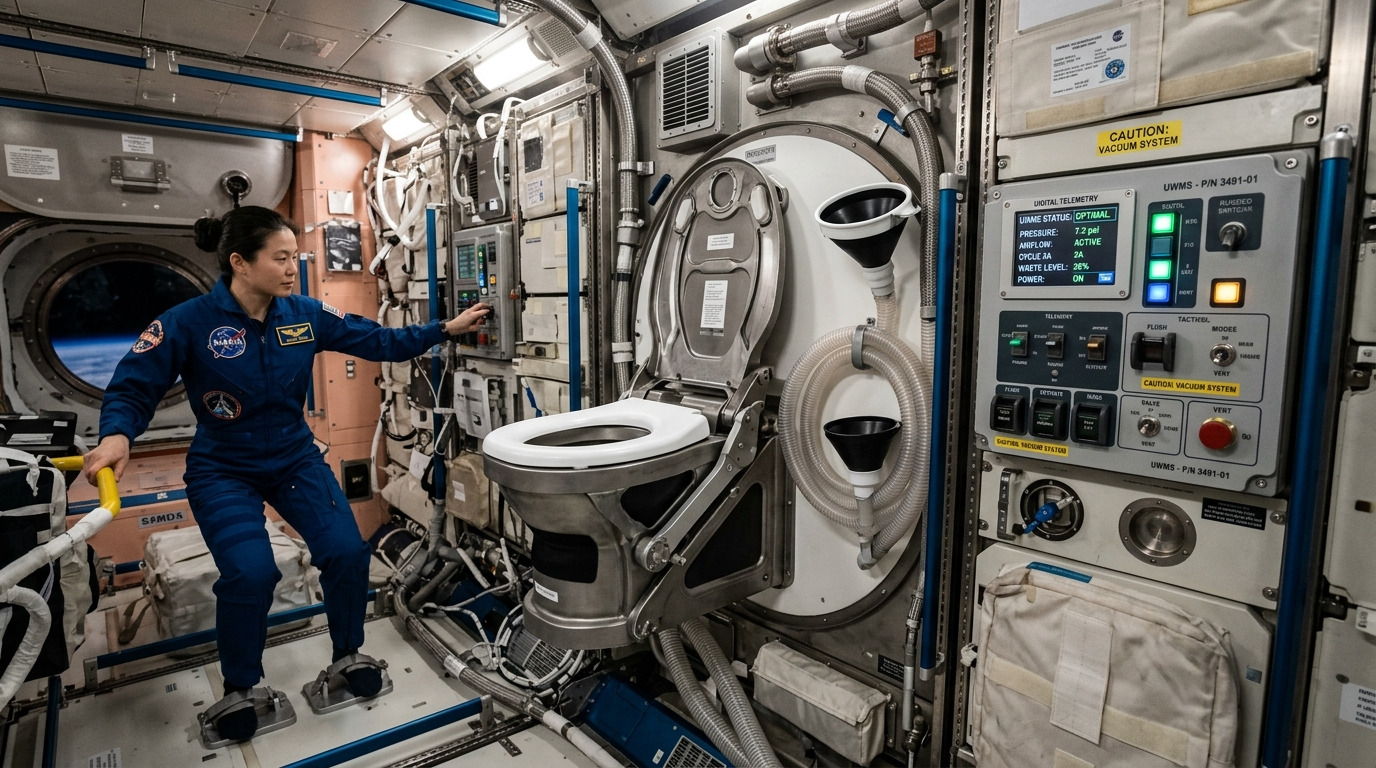
Today, this engineering lineage culminates in the Universal Waste Management System (UWMS), a $23 million next-generation space toilet deployed to the International Space Station (ISS) and integrated into the Orion spacecraft for the Artemis lunar missions. Engineered with 3D-printed titanium components, the UWMS is 65% smaller and 40% lighter than its predecessor on the Space Shuttle and Russian Zvezda module. Crucially, it was designed with comprehensive ergonomic inclusivity, featuring an anatomically optimized, contoured seat and an integrated, independently adjustable urine funnel that enables simultaneous urination and defecation for both female and male crew members—a major biological and mechanical advancement over older, male-centric systems.
3. Engineering Fluid Dynamics: Airflow Entrainment and Phase Separation
At the mechanical heart of modern space toilets like the UWMS lies the principle of aerodynamic entrainment. Because gravity cannot pull waste away from the human body, the system creates a high-throughput, low-pressure pneumatic sink. The moment an astronaut opens the toilet lid or activates the collection funnel, dual high-speed centrifugal fans spin up, drawing cabin air through the system at volumetric flow rates exceeding 800 liters per minute.
For solid waste, this high-velocity airflow acts as an artificial gravitational draft, shearing the fecal mass from the astronaut’s body and entraining it into a porous, air-permeable collection canister. The canister is lined with a micro-perforated bag that allows air to pass through while capturing solids. The exhaust air is then routed through a multi-stage filtration manifold consisting of high-efficiency particulate air (HEPA) filters to capture biological particles, followed by dense activated carbon and catalytic beds that adsorb volatile organic compounds (VOCs) like indole, skatole, methane, and ammonia, returning pristine, odor-free air back into the cabin habitat.
For liquid waste, the challenge is even more complex due to the dynamics of two-phase (gas-liquid) fluid flow. The astronaut urinates into an ergonomic funnel connected to a flexible hose where high-velocity air carries the stream inward. However, this creates an intimate mixture of liquid urine and cabin air that cannot be stored or processed together. The UWMS routes this turbulent two-phase mixture into a high-speed Rotary Drum Phase Separator. Inside this spinning centrifuge, the dense liquid urine is hurled outward against the rotating drum walls by centrifugal acceleration, forming a coherent liquid film that is skimmed by stationary pickup tubes and pumped into holding tanks. Meanwhile, the lighter, de-wetted air remains at the central axis of the drum, where it is extracted, filtered, and recirculated.
4. Closing the Loop: The Chemistry of Urine-to-Water Recycling (ECLSS)
In the brutal arithmetic of space logistics, mass is destiny. Launching a single kilogram of water from Earth to low Earth orbit historically cost between $10,000 and $20,000. For a four-person crew embarking on a 1,000-day mission to Mars, carrying all necessary consumable water from Earth would require over 10,000 kilograms of launch mass—an engineering impossibility with current rocketry. Thus, the space toilet is not an endpoint of waste, but the indispensable intake valve of the regenerative Environmental Control and Life Support System (ECLSS).
On the International Space Station, urine collected by the UWMS is immediately injected with a potent chemical pretreatment cocktail consisting of sulfuric acid, chromium trioxide (or phosphoric acid alternatives), and proprietary biocides. This harsh chemical mixture lowers the pH below 2.0, preventing urea from hydrolyzing into volatile ammonia gas and neutralizing bacterial proliferation that would otherwise clog micro-plumbing lines with calcium sulfate precipitates.
The pretreated urine is then transferred to the Urine Processor Assembly (UPA), which utilizes Vapor Compression Distillation (VCD) inside a rotating vacuum centrifuge drum. Operating under vacuum allows the water in the urine to boil at room temperature, while compression pumps elevate the vapor pressure, enabling thermal energy to be recycled to drive further evaporation. The evaporated steam is condensed into pure distillate, while the concentrated, thick chemical slurry—known as urine brine—is directed to the newly operational Brine Processor Assembly (BPA). The BPA forces the brine through specialized selective membrane distillation sleeves, extracting the final remnants of moisture. When combined with the catalytic oxidation and multi-bed filtration of the Water Processor Assembly (WPA), NASA achieved a historic 98% total water recovery rate from human urine and sweat in recent long-duration validations. The purified water emerging from this loop surpasses municipal tap water on Earth in chemical and microbiological purity, embodying the famous astronaut adage: “Yesterday’s coffee becomes tomorrow’s coffee.”
5. Deep Space Geopolitics: Closed-Loop Metabolism for Mars Exploration
As space exploration transitions from orbital outposts to deep-space transit and permanent planetary settlements, waste management physics transforms into a vital strategic asset. An expedition to Mars will operate outside Earth’s supply chain for upwards of three years. There will be no resupply capsules like SpaceX Cargo Dragon or Northrop Grumman Cygnus to deliver fresh water or haul away discarded waste canisters for atmospheric incineration.
In this context, every gram of carbon, nitrogen, hydrogen, and phosphorus excreted by the crew represents an irreplaceable planetary resource. Space agencies and commercial innovators are actively developing bioregenerative life support architectures where human waste forms the foundation of synthetic agricultural soil. Solid fecal matter, currently desiccated and stored in aluminum canisters, is being researched for dual-use applications: when packed into modular habitat walls, the high hydrogen content of dried biological waste provides exceptional shielding against Galactic Cosmic Rays (GCR) and Solar Particle Events (SPE). Furthermore, advanced pyrolysis and anaerobic digestion systems are being engineered to convert solid waste into nutrient-rich biochar for hydroponic crop cultivation and methane fuel for surface ascent vehicles.
The mastery of closed-loop metabolic engineering is the definitive technological barrier between temporary orbital sorties and permanent interplanetary civilization. Nations and space consortia that master the thermodynamics of zero-loss biological recycling will dictate the logistics, longevity, and territorial reach of lunar bases and Martian outposts.
Conclusion: The Unspoken Foundation of Interplanetary Civilization
The technological triumphs of space exploration are frequently celebrated through colossal rocket launches, planetary rovers, and breathtaking images of distant nebulae. Yet, the true measure of our capacity to dwell among the stars lies within the quiet, unglamorous mechanics of space sanitation. It is in the microscopic boundary layers of titanium suction nozzles, the relentless centrifugal spin of rotary phase separators, and the immaculate molecular filters of regenerative distillers that the human species negotiates its survival with the vacuum.
By conquering the fluid physics of microgravity and transforming biological metabolic waste into a closed, perpetual loop of life-sustaining water and breathable oxygen, space engineers have resolved an ancient evolutionary contradiction: taking a terrestrial organism dependent on an entire biosphere and sustaining it inside a sealed metal hull. The humble space toilet is not merely a convenience of modern spaceflight; it is the ultimate testament to scientific rationality and human ingenuity—the quiet, indispensable machine that makes human life possible beyond the cradle of Earth.
인류가 우주를 향해 나아가는 장대한 여정을 상상할 때, 대중의 시선은 웅장한 로켓의 화염, 미래지향적인 우주선, 그리고 칠흑 같은 암흑 속에 펼쳐진 성간 공간의 낭만에 먼저 머뭅니다. 그러나 우주라는 극한 환경에서 인류의 확장을 가로막는 가장 본질적인 장벽은 추진 엔진의 출력이나 궤도역학적 계산보다, 지극히 원초적이고 생물학적인 인간 신체의 한계에서 비롯됩니다. 지구의 저궤도와 심우주가 강제하는 미세중력(Microgravity) 환경 속에서, 인간의 가장 자연스러운 생리적 행위인 배설은 고도의 다상 유체역학(Multiphase Fluid Dynamics)과 환경제어 생명유지시스템(ECLSS)이 결합된 최고 난도의 공학적 도전 과제로 탈바꿈합니다.
지구 위에서 중력은 보이지 않는 거대한 자연의 하수관 역할을 무상으로 수행해 왔습니다. 중력은 고체 폐기물을 자연스럽게 바닥으로 낙하시키고, 액체의 하향 흐름을 유도하며, 밀도 차이에 의한 자연 대류와 부력을 발생시켜 기체와 액체를 완벽히 분리합니다. 그러나 우주선의 궤도 운동으로 인해 겉보기 중력이 사라지는 순간, 화장실을 이용하는 단순한 행위는 표면장력, 모세관 현상, 액체 점성, 그리고 미생물학적 위험에 맞서는 치열한 물리적 전쟁이 됩니다.
우주선에서의 위생 처리는 결코 단순한 생활 편의의 문제가 아닙니다. 그것은 우주비행사의 건강과 우주선 내부 전자 시스템의 안전을 보장하는 기초 생명선이자, 아르테미스(Artemis) 계획의 달 기지 건설과 수년에 걸친 화성 유인 탐사를 성립시키는 물질 순환의 핵심 고리입니다. 고립된 우주선이라는 폐쇄 생태계에서 인간의 소변과 대변은 버려지는 오물이 아니라, 98% 이상 회수되어 다시 마실 물과 산소로 전환되어야 하는 가장 소중한 1차 자원입니다. 본 글에서는 미세중력 환경에서 배설이 마주하는 물리적 메커니즘을 심층 분석하고, 우주 화장실의 진화 과정과 유체역학적 기액 분리 기술, 그리고 심우주 진출을 가능케 하는 물질 완전 순환 생명유지시스템의 전략적 의미를 살펴보고자 합니다.
1. 무중력의 역설: 원초적 생리현상이 마주한 미세중력의 물리학
우주선 화장실의 공학적 메커니즘을 이해하기 위해서는 먼저 미세중력 환경에서 유체역학이 어떻게 급변하는지 그 물리적 본질을 들여다보아야 합니다. 지표면에서는 정수압($\rho g h$)과 중력 가속도($g$)가 유체의 거동을 완벽히 지배합니다. 사람이 대소변을 배출할 때 중력은 즉각적인 방향성 벡터를 제공하여 배설물을 신체로부터 떼어내고 아래 방향으로 떨어뜨립니다. 이 과정에서 별도의 외력이나 복잡한 기계 장치는 전혀 필요하지 않습니다.
그러나 중력의 영향이 $10^{-6}\ g$ 수준으로 극소화되는 미세중력 궤도 환경에서는 체적력(Body Force)인 중력이 완전히 무력화되고, 계면 표면장력(Surface Tension), 부착력(Adhesion), 응집력(Cohesion)과 같은 분자 간 힘이 유체 거동의 지배적 변수로 부상합니다. 액체가 체외로 배출될 때 지구에서처럼 아래로 흐르는 유선(Streamline)을 형성하지 못합니다. 액체는 자신의 표면 자유 에너지를 최소화하기 위해 구형의 액적(Droplet)을 형성하며, 노즐이나 비행사의 피부, 기체 벽면에 닿는 즉시 강한 표면 부착력으로 인해 끈적하게 달라붙어 떨어지지 않습니다. 고체 배설물 역시 마찬가지입니다. 지구에서는 괄약근의 수축과 중력에 의해 자연스러운 질량 분리가 일어나지만, 무중력에서는 표면 점착력 때문에 배설물이 신체 표면에서 저절로 분리되지 않으며, 인위적인 외력이 작용하지 않으면 허공에 불규칙하게 부유하게 됩니다.
가압된 우주선 조종실 내부에서 생체 유체나 배설 입자가 자유롭게 부유하는 현상은 단순한 불쾌감을 넘어 임무 전체를 파멸로 몰고 갈 수 있는 치명적인 물리적 위험입니다. 소변은 전해질과 요소(Urea)가 농축된 전도성 액체이기 때문에, 공중에 흩어진 단 한 방울의 미세 액적이 정밀 항공전자장비(Avionics) 회로 기판에 침투할 경우 전기적 단락(Short Circuit)과 화재, 주 컴퓨터의 오작동을 유발합니다. 또한 분변 입자가 공기 중에 에어로졸 형태로 떠돌 경우 대장균(E. coli)과 같은 병원성 박테리아가 좁은 폐쇄 공간의 대기를 급속히 오염시키고, 환경 정화용 HEPA 필터를 막히게 하며, 비행사의 호흡기로 흡입되어 심각한 폐 질환을 일으킵니다. 따라서 우주 화장실은 자연계의 중력을 완벽히 대체할 수 있는 인위적이고 정밀한 강제 공기역학 및 원심 분리 시스템을 갖추어야만 합니다.
2. 우주 화장실의 진화사: 접착 비닐봉투에서 3D 프린팅 타이타늄까지
우주 위생 공학의 역사는 인류가 우주라는 극한 공간에 적응하기 위해 겪어야 했던 수많은 시행착오와 말 못 할 고초의 연대기입니다. 유인 우주비행 초기였던 1960년대 초반, 비행 시간이 수 시간에 불과했던 머큐리(Mercury) 프로젝트 당시 NASA 엔지니어들은 배설 문제를 사실상 부차적인 요소로 취급했습니다. 최초의 미국 우주비행사 앨런 셰퍼드는 발사대에서 수 시간 동안 지연 대기하던 중, 소변을 참지 못하고 우주복 내부에 그대로 방출해야 했으며 이로 인해 가슴에 부착된 생체 전기 센서가 합선되는 굴욕을 겪었습니다.
제미니(Gemini)와 아폴로(Apollo) 프로그램에 이르러 비행 기간이 수일에서 1주일 이상으로 늘어나자 원시적인 수거 장치가 도입되었습니다. 소변의 경우 콘돔 형태의 라텍스 롤온 커프(Roll-on cuff)를 착용해 밸브를 통해 우주선 밖으로 배출(Venting)했고, 대변 처리를 위해서는 일명 ‘아폴로 백(Apollo fecal bag)’이라 불리는 특수 비닐봉투가 지급되었습니다. 비행사들은 가장자리에 의료용 접착 테이프가 붙은 비닐봉투를 둔부에 직접 밀착시킨 뒤 볼일을 보아야 했습니다. 볼일을 마친 후에는 봉투 안에 살균제를 터뜨려 손으로 직접 반죽함으로써 미생물에 의한 가스 팽창과 폭발을 방지해야 했는데, 이 과정은 비행사들에게 극심한 심리적 스트레스와 굴욕감을 안겨주었으며 때로는 봉투 밖으로 변이 누출되어 선내를 둥둥 떠다니는 비상사태가 발생하기도 했습니다. 이 때문에 당시 우주비행사들은 발사 전 장내 잔여물이 남지 않는 특수 고단백 저잔여물 식단을 섭취하고 심지어 장운동 억제제를 복용하며 배변을 최대한 억제했습니다.
1970~80년대 우주정거장 스카이랩(Skylab)과 우주왕복선(Space Shuttle) 시대로 접어들면서 비로소 기계화된 화장실이 등장했습니다. 우주왕복선에 탑재된 폐기물 수집 시스템(WCS, Waste Collection System)은 고속 팬 모터를 이용해 공기를 흡입함으로써 중력 대신 기류로 대소변을 빨아들이는 현대적 메커니즘을 확립했습니다. 대변 수집 챔버 내부에는 고속으로 회전하는 슬링거 블레이드(Slinger Blade)가 장착되어 고체 변을 갈아서 캔 내부 벽면에 얇게 밀착시켰고, 이후 우주의 진공 공간에 노출시켜 수분을 급속 증발·건조시킴으로써 세균 번식을 차단했습니다.
그리고 마침내 2020년대, 인류는 약 2,300만 달러(한화 약 300억 원)가 투입된 현존 최고 성능의 차세대 우주 화장실인 **범용 폐기물 관리 시스템(UWMS, Universal Waste Management System)**을 탄생시켰습니다. 국제우주정거장에 시험 배치되고 아르테미스 2호 오리온(Orion) 우주선에 탑재된 UWMS는 3D 프린팅 타이타늄 합금 부품을 대거 적용하여 이전 시스템 대비 부피를 65% 줄이고 무게를 40%나 경감시켰습니다. 특히 과거 남성 신체 구조 위주로 설계되었던 깔때기와 좌석 구조를 전면 재설계하여, 여성 우주비행사도 불편함 없이 소변과 대변을 동시에 볼 수 있도록 인체공학적 통합 설계를 구현했습니다.
3. 공학적 해법과 유체역학: 강제 기류 흡입과 기액 분리의 정밀 메커니즘
현대 우주 화장실의 핵심 작동 원리는 공기역학적 흡인(Aerodynamic Entrainment)과 원심력을 이용한 다상 유체 분리(Multiphase Phase Separation)에 기반합니다. 중력이 없는 환경에서 유체를 원하는 위치로 이동시키는 유일하게 신뢰할 수 있는 방법은 공기의 압력 구배(Pressure Gradient)를 형성하는 것입니다.
비행사가 변기 뚜껑을 열거나 소변 깔때기의 스위치를 켜는 순간, 고성능 이중 원심 송풍기가 즉각 회전하기 시작합니다. 이때 발생하는 기류의 유량은 분당 800리터 이상으로, 신체 주변의 공기를 변기 내부로 강력하게 빨아들입니다. 대변을 볼 때 비행사는 엉덩이를 변기 시트 가장자리에 완벽히 밀착시켜 공기가 새지 않는 실링(Sealing)을 형성해야 합니다. 시트의 구멍 직경은 지구의 변기보다 훨씬 작은 약 10~15cm에 불과하므로 극도의 조준 정확도가 요구됩니다. 비행사가 배변을 시작하면 고속으로 하강하는 강제 공기 기류가 고체 덩어리를 물리적으로 잡아당겨 체모와 피부로부터 분리시킨 후, 캔 내부의 미세 다공성 수거 백으로 유도합니다. 공기는 필터를 통과해 빠져나가고 고체는 백 내부에 포집됩니다. 배출된 공기는 즉각 다단계 정화 시스템으로 유입되어 미생물을 99.97% 제거하는 HEPA 필터와 메탄, 암모니아, 인돌, 스카톨 등 지독한 악취를 흡착하는 활성탄 및 촉매 필터를 통과하여 완벽히 정화된 후 선내로 재순환됩니다.
소변 처리의 경우 공학과 유체역학의 난이도는 한층 더 상승합니다. 비행사는 자신에게 맞춤 설계된 실리콘 깔때기를 신체에 밀착시키고 소변을 배출하는데, 이때 흡입된 고속 공기와 소변 액체가 호스 내부에서 뒤섞이면서 복잡한 2상(기체-액체) 난류 혼합물을 형성합니다. 기체와 액체가 뒤섞인 상태로는 액체를 탱크에 저장하거나 정제 장치로 보낼 수 없기 때문에, 이 혼합물은 즉시 **회전 드럼 기액 분리기(Rotary Drum Phase Separator)**로 투입됩니다.
이 장치는 분당 수천 회 회전하는 소형 원심분리기입니다. 혼합물이 드럼 내부로 유입되면 밀도가 높은 액체 상태의 소변은 원심 가속도에 의해 바깥쪽 회전벽으로 강하게 밀려나 얇은 액체 막을 형성합니다. 벽면에 고인 소변은 고정된 픽업 튜브(Pitot Tube)를 통해 정밀하게 긁어 모아져 수거 파이프라인으로 압송됩니다. 반면 밀도가 현저히 낮은 공기는 회전축 중심부에 머무르게 되며, 중심부의 기체 배출구를 통해 뽑아내어 필터를 거친 뒤 선내 대기로 되돌아갑니다. 미세중력 속에서 기포 하나 없이 순수한 액체만을 분리해 내는 이 회전 분리 기술은 우주 유체역학이 이룩한 가장 정교한 공학적 성과 중 하나입니다.
4. 닫힌 루프의 완성: 소변에서 완벽한 음용수로 이어지는 화학적 정제 (ECLSS)
우주 물류의 냉혹한 경제학에서 ‘질량(Mass)’은 곧 임무의 성패를 가르는 절대적인 한계입니다. 지상에서 물 1리터(1kg)를 지구 저궤도로 쏘아 올리는 데는 과거 수천만 원, 로켓 재사용 기술이 고도화된 현재에도 수백만 원의 천문학적 발사 비용이 소모됩니다. 4명의 승무원이 3년 동안 화성을 왕복 탐사하려면 수십 톤의 물이 필요한데, 이를 지구에서 전부 싣고 출발하는 것은 물리적으로 불가능합니다. 따라서 우주 화장실은 단순한 위생 시설을 넘어, 국제우주정거장과 심우주 우주선의 환경제어 생명유지시스템(ECLSS)을 지탱하는 가장 거대한 물질 유입 밸브입니다.
UWMS를 통해 분리 포집된 소변은 저장 탱크로 들어가자마자 황산과 크롬산(또는 인산계 대체재), 그리고 강력한 살균제로 구성된 화학 전처리제(Pretreatment Solution)와 자동 혼합됩니다. 사람의 소변은 상온에 방치되면 박테리아에 의해 요소가 분해되어 독성의 암모니아 가스를 방출하고 pH가 상승하여 요석(Calcium Sulfate/Uric Salt) 침전물을 형성합니다. 이 침전물은 직경 수 밀리미터의 미세 배관을 순식간에 막아버립니다. 전처리제는 소변의 pH를 2.0 이하의 강산성으로 급격히 떨어뜨려 세균 번식을 원천 봉쇄하고 화학적 침전을 완벽히 방지합니다.
전처리된 소변은 이후 **소변 처리 장치(UPA, Urine Processor Assembly)**로 이송됩니다. UPA 내부에서는 증기 압축 증류(VCD, Vapor Compression Distillation) 공정이 수행됩니다. 지상과 달리 대류가 일어나지 않으므로 회전하는 진공 보일러 내부에서 증류를 진행합니다. 진공 상태에서는 물이 체온에 가까운 낮은 온도에서도 끓어오르며, 발생한 수증기를 압축기로 가압하여 응축열을 회수함으로써 에너지 소비를 극소화합니다.
증류를 거쳐 남은 고농도 농축액인 브라인(Brine)은 과거에는 폐기되었으나, 최근에는 최신 **브라인 처리 장치(BPA, Brine Processor Assembly)**로 보내집니다. BPA는 특수 고분자 막 증류 기술을 적용해 잔여 소금물 속의 마지막 수분 분자까지 강제로 쥐어짜 냅니다. 이렇게 회수된 증류수는 승무원의 땀과 호흡에서 포집된 응축수와 함께 **수자원 처리 장치(WPA, Water Processor Assembly)**로 투입됩니다. WPA는 다층 활성탄 필터, 이온 교환 수지, 130°C 이상의 고온 고압 촉매 산화 리액터, 그리고 요오드 살균 공정을 차례로 거쳐 유기물과 미생물을 100% 분해합니다.
2023년 NASA는 BPA 기술의 완전한 통합을 통해 ISS 승무원의 배설물과 땀으로부터 **물 회수율 98%**라는 경이적인 대기록을 공식 달성했습니다. 이 정제 과정을 거쳐 나온 물은 지구상의 어떤 시판 생수나 수돗물보다 화학적·미생물학적으로 순수하며, 우주비행사들이 매일 마시는 커피와 식수, 산소 발생기(OGS)의 전기분해 원료로 완벽하게 재활용됩니다. *“어제 마신 커피가 정제를 거쳐 내일의 커피가 된다”*는 우주비행사들의 농담은 현대 화학공학이 완성한 가장 아름다운 닫힌 루프(Closed-Loop)의 실체입니다.
5. 심우주를 향한 전략적 통찰: 화성 개척과 물질 자립형 인공 생태계
지구 저궤도를 넘어 달 궤도 우주정거장 루나 게이트웨이(Gateway)와 화성 표면 개척을 준비하는 오늘날, 우주 폐기물 관리 기술은 단순한 생명 유지를 넘어 행성 간 문명의 지속가능성을 판가름하는 전략적 자산으로 평가받고 있습니다. 화성으로 떠나는 탐사선은 지구로부터의 보급선이 완전히 끊기는 수년간의 ‘보급 암흑기’를 견뎌내야 합니다. 우주 쓰레기를 화물선에 실어 지구 대기권에 태워버리는 저궤도 방식의 폐기물 처리는 더 이상 불가능합니다.
따라서 미래 심우주 미션에서 고체 배설물(대변)의 재자원화는 차세대 우주 생태학의 핵심 연구 분야로 급부상하고 있습니다. 대변은 수분을 건조하고 나면 풍부한 유기 탄소, 질소, 인, 그리고 수소 원자로 구성된 고밀도 자원이 됩니다. 현재 NASA와 유럽우주국(ESA)은 건조 압축된 고체 분변 블록을 서식지 벽면에 샌드위치 구조로 배치하여 우주 방사선(은하 우주선 GCR 및 태양 입자선 SPE)을 막는 생체 방사선 차폐재로 활용하는 방안을 실증 연구하고 있습니다. 수소 함량이 높은 물질일수록 고에너지 방사선 입자를 흡수하고 차단하는 능력이 탁월하기 때문입니다.
더 나아가, 합성 생물학과 호기성 고온 미생물 발효 공학을 결합하여 고체 배설물을 우주 온실(Bioregenerative Habitat)의 수경재배용 유기질 비료로 전환하거나, 혐기성 소화를 통해 화성 착륙선의 보조 추진 연료인 메탄($\mathrm{CH_4}$) 가스를 생산하는 인공 생태계 연구가 활발히 진행 중입니다. 배설물을 완벽히 순환시키는 자립형 물질 대사(Metabolic Autonomy) 시스템을 구축하지 못하는 국가는 결코 지구 중력권을 벗어난 심우주에 영구적인 식민지나 유인 기지를 건설할 수 없습니다. 즉, 배설의 완벽한 통제와 자원화는 행성 간 거주 능력을 가르는 가장 중대한 기술적 주권입니다.
Conclusion: 인간의 존엄과 우주 문명의 지속가능성을 잇는 교량
우주 탐사의 위대함을 이야기할 때 우리는 흔히 은하계를 가로지르는 광속 엔진이나 거대한 우주 망원경을 떠올립니다. 그러나 인류가 지구라는 요람을 떠나 별들의 세계로 안전하게 영토를 확장할 수 있는 진정한 저력은, 인간이라는 생명체가 가진 가장 낮고 은밀하며 원초적인 생리적 문제를 완벽하게 해결해 낸 배설 공학의 정밀함 속에 깃들어 있습니다.
우주 화장실은 티타늄 흡입 노즐의 미세한 기류 제어, 기체와 액체를 갈라놓는 회전 분리기의 원심력, 그리고 오염된 유체를 다시 생명의 원천으로 되돌리는 화학 분자 필터의 경이로운 총합입니다. 미세중력 속에서 유체역학적 한계를 극복하고 배설물을 완벽한 물질 순환의 고리로 탈바꿈시킨 이 조용한 기술은, 지구 생태계에 절대적으로 의존하던 나약한 유기체를 우주 공간에서 자립 가능한 지적 종족으로 진화시켰습니다. 가장 인간적인 존엄성을 지켜내면서 동시에 우주적 자립을 완성해 낸 우주 화장실의 물리학이야말로, 인류가 다행성 종족으로 도약하기 위해 쌓아 올린 가장 위대하고 필수불가결한 과학의 초석입니다.
답글 남기기