
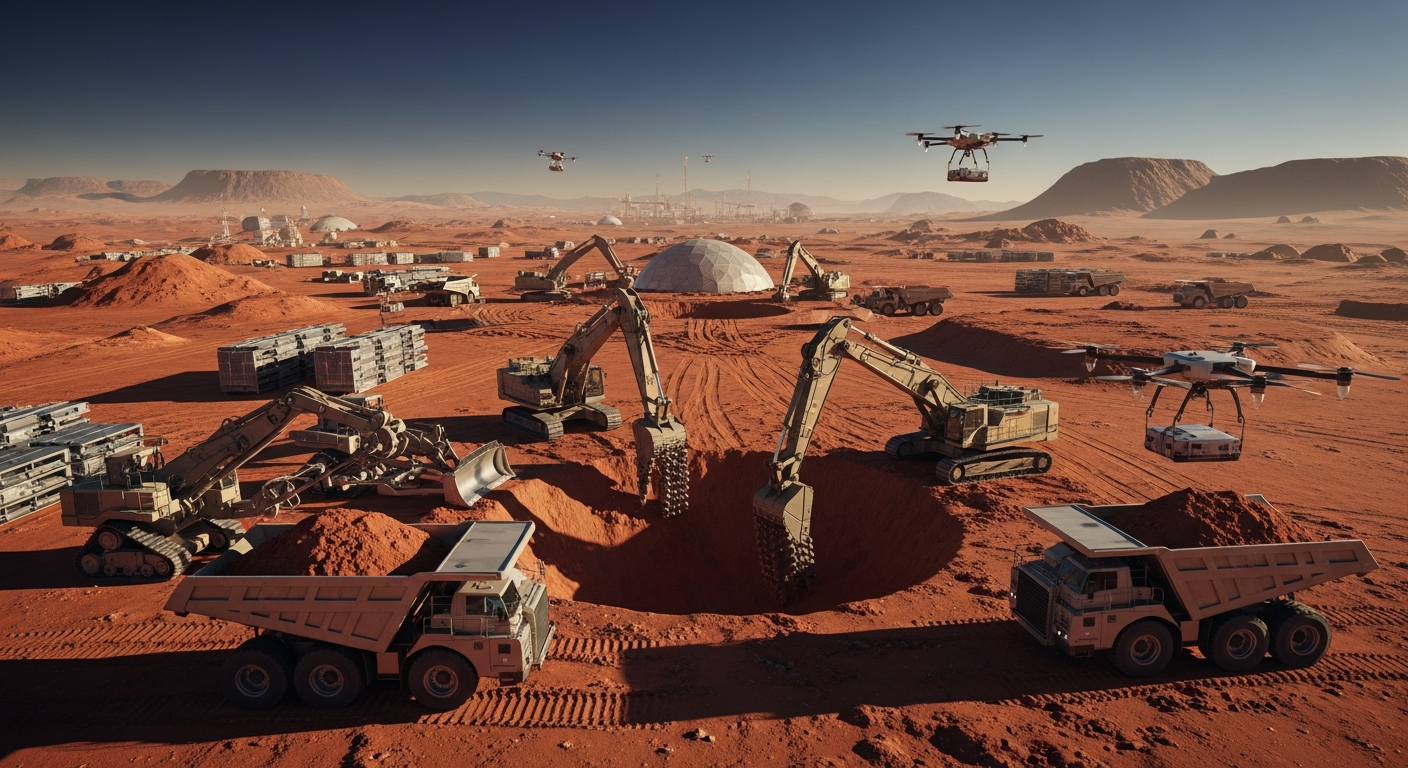
화성 테라포밍은 SF 영화의 단골 소재지만, 이 거대한 프로젝트를 단순한 상상이 아닌 실제 건설자의 눈으로 바라보면 어떨까요? 붉은 행성을 인류의 두 번째 보금자리로 만드는 과정은 인류 역사상 가장 거대한 건설 프로젝트가 될 것입니다. 이 글에서는 영화 속 스펙터클을 넘어, 화성 테라포밍을 실현하기 위해 넘어야 할 공학적, 건설적 난제들을 구체적으로 파헤쳐 봅니다.
상상에서 과학의 영역으로
화성 테라포밍(Mars Terraforming)이란, 화성의 대기, 온도, 지표 환경 등을 인위적으로 조절하여 지구와 유사한 환경으로 바꾸는 행성 개조 프로젝트를 의미합니다. 1942년 SF 소설에서 처음 등장한 이 개념은 칼 세이건과 같은 천문학자들에 의해 학문적 논의로 발전했습니다. 지구와 하루 길이가 비슷하고, 계절 변화가 있으며, 극지방에 얼음이 존재하는 화성은 테라포밍의 가장 유력한 후보지로 꼽혀왔습니다. 궁극적인 목표는 인류가 특별한 보호 장비 없이도 거주할 수 있는 환경을 조성하는 것입니다.
현실의 벽: 과학적 회의론과 미래 비전의 충돌
현재 테라포밍은 과학적 회의론과 인류의 미래를 위한 필요성이라는 주장이 팽팽히 맞서고 있습니다. 건설자의 관점에서 볼 때, 현실의 장벽은 너무나도 높습니다.
- 근본적인 한계: 화성은 지구 중력의 약 38%에 불과해 애써 만든 대기를 우주로 잃기 쉽습니다. 또한 행성 전체를 보호할 자기장이 없어 치명적인 태양풍과 우주 방사선에 그대로 노출됩니다. 최근 연구에 따르면, 유의미한 온실 효과를 일으키기에 화성에 존재하는 이산화탄소의 총량이 턱없이 부족하다는 사실도 밝혀졌습니다.
- 미래를 향한 열망: 반면, 일론 머스크와 같은 혁신가들은 지구의 자원 고갈, 기후 변화 등 잠재적 위협에 대비해 인류가 ‘다행성 종족(Multi-planetary species)’으로 나아가야 한다고 주장합니다. 이러한 비전은 테라포밍이라는 거대한 도전을 계속하게 만드는 강력한 원동력이 되고 있습니다.
결국 행성 전체를 바꾸는 것보다, 돔 시티 건설과 같은 ‘부분적 테라포밍’ 또는 ‘화성 식민지화’가 더 현실적인 대안으로 부상하고 있습니다.
건설자의 시선으로 본 핵심 난제
화성 기지를 건설하고 생존 환경을 구축하는 과정은 지구의 어떤 토목 공사와도 비교할 수 없는 극한의 도전입니다. 핵심 난제는 크게 두 가지로 나눌 수 있습니다.
1. 중력과 압력을 이겨내는 토목 공학
화성의 낮은 중력은 구조물의 무게 부담을 줄여주는 장점이 있지만, 동시에 새로운 문제들을 야기합니다. 희박한 대기 탓에 거주지 내부는 높은 압력을 유지해야 하고, 이 압력은 구조물을 밖으로 밀어내는 거대한 힘(인장 응력)으로 작용합니다.
- 현지 자원 활용(ISRU) 건축: 지구에서 벽돌 한 장이라도 가져가는 것은 천문학적인 비용이 듭니다. 따라서 화성 표면의 흙, 즉 ‘레골리스(Regolith)’를 활용하는 것이 필수적입니다. 3D 프린팅 기술로 레골리스를 건축 자재로 바꾸거나, 지하 용암 동굴을 활용해 자연 방사선 차폐막이자 안정적인 구조물로 삼는 방안이 현실적인 대안으로 연구되고 있습니다.
- 새로운 구조 설계: 압력 분산에 유리한 돔 형태나, 운송과 설치가 용이한 팽창식 서식지 모듈이 초기 기지 건설에 핵심적인 역할을 할 것입니다. 또한, 장기 거주 시 저중력으로 인한 인체 문제를 해결하기 위해 회전식 인공 중력 시설을 건설하는 것도 궁극적인 과제 중 하나입니다.
2. 대기 재건을 위한 에너지 공학
화성의 대기를 만들고 온도를 높이는 과정은 상상을 초월하는 에너지를 필요로 합니다.
- 에너지원 확보: 이 막대한 에너지를 안정적으로 공급하기 위한 가장 현실적인 대안은 핵분열 또는 핵융합 발전입니다. 초기 기지는 태양광 발전에 의존하겠지만, 먼지 폭풍과 약한 햇빛이라는 한계를 극복하기 위해서는 결국 강력한 에너지원이 필수적입니다.
- 대기 생성 기술: 화성 궤도에 거대한 반사경을 띄워 극지방의 이산화탄소 얼음을 녹이거나, 대기 중에 온실 효과를 유발하는 나노 입자를 살포하는 아이디어가 제시되었습니다. 또한, NASA의 ‘MOXIE’ 실험은 화성 대기의 이산화탄소에서 산소를 성공적으로 추출하며 현지 자원 활용의 가능성을 증명했습니다. 장기적으로는 태양풍을 막기 위해 화성과 태양 사이에 인공 자기장을 생성하는 거대 프로젝트도 구상되고 있습니다.
결론: 먼 미래의 꿈, 그러나 현재의 동력
행성 전체를 지구처럼 바꾸는 완전한 테라포밍은 수백, 수천 년이 걸릴지도 모르는 먼 미래의 이야기입니다. 하지만 불가능해 보이는 이 꿈은 인류의 기술 발전을 이끄는 강력한 동력이 됩니다.
현재 우리는 MOXIE의 산소 생산 성공처럼 작은 기술적 진보들을 쌓아나가고 있습니다. 이러한 성과들이 모여 돔 시티를 건설하고, 점차 거주 가능 영역을 넓혀나가는 ‘부분적 테라포밍’의 기반이 될 것입니다. 화성 테라포밍은 단순한 SF가 아니라, 인류의 생존과 확장을 위한 가장 원대한 건설 프로젝트이자, 우리의 미래를 개척하는 도전 그 자체입니다.
Terraforming Mars: A Realistic Look at the Challenges from a Builder’s Perspective
Terraforming Mars is a staple of science fiction films, but what happens when we view this grand project not as mere fantasy, but through the eyes of an actual builder? The process of turning the Red Planet into humanity’s second home would be the largest construction project in human history. This post moves beyond cinematic spectacle to concretely explore the engineering and construction hurdles we must overcome to make Martian terraforming a reality.
From Imagination to the Realm of Science
Mars Terraforming is the planetary engineering project of artificially altering Mars’s atmosphere, temperature, and surface environment to make it similar to Earth. First appearing in a 1942 sci-fi novel, the concept evolved into a subject of academic debate thanks to astronomers like Carl Sagan. With a day length similar to Earth’s, seasonal changes, and polar ice caps, Mars has long been considered the most viable candidate for terraforming. The ultimate goal is to create an environment where humans can live without special protective gear.
The Wall of Reality: A Clash of Scientific Skepticism and Future Vision
Currently, the debate over terraforming is a tense standoff between scientific skepticism and the perceived necessity for humanity’s future. From a builder’s point of view, the real-world barriers are immense.
- Fundamental Limitations: Mars has only about 38% of Earth’s gravity, making it difficult to retain any newly created atmosphere. Furthermore, the lack of a global magnetic field leaves the surface exposed to lethal solar winds and cosmic radiation. Recent studies have also revealed that the total amount of carbon dioxide available on Mars is woefully insufficient to create a significant greenhouse effect.
- Aspiration for the Future: On the other hand, innovators like Elon Musk argue that humanity must become a multi-planetary species to hedge against potential threats on Earth, such as resource depletion and climate change. This vision serves as a powerful driving force to continue pursuing the monumental challenge of terraforming.
Ultimately, instead of transforming the entire planet, a more realistic approach is emerging: “partial terraforming” or “Mars colonization,” such as building self-contained dome cities.
Core Challenges from a Builder’s Viewpoint
Constructing a Martian base and establishing a habitable environment is an extreme challenge, incomparable to any civil engineering project on Earth. The core difficulties can be broadly divided into two categories.
1. Civil Engineering: Conquering Gravity and Pressure
While Mars’s low gravity reduces the load-bearing requirements for structures, it also introduces new problems. Due to the thin atmosphere, habitats must maintain high internal pressure. This pressure exerts a massive outward force (tensile stress) on the structure.
- In-Situ Resource Utilization (ISRU) Construction: Transporting even a single brick from Earth would be astronomically expensive. Therefore, utilizing Martian soil, or ‘regolith,’ is essential. Active research is focused on using 3D printing technology to convert regolith into building materials and leveraging underground lava tubes as natural radiation shields and stable structures.
- New Structural Designs: Dome shapes, which are excellent at distributing pressure, and inflatable habitat modules, which are easy to transport and deploy, will play a key role in the initial base construction. In the long term, building rotating artificial gravity facilities to counteract the health problems caused by prolonged low-gravity exposure will be another crucial task.
2. Energy Engineering for Atmospheric Reconstruction
Creating an atmosphere and raising the temperature on Mars will require an unimaginable amount of energy.
- Securing an Energy Source: The most realistic option for reliably supplying this vast amount of energy is nuclear fission or fusion power. While initial bases will rely on solar power, a more potent energy source is indispensable to overcome the limitations of dust storms and weak sunlight.
- Atmosphere Generation Technology: Ideas have been proposed such as placing giant mirrors in orbit to vaporize the carbon dioxide ice at the poles or dispersing nanoparticles in the atmosphere to induce a greenhouse effect. NASA’s ‘MOXIE’ experiment successfully demonstrated the potential of ISRU by extracting oxygen from the Martian carbon dioxide atmosphere. For the long term, massive projects like creating an artificial magnetic shield between Mars and the Sun are also being conceptualized to protect the new atmosphere.
Conclusion: A Distant Dream, but a Present-Day Driver
Full terraforming, transforming the entire planet to be Earth-like, is a dream that may take hundreds or even thousands of years to realize. However, this seemingly impossible dream is a powerful engine driving human technological advancement.
Currently, we are accumulating small technological victories, like the successful oxygen production by MOXIE. These achievements will build the foundation for “partial terraforming”—constructing dome cities and gradually expanding habitable zones. Terraforming Mars is not just science fiction; it is the grandest construction project for the survival and expansion of humanity, and a challenge that forges our future.
답글 남기기