
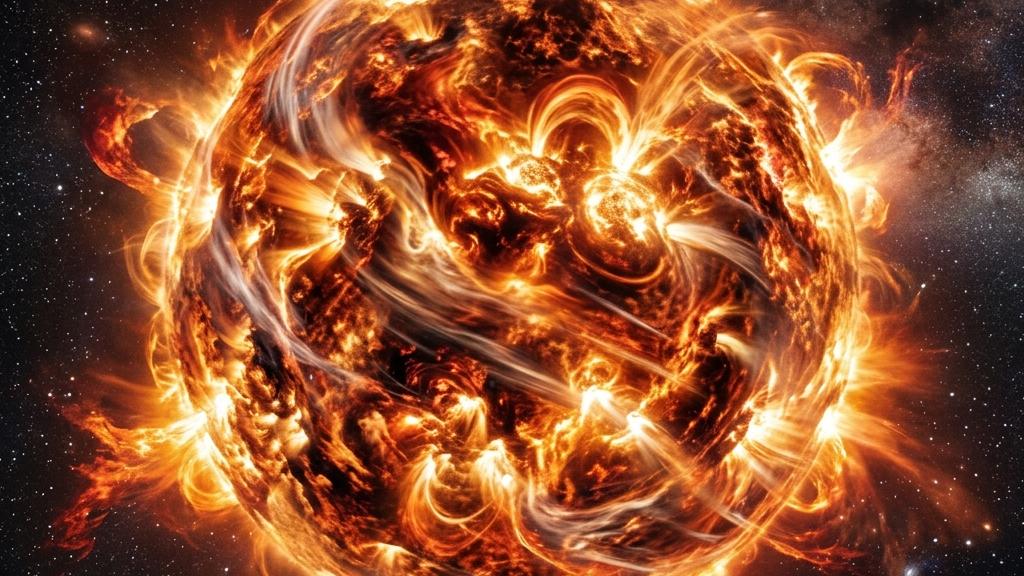
When we look up at the night sky, the stars appear as eternal sentinels, quiet and unchanging. For decades, our understanding of their lifespans followed a seemingly intuitive narrative: stars are born in a chaotic swirl of gas and dust, they burn fiercely throughout their lives, and as they age, they gradually slow down, exhausting their energy until they silently fade into the dark. It is a story that closely mirrors our human perception of aging—a slow, inevitable decline in vitality. However, the universe is rarely so straightforward. A recent, groundbreaking study from Kyoto University published in The Astrophysical Journal has radically upended this long-held belief. By peering deep into the turbulent hearts of dying massive stars, researchers have discovered a breathtaking cosmic plot twist: right before they meet their ultimate demise, some stars do not slow down. Instead, they spin faster, engaging in a furious, final dance before collapsing into the abyss.
This profound discovery not only rewrites the textbooks on stellar evolution but also offers a beautiful philosophical metaphor. It challenges the assumption that the end of a lifecycle must be a period of quiet resignation. Instead, it suggests that even on the precipice of obliteration, there can be a sudden, spectacular burst of energy that forever alters the legacy left behind. Let us delve into the fascinating mechanics of this celestial phenomenon and explore the poetic resonance it holds for our understanding of life, death, and the brilliant sparks that can ignite just before the lights go out.
1. The Conventional Wisdom: A Slow Fade into the Dark
To fully appreciate the magnitude of the Kyoto University discovery, we must first understand the scientific dogma it disrupts. For years, astrophysicists have relied on the principle of “magnetic braking” to explain the rotation of aging stars. Just as a figure skater slows their spin by extending their arms, a star is thought to lose its angular momentum over time. As a star ages, it sheds mass through powerful stellar winds. These winds carry away plasma, and because the plasma interacts with the star’s magnetic field, it acts like a giant, invisible brake, sapping the star’s rotational energy over millions of years.
This “spin-down” model was elegant, logical, and widely accepted. It painted a picture of stellar old age characterized by a slow, lethargic rotation. According to this theory, by the time a massive star reaches its final burning phases—fusing heavier elements like oxygen and silicon in a desperate bid to stave off gravitational collapse—its core should be rotating sluggishly. This assumption formed the bedrock of many theoretical models predicting the final states of massive stars.
Philosophically, this model resonated with our innate fear of winding down. It suggested a universe where energy inevitably dissipates into weariness. However, asteroseismology—the study of stellar oscillations or “starquakes”—began to reveal inconsistencies. The measured rotation rates of some stellar cores did not match the predictions of the spin-down model. There was a missing piece to the puzzle, a hidden mechanism operating in the deep, opaque interiors of these dying giants that defied our expectations of a quiet end.
2. A Cosmic Plot Twist: Spinning Up Before the End
Enter the team from Kyoto University. Armed with advanced 3D supercomputer simulations, they decided to look closer at the chaotic, final days of a massive star’s life. What they found was nothing short of revolutionary. Instead of a uniform, predictable slow-down, they observed a complex internal mechanism that can actually cause the star’s core to “spin up”—accelerating its rotation significantly just moments (in cosmic terms) before its death.
The researchers discovered that during the late stages of a star’s life, specifically during the burning of oxygen and silicon shells, the core does not quietly submit to its fate. Instead, intense convective currents arise. These currents are like massive, boiling rivers of plasma, churning violently deep within the star. Under specific conditions, these convective flows can interact with the star’s internal magnetic field in a way that transfers angular momentum inward, toward the core, rather than outward.
This mechanism acts like an internal engine, revving up the core’s rotation when it should technically be slowing down. It is a stunning defiance of the expected cosmic order. The star, facing imminent gravitational collapse, gathers its remaining strength and spins furiously, like a dying top given one final, forceful twist. It proves that the end of a star’s life is not a peaceful surrender, but a highly dynamic, energetic rebellion against the dying of the light.
3. The Dance of Magnetism and Plasma
The secret to this final, furious spin lies in the intricate, invisible dance between magnetism and plasma. The Kyoto University study highlighted that the internal magnetic fields of massive stars are far more complex than previously modeled. The geometry, strength, and topology of these fields are not uniform; they are tangled, twisted, and highly variable from one star to another.
When the boiling convective flows of plasma encounter these tangled magnetic fields, they do not simply pass through each other. They become inextricably linked. The magnetic field lines act as conduits, channeling the kinetic energy of the churning plasma and redirecting the star’s angular momentum. If the magnetic field configuration is just right, it acts as a funnel, forcing the rotational energy deep into the core, causing it to spin faster and faster.
This intricate interplay highlights the profound interconnectedness of the universe. A star’s fate is not solely determined by its mass or age, but by the complex, unseen relationships between its internal forces. In our own lives, we often attribute our trajectories to obvious, external factors. Yet, just like the dying star, our final outcomes are often shaped by the complex, internal interplay of our hidden passions, deeply ingrained beliefs, and the invisible networks of our relationships.
4. Designing Destiny: What Follows the Collapse
The revelation that a star can spin up before it dies is not just a fascinating trivia fact; it has profound implications for what happens after the star dies. When a massive star finally exhausts its nuclear fuel, its core collapses under its own immense gravity, triggering a spectacular supernova explosion. But what remains in the center—the corpse of the star—depends entirely on the conditions at the exact moment of collapse.
If the core is rotating slowly, it might collapse into a standard neutron star or a typical black hole. But if the core has been “spun up” by the mechanisms discovered by the Kyoto team, the outcome is vastly different. A rapidly rotating core can give birth to a highly energetic millisecond pulsar, or even a magnetar—a bizarre type of neutron star with a magnetic field trillions of times stronger than Earth’s. In some cases, the rapid rotation can profoundly alter the dynamics of the supernova itself, leading to hypernovae or long-duration gamma-ray bursts, the brightest electromagnetic events in the universe.
Thus, the star’s final, defiant burst of rotational energy dictates its eternal legacy. The spin-up mechanism ensures that the star does not simply vanish into obscurity; it transforms into one of the most extreme, powerful, and fascinating objects in the cosmos. It is a testament to the idea that the manner in which we face our end can fundamentally reshape what we leave behind for the future to witness.
Conclusion: The Brilliance of a Final Burst
The Kyoto University research serves as a beautiful, scientific reminder that the universe is far too complex for simple, linear narratives. The discovery that dying stars can spin up and accelerate just before their collapse shatters the melancholic assumption of a slow, inevitable fade into the dark. It reveals a cosmos where the final act can be the most dynamic and energetic of all.
For us, navigating the complexities of human existence, this celestial phenomenon offers a profound comfort. When we feel our energy waning, or when we face the closing chapters of a career, a relationship, or even life itself, we are not doomed to a quiet, lethargic decline. Like the massive stars glowing fiercely in the dark, we too possess internal currents and hidden reservoirs of strength. Under the right conditions, our internal passions can align, causing us to ‘spin up’ and deliver a final, brilliant burst of creativity, love, or impact. The end is not merely a cessation of existence; it is an opportunity to forge a legacy that will radiate across the fabric of time.
밤하늘을 올려다볼 때, 별들은 마치 영원불멸의 파수꾼처럼 고요하고 변함없는 모습으로 우리를 내려다보는 듯합니다. 수십 년 동안, 이 빛나는 천체들의 일생에 대한 우리의 이해는 매우 직관적이고 멜랑콜리한 서사를 따랐습니다. 별은 가스와 먼지가 소용돌이치는 혼돈 속에서 태어나, 일생 동안 뜨겁고 격렬하게 타오르다가, 나이가 들면서 점차 그 에너지를 소진하여 마침내 어둠 속으로 조용하고 쓸쓸하게 스러져간다는 이야기입니다. 이는 노화와 쇠퇴를 피할 수 없는 인간의 삶을 거울처럼 비추는 듯하여 우리에게 깊은 서글픔을 안겨주기도 했습니다. 그러나 우주의 진실은 우리가 상상하는 것보다 훨씬 더 복잡하고 경이롭습니다. 최근 2026년 4월, 세계적인 권위를 자랑하는 《천체물리학 저널(The Astrophysical Journal)》에 발표된 일본 교토대학교(Kyoto University) 연구팀의 획기적인 논문은 이러한 인류의 오랜 믿음을 근본적으로 뒤엎어버렸습니다. 연구진은 죽음을 앞둔 거대 질량 별들의 요동치는 심장부를 깊숙이 들여다봄으로써, 우주가 숨겨둔 숨 막히는 반전을 발견했습니다. 일부 별들은 죽기 직전, 결코 속도를 늦추며 포기하지 않는다는 것입니다. 오히려 그들은 심연으로 붕괴하기 직전, 회전 속도를 극적으로 끌어올리며 맹렬하고 찬란한 마지막 춤을 춥니다.
이 심오하고 놀라운 발견은 천체 진화의 교과서를 완전히 새로 쓰게 만들었을 뿐만 아니라, 우리 삶에 적용할 수 있는 매우 아름다운 철학적 은유를 제공합니다. 생명주기의 마지막 순간이 반드시 체념과 정적의 시간이어야 한다는 우리의 고정관념에 정면으로 도전하는 것입니다. 이 우주적 현상은 완전한 소멸을 코앞에 둔 아득한 벼랑 끝에서도, 자신이 세상에 남길 유산을 영원히 바꿔놓을 만큼 갑작스럽고 눈부신 에너지의 폭발이 일어날 수 있음을 암시합니다. 오늘 우리는, 빛이 완전히 꺼지기 직전 가장 맹렬하게 타오르는 이 불꽃 같은 별들의 역학적 비밀을 파헤치고, 그것이 유한한 삶과 죽음을 마주하는 우리에게 어떤 시적인 울림과 철학적 위로를 건네는지 깊이 탐구해 보고자 합니다.
1. 기존의 통념: 어둠 속으로 서서히 스러져가다
교토대학교 연구팀이 이루어낸 이 위대한 발견의 진정한 가치를 온전히 이해하기 위해서는, 먼저 이 발견이 산산조각 낸 기존의 과학적 정설이 무엇이었는지를 짚어볼 필요가 있습니다. 오랫동안 천체물리학자들은 늙어가는 별의 회전 속도를 설명하기 위해 ‘자기 제동(Magnetic Braking)’이라는 원리에 전적으로 의존해 왔습니다. 이는 피겨 스케이팅 선수가 팔을 넓게 뻗으면 회전 속도가 느려지는 것과 매우 흡사한 원리입니다. 별은 나이를 먹어감에 따라 강력한 항성풍(Stellar wind)의 형태로 자신의 질량을 우주 공간으로 지속적으로 방출합니다. 이때 방출되는 플라즈마 입자들은 별이 지닌 자기장과 상호작용하게 되고, 이 과정이 마치 눈에 보이지 않는 거대한 브레이크처럼 작용하여 수백만 년에 걸쳐 별의 회전 에너지를 서서히 갉아먹는다는 것입니다.
이른바 ‘스핀 다운(Spin-down)’이라고 불렸던 이 모델은 수학적으로 매우 우아하고 논리적이었으며, 학계에서 의심의 여지 없이 널리 받아들여졌습니다. 이 이론이 그려낸 별의 노년기는 느리고 무기력한 회전으로 가득 찬, 조용한 쇠퇴의 시간이었습니다. 이 모델에 따르면, 거대 질량 별이 중력 붕괴를 막기 위한 필사적인 저항으로 산소와 규소 같은 무거운 원소들을 태우는 생애의 마지막 단계에 도달했을 때쯤이면, 그 별의 핵심부(Core)는 이미 에너지를 잃고 매우 둔탁하고 느리게 회전하고 있어야만 했습니다. 이러한 가정은 죽어가는 별의 마지막 모습을 예측하는 수많은 이론적 모델들의 단단한 초석이 되었습니다.
철학적인 관점에서 볼 때, 이 쇠퇴의 모델은 점진적으로 무너져 내리는 것에 대한 인간의 근원적인 두려움과 맞닿아 있었습니다. 그것은 모든 에너지가 결국 피로와 무기력 속으로 흩어져 버리고 마는 우주의 숙명을 암시하는 듯했습니다. 하지만 과학 기술이 발전하면서, 성진학(Asteroseismology), 즉 별 내부의 진동이나 ‘별의 지진’을 연구하는 학문이 기존 모델의 치명적인 모순들을 하나둘씩 폭로하기 시작했습니다. 관측을 통해 실제 측정된 몇몇 늙은 별들의 핵심부 회전 속도는 스핀 다운 모델의 예측과는 너무나 달랐습니다. 예상보다 훨씬 빠르게 돌고 있는 별들이 존재했던 것입니다. 이는 기존 이론에 무언가 중대한 오류가 있거나, 죽어가는 거인의 깊고 불투명한 내부에서 우리의 예상을 뒤엎는 어떤 은밀한 메커니즘이 작동하고 있음을 강력하게 시사하는 것이었습니다.
2. 우주적 반전: 마지막 순간에 빨라지는 회전
이러한 수수께끼를 풀기 위해 교토대학교 연구팀이 등장했습니다. 그들은 세계 최고 수준의 첨단 3D 슈퍼컴퓨터 시뮬레이션을 무기로 삼아, 거대 질량 별이 맞이하는 혼돈스럽고 파괴적인 생애 마지막 며칠을 현미경으로 들여다보듯 정밀하게 관찰하기로 결심했습니다. 그리고 그들이 시뮬레이션의 장막 너머에서 발견한 것은 그야말로 혁명 그 자체였습니다. 기존 이론이 예측했던 것처럼 회전 속도가 점진적이고 획일적으로 느려지는 현상 대신, 그들은 별의 핵심부를 도리어 ‘스핀 업(Spin-up)’ 시키는, 즉 별의 죽음 직전에 회전 속도를 폭발적으로 가속시키는 극도로 복잡하고 역동적인 내부 메커니즘을 목격하게 된 것입니다.
연구진의 정밀한 분석에 따르면, 별의 수명이 거의 다해가는 후기 단계, 특히 산소와 규소 껍질이 격렬하게 타들어 가는 그 마지막 순간에 별의 핵심부는 결코 자신의 운명에 순순히 항복하지 않았습니다. 오히려 그 내부에서는 상상을 초월하는 강력한 대류 흐름(Convective currents)이 솟구쳐 올랐습니다. 이 대류 현상은 마치 펄펄 끓어오르는 거대한 플라즈마의 강물과도 같아서, 별의 깊숙한 내부를 폭력적일 만큼 맹렬하게 휘저어 놓았습니다. 그리고 특정한 조건이 갖춰졌을 때, 이 격렬한 대류의 흐름은 별 내부의 얽히고설킨 자기장과 기묘한 상호작용을 일으키며 별의 각운동량(Angular momentum)을 바깥쪽으로 흩뿌리는 대신, 오히려 심장부인 코어(Core)를 향해 안쪽으로 강하게 펌프질하듯 끌어모으는 현상을 발생시켰습니다.
이 놀라운 메커니즘은 마치 죽어가는 별 내부에 숨겨져 있던 비밀 엔진과도 같이 작동하여, 기술적으로는 마땅히 느려져야 할 시점에 오히려 코어의 회전을 미친 듯이 가속시켰습니다. 이는 우주가 정해놓은 거대한 질서와 운명에 대한 눈부신 저항이자 반역입니다. 임박한 중력 붕괴라는 확정된 죽음을 눈앞에 둔 별이, 마지막 남은 모든 생명력을 긁어모아 쓰러지기 직전의 팽이처럼 필사적이고 맹렬하게 회전하는 것입니다. 이는 별의 일생이 끝나는 순간이 결코 평화롭고 조용한 백기 투항이 아니라, 꺼져가는 빛의 심연 속에서 벌어지는 가장 에너제틱하고 역동적인 생명의 발악임을 우리에게 온몸으로 증명해 보여줍니다.
3. 자기장과 플라즈마의 매혹적인 춤
죽음을 앞둔 별이 보여주는 이 맹렬하고 경이로운 마지막 회전의 비밀은, 눈에 보이지 않는 자기장과 끓어오르는 플라즈마 사이에서 벌어지는 정교하고 복잡한 춤사위에 숨겨져 있습니다. 교토대학교 연구팀은 이번 연구를 통해 거대 질량 별 내부의 자기장이 과거 우리가 단순화하여 모델링했던 것보다 훨씬 더 기괴하고 복잡하다는 사실을 명백히 밝혀냈습니다. 이 자기장들의 기하학적 구조와 강도, 그리고 형태적 위상(Topology)은 결코 균일하지 않으며, 각 별의 고유한 특성에 따라 심하게 뒤엉키고 꼬여 있는 매우 가변적인 형태를 띠고 있었습니다.
끓어오르는 대류성 플라즈마의 거친 흐름이 이렇게 복잡하게 얽힌 자기장과 충돌할 때, 이들은 결코 서로를 유령처럼 무심하게 통과하지 않습니다. 그들은 마치 운명처럼 서로에게 떼려야 뗄 수 없이 단단히 묶이게 됩니다. 이때 자기장의 역선(Magnetic field lines)들은 맹렬하게 요동치는 플라즈마의 운동 에너지를 통제하고 유도하는 파이프라인 역할을 수행하며 별의 각운동량을 재배치합니다. 만약 별 내부의 자기장 구조가 특정하고 완벽한 조건을 형성하게 되면, 이 자기장 네트워크는 거대한 깔때기처럼 작용하여 별 전체의 회전 에너지를 깊은 핵심부로 강제로 쑤셔 넣기 시작합니다. 그 결과 별의 심장은 한계 속도를 향해 점점 더 빠르고 격렬하게 회전하게 되는 것입니다.
이토록 정교한 상호작용은 우주에 존재하는 모든 것들이 얼마나 깊고 은밀하게 연결되어 있는지를 보여주는 극적인 사례입니다. 별의 궁극적인 운명은 단순히 그 별이 지닌 질량의 크기나 절대적인 나이에 의해서만 결정되는 것이 아니라, 내부 깊숙한 곳에서 벌어지는 보이지 않는 힘들의 복잡한 관계에 의해 결정됩니다. 우리의 삶 또한 이와 매우 닮아 있습니다. 우리는 종종 우리의 삶의 궤적이 외부에서 주어지는 명백하고 가시적인 조건들에 의해 좌우된다고 믿습니다. 하지만 죽어가는 별의 운명이 내부의 자기장 얽힘에 의해 뒤바뀌듯, 우리 인생의 마지막 성취와 남겨질 유산 역시 우리가 남몰래 품고 있던 내면의 열정, 깊이 뿌리내린 신념, 그리고 보이지 않는 사람들과의 관계망이 빚어내는 복잡한 상호작용에 의해 극적으로 변화할 수 있습니다.
4. 운명의 설계: 붕괴 이후에 찾아오는 것
교토대학교 연구팀이 밝혀낸 “별이 죽기 전 회전 속도를 높일 수 있다”는 사실은 단순히 천문학자들의 호기심을 충족시키는 흥미로운 잡학 지식에 그치지 않습니다. 이 발견은 별이 폭발하며 죽음을 맞이한 그 이후에 어떤 존재로 다시 태어날 것인가를 결정짓는, 우주적 운명론에 관한 매우 심오한 의미를 내포하고 있습니다. 거대 질량 별이 마침내 내부의 핵융합 연료를 모두 소진하게 되면, 별의 핵심부는 자신의 어마어마한 중력을 이기지 못하고 순식간에 붕괴하며 우주에서 가장 파괴적인 현상 중 하나인 초신성(Supernova) 폭발을 일으킵니다. 이때 폭발의 파편들이 흩어지고 난 중심부에 남겨진 별의 시체가 구체적으로 어떤 형태를 띠게 될지는, 붕괴가 일어나는 정확히 그 찰나의 순간에 핵심부가 얼마나 빠르게 회전하고 있었는지에 전적으로 달려 있습니다.
만약 코어가 기존의 이론대로 에너지를 잃고 느리게 회전하고 있었다면, 그것은 평범한 중성자별(Neutron star)이나 일반적인 블랙홀로 조용히 붕괴하고 말 것입니다. 그러나 교토대 연구팀이 발견한 ‘스핀 업’ 메커니즘을 통해 코어가 극도로 빠르게 회전하는 상태에서 붕괴를 맞이한다면, 그 결과는 완전히 달라집니다. 맹렬하게 회전하는 코어는 폭발 이후, 1초에 수백 번을 회전하는 초고에너지 밀리초 펄사(Millisecond pulsar)를 탄생시키거나, 지구 자기장의 수조 배에 달하는 상상 불가의 강력한 자기장을 뿜어내는 기괴한 괴물, 마그네타(Magnetar)로 환생할 수 있습니다. 심지어 이러한 극단적인 회전은 초신성 폭발 자체의 역학을 근본적으로 변화시켜, 일반적인 초신성보다 수십 배 강력한 극초신성(Hypernova)을 일으키거나 우주에서 가장 밝은 전자기파의 분출인 장기 감마선 폭발(Long-duration gamma-ray burst)을 촉발하는 원동력이 되기도 합니다.
결과적으로, 별이 죽음을 앞두고 짜낸 그 반항적이고 폭발적인 마지막 회전 에너지는, 자신이 우주에 남길 영원한 유산의 형태를 스스로 설계하는 숭고한 행위가 됩니다. ‘스핀 업’ 메커니즘은 별이 단순히 차가운 암석 덩어리나 관측 불가능한 암흑 속으로 사라지도록 내버려 두지 않습니다. 그것은 별을 우주에서 가장 극단적이고, 역동적이며, 치명적으로 매혹적인 천체로 탈바꿈시킵니다. 이는 우리가 피할 수 없는 끝을 어떤 태도로, 얼마나 치열하게 마주하느냐에 따라, 우리가 미래의 시간 속에 남겨둘 흔적의 모양과 온도가 근본적으로 달라질 수 있음을 보여주는 장엄한 우주적 증명서와도 같습니다.
Conclusion: 마지막 춤이 남기는 찬란한 여운
일본 교토대학교의 이번 연구는, 우주가 우리가 상상하는 것보다 훨씬 더 복잡하고 예측 불가능하며 단순한 선형적 서사로는 결코 담아낼 수 없는 경이로운 공간임을 증명하는 아름다운 과학적 쾌거입니다. 죽어가는 거대한 별들이 붕괴의 심연으로 떨어지기 직전, 회전 속도를 높이고 가속할 수 있다는 이 놀라운 발견은, 별의 노년기가 서서히 빛을 잃어가는 어둡고 우울한 퇴장일 것이라는 우리의 오랜 비관적 가정을 완벽하게 산산조각 내었습니다. 우주는 우리에게 마지막 순간(Final act)이 삶의 어느 때보다도 가장 역동적이고 폭발적인 에너지로 가득 찬, 눈부신 하이라이트가 될 수 있음을 시각적으로 웅변하고 있습니다.
인간 존재의 헤아릴 수 없는 복잡성을 안고 살아가는 우리에게, 이 장엄한 천문학적 현상은 말로 다 할 수 없는 깊고 따뜻한 위로를 건넵니다. 삶의 무거운 짐에 짓눌려 내면의 에너지가 고갈되어 가는 것을 느낄 때, 혹은 열정을 바쳤던 직업이나 사랑했던 사람과의 관계, 나아가 우리 자신의 생명 그 자체가 저물어가는 닫힌 장(Chapter)을 마주할 때, 우리는 결코 무기력하고 조용한 쇠퇴라는 정해진 운명에 갇힌 존재가 아닙니다. 캄캄한 어둠 속에서도 가장 맹렬하고 거칠게 타오르는 저 거대 질량 별들처럼, 우리 내면 깊은 곳에는 아직 발견하지 못한 뜨거운 해류와 무한한 힘의 저수지가 숨겨져 있습니다.
우리가 삶을 대하는 태도와 내면의 열정들이 올바른 방향으로 정렬되는 바로 그 순간, 우리는 스스로를 ‘스핀 업’ 시킬 수 있습니다. 그리고 소멸의 직전, 창조성과 사랑, 그리고 세상에 미치는 선한 영향력의 찬란한 마지막 폭발을 만들어낼 수 있습니다. 끝은 단순히 존재의 정지나 소멸을 의미하지 않습니다. 그것은 시간의 직물 위에 우리만의 눈부신 무늬를 영원히 새겨 넣을 수 있는, 생애 가장 경이로운 도약의 기회입니다. 별은 마지막 순간 가장 빠르게 회전함으로써 우주의 지형을 바꿉니다. 우리 역시, 마지막까지 치열하게 타오르는 우리의 빛으로 세상에 지워지지 않는 찬란한 여운을 남길 수 있을 것입니다.
답글 남기기