
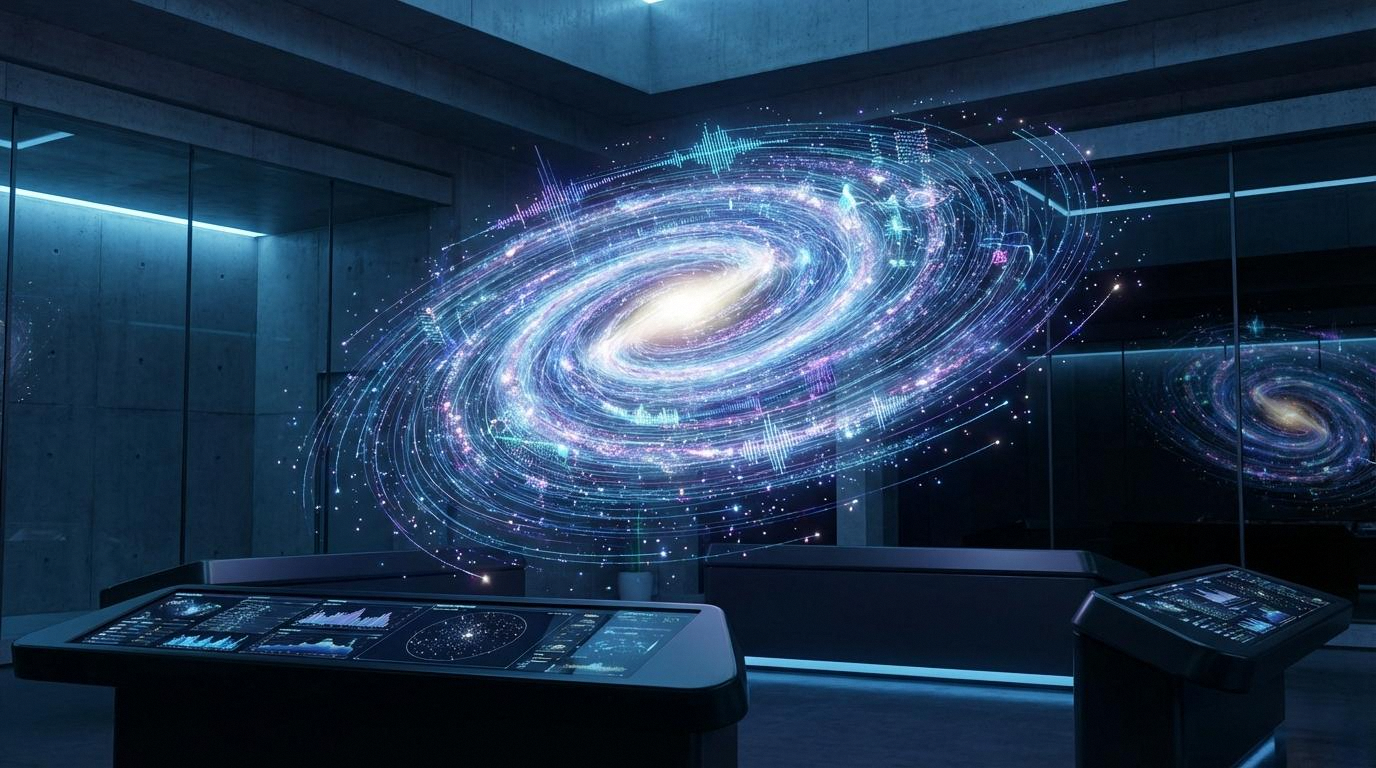
We are part of the vast Milky Way galaxy, yet just as it’s difficult to grasp the full shape of a forest while standing in its midst, we cannot directly see the complete form of our cosmic home. However, humanity found its first clue in the band of stars stretching across the night sky: the Milky Way. This post explores the incredible astronomical journey of how we, from within our galaxy, have managed to map its overall structure and shape.
From a River in the Sky to a Barred Spiral Galaxy: A Shift in Perspective
Since Galileo first discovered that the Milky Way was a collection of countless stars, our understanding of its appearance has steadily evolved. It has been a grand journey, from William Herschel’s early disc-shaped map of the galaxy to Harlow Shapley’s revolutionary discovery that our solar system is not at the galactic center. Critically, the advancement of radio and infrared telescope technology allowed us to peer through interstellar dust, confirming the existence of hidden spiral arms and a central bar structure, thus establishing the modern model of a “Barred Spiral Galaxy.”
The Journey of Discovery
- 17th Century, Galileo Galilei: Pointed a telescope to the sky for the first time and discovered that the Milky Way was not a cloud but a collection of innumerable stars.
- 18th Century, William Herschel: Created the first map of the galaxy by counting stars in different regions. He correctly identified its flat, disc-like shape but mistakenly placed the solar system at its center, unaware that interstellar dust was obscuring his view.
- Early 20th Century, Harlow Shapley: Studied the distribution of globular clusters (dense groups of hundreds of thousands of stars) and found they were centered around the direction of Sagittarius. This led to the revolutionary conclusion that the solar system is located in the outskirts of the galaxy, not the center.
- Mid-20th Century Onward: The development of radio telescopes enabled observation of the 21cm hydrogen line, radio waves emitted by hydrogen gas that can penetrate interstellar dust. This confirmed the existence of dense gas in spiral arms, solidifying the belief that our galaxy is a spiral one.
- 21st Century: Infrared observations from telescopes like the Spitzer Space Telescope clearly revealed a massive bar structure at the galaxy’s core, hidden by dust, completing our current “Barred Spiral Galaxy” model.
The Eyes of Modern Astronomy: Three Ways We ‘See’ Our Galaxy
Today, scientists use a combination of advanced technologies to draw a precise map of the Milky Way, which we cannot see directly.
1. Multi-wavelength Astronomy: Seeing Through the Dust
While visible light is easily blocked by interstellar dust, longer wavelengths like infrared and radio waves can penetrate it and travel farther. Scientists combine data from various observations—radio waves to map gas distribution, infrared to see star density, and X-rays to observe high-energy phenomena—to piece together the galaxy’s overall picture like a cosmic puzzle.
2. 3D Mapping: Charting the Addresses of Stars
The European Space Agency’s (ESA) Gaia satellite is measuring the precise positions, distances, and velocities of nearly two billion stars. This vast dataset is being used to create a detailed three-dimensional map of our galaxy. By tracing the movements of stars backward in time, we can even uncover the galaxy’s history.
3. External Galaxies: A Mirror to Ourselves
Another method involves observing external barred spiral galaxies similar to our own, such as the Andromeda Galaxy. By comparing their structures with data observed from within our galaxy, we can model and infer what the Milky Way would look like if viewed from the outside.
Unsolved Riddles: The Blank Spots on the Galactic Map
Although much has been revealed about our galaxy, several topics remain subjects of active debate among astronomers.
- Two Spiral Arms or Four? Observations of young, hot stars and gas distribution suggest four major spiral arms, but the overall density of older stars like our Sun more clearly shows only two dominant arms. This indicates the spiral structure of our galaxy is more complex than we thought.
- What is the True Mass of the Milky Way? The majority of our galaxy’s mass is composed of invisible dark matter, making its total mass extremely difficult to measure. Depending on the research method, results can vary wildly, with some studies suggesting our galaxy is much heavier than the neighboring Andromeda Galaxy, and others suggesting it is much lighter.
- The Cause of the Warped Disc: The disc of our galaxy is not perfectly flat like a record; its edges are warped up and down. The debate continues as to whether this warp is caused by the gravitational pull of neighboring satellite galaxies or by interactions with the dark matter halo surrounding our galaxy.
Future Telescopes Will Uncover the Galaxy’s Secrets
Next-generation observatories like the James Webb Space Telescope (JWST) are opening new frontiers in the study of our galaxy. Their powerful capabilities will provide a clearer view of the dust-shrouded galactic center and the spiral arms on the far side. In conclusion, we have drawn the map of our cosmic home by combining multi-wavelength observational data and reconstructing it in three dimensions. Future technologies are expected to complete this map, finally unveiling the ultimate secrets of the Milky Way’s birth and evolution.
숲 속에서 숲의 지도를 그리다: 서론
우리는 거대한 우리 은하의 일부이지만, 마치 숲 한가운데서 숲 전체의 모습을 알기 어려운 것처럼 그 완전한 형태를 직접 볼 수는 없습니다. 하지만 인류는 밤하늘에 길게 늘어선 별의 띠, 은하수에서 첫 번째 단서를 얻었습니다. 이 포스트에서는 우리가 은하 내부에 있으면서도 어떻게 은하의 전체적인 구조와 형태를 파악해왔는지, 그 놀라운 천문학적 탐사 과정을 알아봅니다.
하늘의 강에서 막대 나선 은하까지: 관점의 전환
과거 갈릴레오가 은하수가 무수한 별의 집합임을 처음 발견한 이래, 우리 은하의 모습에 대한 이해는 꾸준히 발전해왔습니다. 윌리엄 허셜의 초기 원반형 은하 지도부터, 할로 섀플리가 태양계가 은하 중심이 아님을 밝혀낸 혁명적인 발견에 이르기까지 위대한 여정이 있었습니다. 결정적으로 전파 및 적외선 망원경 기술이 성간 먼지를 투과해 숨겨진 나선팔과 중심부 막대 구조를 확인하면서, 오늘날의 ‘막대 나선 은하(Barred Spiral Galaxy)’ 모델이 정립되었습니다.
발견의 여정
- 17세기, 갈릴레오 갈릴레이: 처음으로 망원경을 하늘로 향해 은하수가 단순한 구름이 아닌 무수히 많은 별의 집합체임을 발견했습니다.
- 18세기, 윌리엄 허셜: 하늘의 각 구역에 있는 별의 수를 세어 최초의 은하 지도를 만들었습니다. 그는 우리 은하가 납작한 원반 모양임을 알아냈지만, 태양계를 은하의 중심에 두는 실수를 범했습니다. 당시에는 별들 사이의 가스와 먼지, 즉 성간 먼지가 시야를 가린다는 사실을 몰랐기 때문입니다.
- 20세기 초, 할로 섀플리: 구상성단(수십만 개의 별이 빽빽하게 모인 집단)의 분포를 연구하여, 이들이 궁수자리 방향을 중심으로 넓게 퍼져 있음을 발견했습니다. 이를 통해 태양계는 은하의 중심이 아니라 변두리에 위치한다는 혁명적인 사실을 밝혀냈습니다.
- 20세기 중반 이후: 전파 망원경 기술이 발전하면서, 성간 먼지를 뚫고 나아가는 **수소 가스의 전파(21cm 수소선)**를 관측할 수 있게 되었습니다. 이를 통해 과학자들은 가스가 밀집된 나선팔의 존재를 확인했고, 우리 은하가 나선 은하임을 확신하게 되었습니다.
- 21세기: 스피처 우주 망원경과 같은 적외선 관측을 통해, 먼지에 가려졌던 은하 중심부에 거대한 막대 구조가 존재한다는 사실이 명확해지면서 현재의 ‘막대 나선 은하’ 모델이 완성되었습니다.
현대 천문학의 눈: 우리 은하를 ‘보는’ 세 가지 방법
오늘날 과학자들은 직접 볼 수 없는 우리 은하의 지도를 정교하게 그리기 위해 여러 첨단 기술을 종합적으로 사용합니다.
1. 다파장 관측: 먼지 너머를 보는 눈
가시광선은 성간 먼지에 쉽게 막히지만, 파장이 긴 적외선이나 전파는 먼지를 뚫고 더 멀리 나아갑니다. 과학자들은 전파로 가스의 분포를, 적외선으로 별의 밀도를, X선으로 고에너지 현상을 관측한 데이터를 모두 합쳐 퍼즐을 맞추듯 은하의 전체 그림을 완성합니다.
2. 3D 매핑: 별들의 주소를 기록하다
유럽우주국(ESA)의 가이아 위성은 약 20억 개에 달하는 별들의 정확한 위치와 거리, 그리고 움직이는 속도를 측정하고 있습니다. 이 방대한 데이터를 통해 우리 은하의 정밀한 3차원 입체 지도를 만들고 있으며, 별들의 움직임을 역추적하여 은하의 역사까지도 알아내고 있습니다.
3. 외부 은하: 우리를 비추는 거울
우리와 비슷한 형태의 외부 막대 나선 은하들(예: 안드로메다 은하)을 관찰하고, 그 구조를 우리 은하 내부에서 관측한 데이터와 비교하여 “만약 우리 은하를 밖에서 본다면 저런 모습일 것이다”라고 추론하는 모델링 방식도 사용됩니다.
아직 풀리지 않은 수수께끼: 은하 지도의 빈칸들
우리 은하에 대해 많은 것이 밝혀졌지만, 여전히 천문학자들 사이에서 활발한 논쟁이 진행 중인 주제들이 남아있습니다.
- 나선팔은 두 개인가, 네 개인가? 젊고 뜨거운 별이나 가스 분포를 보면 4개의 주요 나선팔이 보이지만, 태양과 같이 나이 든 별들의 전체적인 밀도를 보면 2개의 주된 팔만 뚜렷하게 나타납니다. 이는 우리 은하의 나선팔 구조가 생각보다 복잡하다는 것을 의미합니다.
- 우리 은하의 진짜 질량은? 우리 은하의 질량 대부분은 눈에 보이지 않는 암흑물질이 차지하는데, 그 총량을 측정하는 것은 매우 어렵습니다. 연구 방법에 따라 우리 은하가 이웃 안드로메다 은하보다 훨씬 무겁다는 결과와 훨씬 가볍다는 결과가 동시에 나올 정도로 아직 불확실성이 큽니다.
- 휘어진 원반의 원인: 우리 은하의 원반은 레코드판처럼 평평하지 않고 가장자리가 위아래로 휘어져 있습니다. 이 휘어짐이 이웃 위성 은하의 중력 때문인지, 아니면 우리 은하를 둘러싼 암흑물질 헤일로와의 상호작용 때문인지에 대한 논쟁이 계속되고 있습니다.
미래의 망원경, 은하의 비밀을 풀다
제임스 웹 우주 망원경(JWST)과 같은 차세대 관측 장비들은 우리 은하 연구의 새로운 지평을 열고 있습니다. 이들의 강력한 성능은 먼지에 가려진 은하 중심부와 반대편 나선팔의 모습을 더욱 선명하게 보여줄 것입니다. 결론적으로, 우리는 다양한 관측 데이터를 종합하고 입체적으로 재구성하는 방식을 통해 우리 집의 지도를 그려왔으며, 미래의 기술은 이 지도를 완성하고 은하의 탄생과 진화에 대한 궁극적인 해답을 제시할 것으로 기대됩니다.
답글 남기기