
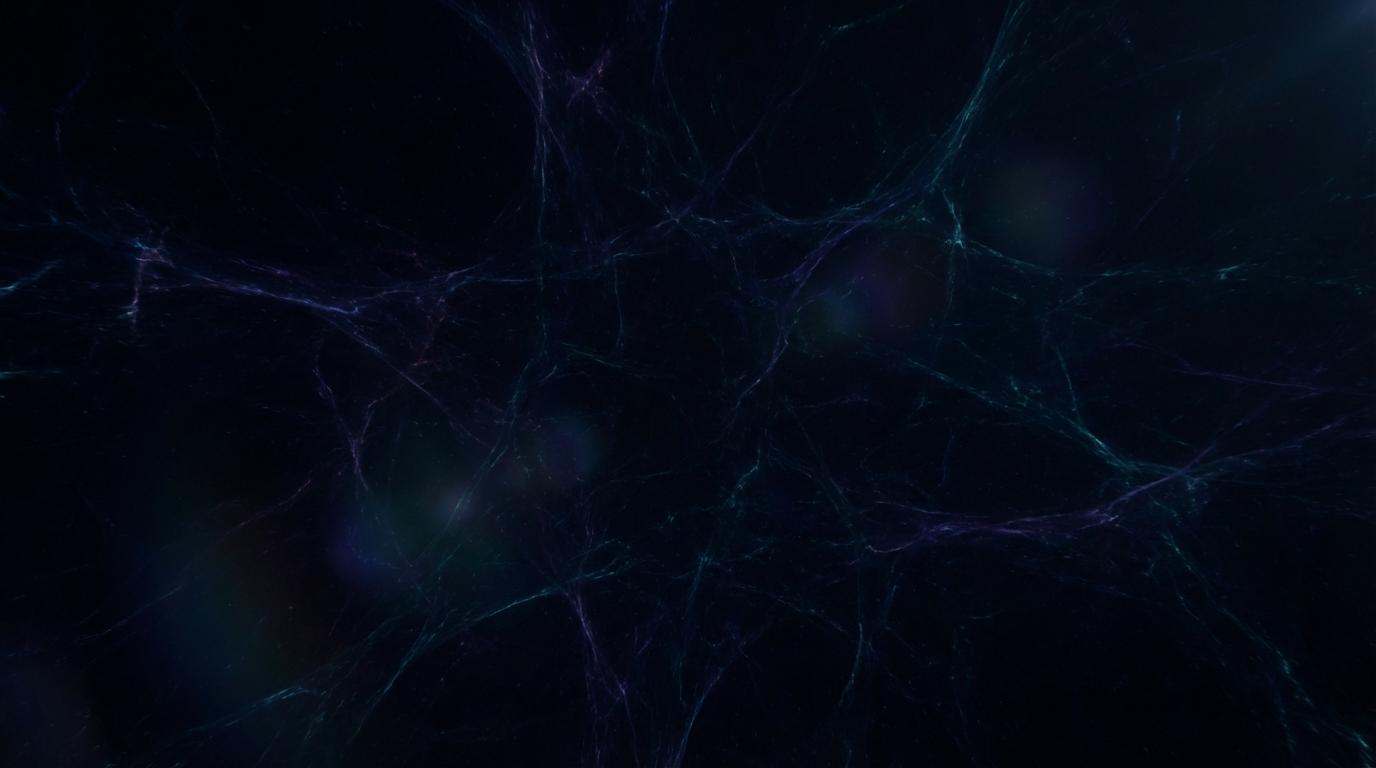
When we gaze up at the night sky, the vast darkness between the stars and galaxies seems to be just ‘nothingness.’ However, modern science has revealed that this seemingly empty space is, in fact, a dynamic stage holding the most profound secrets of the universe. What really fills the cosmic void, and what incredible events are unfolding within it?
From Aether to the Dark Universe: A Paradigm Shift
In the past, scientists believed that the universe was filled with a hypothetical substance called ‘Aether,’ a medium thought necessary for light waves to travel. This idea, however, was dismantled by the Michelson-Morley experiment in 1887 and Albert Einstein’s theory of special relativity.
The true turning point in modern cosmology came with the discovery of the Cosmic Microwave Background (CMB) in 1965. This faint glow, the afterglow of the Big Bang, provided definitive proof of the universe’s hot, dense origins. A detailed analysis of the CMB’s minute temperature fluctuations revealed a critical discrepancy: the visible matter and energy could not account for the observed structure and expansion of the universe. This led to the paradigm-shifting concepts of dark matter and dark energy.
The Standard Model and Its Cracks: ΛCDM
The most widely accepted model explaining our universe today is the ΛCDM (Lambda-Cold Dark Matter) model.
- Λ (Lambda): Represents dark energy, thought to be an intrinsic property of space itself. It acts as a repulsive force, counteracting gravity and causing the universe’s expansion to accelerate. It constitutes about 68% of the universe’s total energy density.
- CDM (Cold Dark Matter): Refers to dark matter composed of slow-moving (‘cold’) particles that do not interact with light. This accounts for about 27% of the universe’s mass. Its gravitational pull is the cosmic glue that holds galaxies and galaxy clusters together, forming the vast ‘Cosmic Web.’
The ordinary matter we can see and touch—stars, planets, and ourselves—makes up a mere 5% of the cosmos. The ΛCDM model has been incredibly successful in explaining a wide range of observations, but it faces a fundamental challenge: its two main components, dark matter and dark energy, have never been directly detected.
This has led to one of the biggest controversies in modern physics: the Hubble Tension. The rate of cosmic expansion (the Hubble constant) calculated from the early universe (via the CMB) significantly disagrees with the rate measured from observing nearby supernovae in the present-day universe. This tension suggests that there might be something missing or incorrect in our standard model, hinting at the need for new physics.
The Hunt for the Invisible and Future Prospects
To solve these cosmic mysteries, humanity is embarking on an unprecedented scientific quest.
- Direct Detection Experiments: Deep underground, shielded from cosmic rays, experiments are underway to catch the faintest signals of dark matter particles colliding with atomic nuclei. Korea’s Yemilab is at the forefront of this global effort.
- Next-Generation Telescopes: The European Space Agency’s Euclid Space Telescope and NASA’s Nancy Grace Roman Space Telescope are set to create the largest-ever 3D maps of the universe. By observing billions of galaxies, they will trace the influence of dark energy and dark matter on cosmic evolution with unparalleled precision, potentially providing clues to resolve the Hubble Tension.
Some scientists are also exploring alternative ideas, such as Modified Gravity theories, which propose that our understanding of gravity itself might be incomplete, thus explaining cosmic observations without the need for dark matter.
The void we once thought was empty is, in reality, filled with the most crucial elements that determine the fate of our universe. Uncovering the true nature of dark matter and dark energy is not just about cataloging cosmic ingredients; it is the key to understanding the origin, evolution, and ultimate future of everything. Humanity’s grand exploration into the invisible universe has only just begun.
우주의 빈 공간: 어둠은 과연 비어있는가?
밤하늘을 올려다볼 때, 별과 은하 사이의 광활한 어둠은 그저 ‘아무것도 없는’ 공간처럼 보입니다. 하지만 현대 과학은 이 텅 빈 공간이 실제로는 우주의 가장 심오한 비밀을 품고 있는 역동적인 무대임을 밝혀냈습니다. 우리가 생각하는 우주의 빈 공간은 무엇으로 채워져 있으며, 그 속에서는 어떤 놀라운 일들이 벌어지고 있을까요?
에테르에서 암흑 우주로: 패러다임의 전환
과거 과학자들은 우주가 ‘에테르(Aether)’라는 가상의 물질로 채워져 있다고 믿었습니다. 빛이 파동으로서 전달되기 위해 필요한 매질이 있을 것이라는 이 가설은 1887년 마이컬슨-몰리 실험과 아인슈타인의 특수 상대성 이론에 의해 폐기되었습니다.
현대 우주론의 진정한 전환점은 1965년 우주배경복사(CMB) 의 발견이었습니다. 빅뱅의 잔해인 이 희미한 빛은 우주가 뜨겁고 밀도 높은 한 점에서 시작되었다는 강력한 증거가 되었습니다. 우주배경복사의 미세한 온도 차이를 정밀 분석한 결과, 우리가 보는 물질과 에너지만으로는 현재 우주의 구조와 팽창을 설명할 수 없다는 결정적인 모순이 드러났습니다. 이는 암흑 물질과 암흑 에너지라는 새로운 패러다임을 열었습니다.
표준 모형의 균열: ΛCDM 모델
현재 우주를 설명하는 가장 표준적인 모델은 ΛCDM(람다-차가운 암흑 물질) 모형입니다.
- Λ (람다): 이는 암흑 에너지를 의미하며, 공간 자체에 내재된 에너지로 추정됩니다. 중력을 밀어내는 척력으로 작용하여 우주 팽창을 가속시키는 주된 원인이며, 우주 전체 에너지의 약 68%를 차지합니다.
- CDM (차가운 암흑 물질): 빛과 상호작용하지 않아 보이지 않는 암흑 물질이 빛보다 훨씬 느린(‘차가운’) 입자로 이루어져 있음을 의미합니다. 이는 우주 물질의 약 27%를 차지하며, 강력한 중력으로 은하와 은하단을 붙잡아 현재의 거미줄 같은 **우주 거대 구조(Cosmic Web)**를 형성하는 역할을 합니다.
우리가 보고 만질 수 있는 별, 행성 등 모든 일반 물질은 우주의 단 5%에 불과합니다. ΛCDM 모형은 수많은 관측 결과를 놀라울 정도로 정확하게 설명해왔지만, 핵심 요소인 암흑 물질과 암흑 에너지가 아직 직접적으로 검출되지 않았다는 근본적인 문제를 안고 있습니다.
이로 인해 현대 물리학의 가장 큰 난제 중 하나인 ‘허블 상수 불일치(Hubble Tension)’ 문제가 발생했습니다. 초기 우주의 흔적인 우주배경복사를 통해 계산한 우주의 팽창 속도와, 현재 가까운 우주의 천체를 관측해 측정한 팽창 속도가 오차 범위를 넘어 다르게 나타나는 것입니다. 이 불일치는 표준 모형에 우리가 모르는 새로운 물리학이 필요할 수 있음을 시사하는 강력한 증거입니다.
보이지 않는 존재를 향한 추적과 미래
인류는 이 거대한 우주적 수수께끼를 풀기 위해 전례 없는 도전을 이어가고 있습니다.
- 암흑 물질 탐지 실험: 대한민국의 예미랩(Yemilab) 을 비롯한 전 세계의 깊은 지하 실험실에서는 다른 모든 우주 신호를 차단한 채, 암흑 물질 입자가 원자핵과 충돌할 때 내는 극미세 신호를 포착하려는 노력을 계속하고 있습니다.
- 차세대 우주 망원경: 유럽우주국(ESA)의 유클리드 우주 망원경과 NASA의 낸시 그레이스 로먼 우주 망원경은 수십억 개의 은하를 관측하여 우주의 3D 지도를 만들 예정입니다. 이를 통해 암흑 에너지와 암흑 물질이 우주 진화에 미친 영향을 정밀하게 추적하고, 허블 상수 불일치 문제에 대한 결정적인 단서를 찾을 것으로 기대됩니다.
일부 과학자들은 암흑 물질 없이 중력 이론 자체를 수정하려는 수정 중력 이론과 같은 대안적 아이디어를 탐구하기도 합니다.
우리가 텅 비어 있다고 생각했던 우주의 공간은 사실 우주의 운명을 결정하는 가장 중요한 요소들로 가득 차 있습니다. 암흑 물질과 암흑 에너지의 정체를 밝히는 것은 단순히 우주의 구성 요소를 아는 것을 넘어, 우주의 시작과 진화, 그리고 궁극적인 미래를 이해하는 열쇠가 될 것입니다. 보이지 않는 우주를 향한 인류의 위대한 탐구는 이제 막 새로운 장을 열고 있습니다.
답글 남기기