
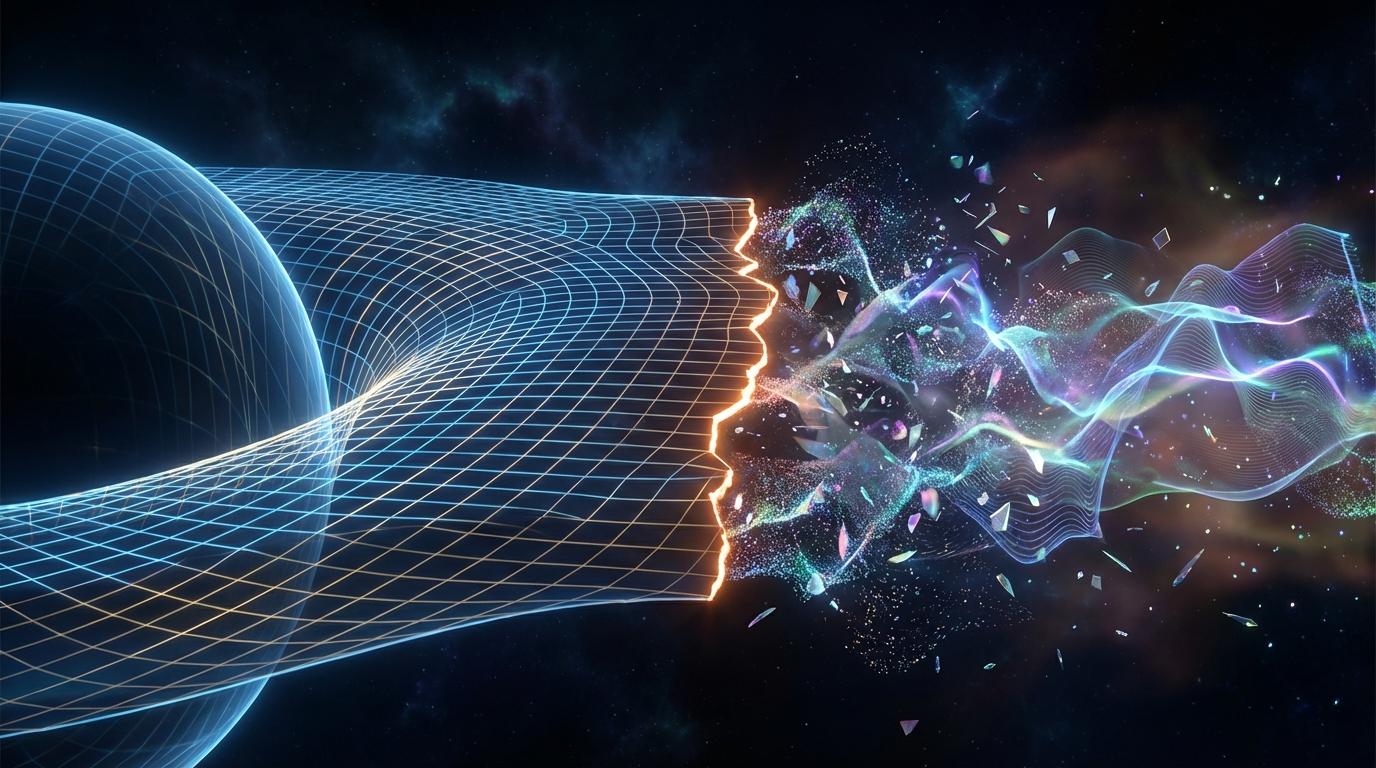
Modern physics stands on two colossal pillars. One is General Relativity, governing the vast cosmos of galaxies, stars, and black holes. The other is Quantum Mechanics, which describes the unseen microscopic world of atoms and electrons. In their respective domains, these two theories are hailed as the most successful in human history, backed by countless experimental verifications. Yet, when they are brought together to describe a single phenomenon, they reveal a profound, unresolved contradiction. Why is the “unification of quantum mechanics and general relativity”—the greatest challenge in modern physics—such a daunting task? Let’s delve into this question from a physics perspective.
Two Worlds, One Universe: The Fundamental Conflict
General Relativity, formulated by Albert Einstein in 1915, redefines gravity not as a force, but as the curvature of spacetime itself caused by mass and energy. In this view, planets orbit the sun because they are following the straightest possible path through the curved spacetime created by the sun’s mass. The world of relativity is macroscopic, continuous, and deterministic, where cause and effect are clearly linked.
Quantum Mechanics, established in the early 20th century by pioneers like Max Planck, Niels Bohr, and Werner Heisenberg, describes a completely different reality. In the quantum realm, physical quantities like energy exist in discrete, “quantized” packets. Particles do not have definite positions and momenta until measured (the Uncertainty Principle), and their behavior is fundamentally probabilistic. An electron is not in one place but exists as a cloud of probability, collapsing into a single state only upon observation.
The fundamental clash occurs when we try to describe environments that are simultaneously extremely massive and extremely small—namely, the singularity at the center of a black hole or the state of the universe at the moment of the Big Bang. These are realms where both theories must apply, yet their languages, principles, and mathematical frameworks are mutually incompatible.
A Fated Encounter: The Historical Context
For much of the 20th century, the two theories coexisted peacefully, as the scales they described were vastly different. Astronomers used relativity, and particle physicists used quantum mechanics, with little need for overlap.
However, as cosmology advanced, this separation became untenable. The Big Bang theory posits that our universe began from an infinitesimally small, yet infinitely dense point. To understand this primordial state, we need the laws of the micro-world (quantum mechanics) and a theory of gravity for extreme densities (general relativity). Similarly, the “singularity” inside a black hole, where matter is crushed to an infinitely small point, requires both theories for a complete description. To answer the most fundamental questions about our universe’s origins and the nature of reality, physicists realized the necessity of a unified theory: a theory of Quantum Gravity.
The Quest for Unification: Current Leading Approaches
The race to formulate a theory of quantum gravity is ongoing, with several competing ideas. The two most prominent candidates are String Theory and Loop Quantum Gravity.
String Theory
This theory proposes that the fundamental constituents of the universe are not point-like particles but one-dimensional, vibrating “strings” of energy. The different ways these strings vibrate produce all the different particles we observe, much like the different vibrations of a violin string produce different musical notes. Crucially, one specific vibrational mode of these strings corresponds perfectly to the properties of the “graviton,” the hypothetical quantum particle that mediates the force of gravity. This makes String Theory a compelling framework for naturally incorporating gravity into the quantum world. However, it comes with its own challenges: the theory requires the existence of extra spatial dimensions beyond our familiar three, and it has yet to produce predictions that can be experimentally tested.
Loop Quantum Gravity (LQG)
LQG takes a different route. Instead of starting with quantum mechanics and trying to fit gravity in, it starts with the core concept of general relativity—spacetime—and attempts to quantize it. In LQG, spacetime is not a smooth, continuous background. Instead, it is a fabric woven from discrete, indivisible “loops” or “atoms” of space at the smallest possible scale, known as the Planck length (approximately 10⁻³⁵ meters). By quantizing space and time themselves, LQG avoids the infinities that plague other approaches, particularly the problem of the singularity in black holes, as space cannot be compressed to a point smaller than these fundamental units.
The Core Obstacles: What Blocks Unification?
The difficulty in uniting these two theories stems from deep, fundamental incompatibilities.
Clashing Views on Spacetime
In General Relativity, spacetime is a smooth, dynamic stage on which the events of the universe unfold. It can bend and warp, but it is a continuous background. From a quantum mechanical perspective, however, if you zoom in to the Planck scale, spacetime should be a tumultuous, chaotic “quantum foam.” Here, the Uncertainty Principle would cause wild fluctuations in energy and geometry, with virtual particles and tiny black holes constantly popping in and out of existence. The stage of relativity becomes a chaotic actor in quantum mechanics, and the two descriptions cannot be reconciled.
The Problem of Renormalization
In Quantum Field Theory, which successfully describes the electromagnetic, weak, and strong nuclear forces, calculations of particle interactions often produce infinite values. Physicists developed a powerful mathematical technique called “renormalization” to skillfully subtract these infinities and arrive at finite, incredibly precise predictions that match experimental results. This technique, however, fails spectacularly when applied to gravity. When one tries to create a quantum theory of gravity using the same methods, the infinities that arise are of a “non-renormalizable” kind. They cannot be systematically removed, rendering the theory mathematically useless and incapable of making any predictions.
The Wall of Experimental Verification
Perhaps the most significant practical barrier is the lack of experimental data. The energy scale at which quantum gravity effects would become apparent—the Planck energy—is about a quadrillion times higher than what can be achieved by our most powerful particle accelerator, the Large Hadron Collider. Probing this realm directly would require an accelerator the size of our galaxy. Without the ability to test their hypotheses, theoretical physicists must rely on mathematical consistency and elegance, leading to a landscape of beautiful but unverified ideas.
Future Outlook: Completing the Unfinished Symphony
The quest for a “Theory of Everything” continues. While direct experiments are out of reach, scientists are pursuing indirect clues.
- Cosmological Observations: Precision measurements of the Cosmic Microwave Background (CMB), the afterglow of the Big Bang, or gravitational waves from merging black holes could hold faint imprints of quantum gravity effects from the early universe.
- Theoretical Breakthroughs: New ideas are constantly emerging. The Holographic Principle, for example, suggests a profound connection where a theory of gravity within a volume of space is equivalent to a quantum field theory on its boundary. This provides a novel mathematical toolkit for bridging the gap.
Ultimately, the failure to unify quantum mechanics and general relativity is not just a technical problem. It signifies that our understanding of the fundamental nature of time, space, and matter is still incomplete. The effort to compose this unfinished symphony is a grand intellectual journey that will continue to expand the horizons of science, whether it reaches its final note in our lifetime or not.
미완의 교향곡: 양자역학과 상대성이론은 왜 하나가 될 수 없는가?
현대 물리학은 두 개의 거대한 기둥 위에 서 있습니다. 하나는 은하, 별, 블랙홀과 같은 거시 세계를 지배하는 일반 상대성이론입니다. 다른 하나는 원자, 전자와 같은 눈에 보이지 않는 미시 세계를 설명하는 양자역학입니다. 각자의 영역에서 이 두 이론은 인류 역사상 가장 성공적인 이론으로 평가받으며, 수많은 실험을 통해 그 정확성이 증명되었습니다. 하지만 이 두 위대한 이론을 하나의 현상을 설명하기 위해 한자리에 모으면, 서로를 인정하지 않는 깊고 해결되지 않은 모순을 드러냅니다. 현대 물리학 최대의 난제인 ‘양자역학과 상대성이론의 통일’은 왜 이토록 어려운 과제일까요? 물리적 관점에서 그 이유를 깊이 파고들어 보겠습니다.
두 개의 세계, 하나의 우주: 근본적인 충돌
1915년 알베르트 아인슈타인이 정립한 일반 상대성이론은 중력을 힘이 아니라, 질량과 에너지에 의해 휘어진 시공간의 곡률 자체라고 재정의했습니다. 이 관점에서 행성들이 태양 주위를 도는 것은, 태양의 질량이 만들어낸 휘어진 시공간을 따라 가장 직선에 가까운 경로로 움직이기 때문입니다. 상대성이론의 세계는 거시적이고, 연속적이며, 인과관계가 명확한 결정론적 세계입니다.
반면, 20세기 초 막스 플랑크, 닐스 보어, 베르너 하이젠베르크와 같은 선구자들이 확립한 양자역학은 전혀 다른 현실을 묘사합니다. 양자 세계에서는 에너지 같은 물리량이 연속적인 값을 갖지 않고, 띄엄띄엄 떨어진 양자화된 묶음으로 존재합니다. 입자는 측정되기 전까지 명확한 위치와 운동량을 동시에 갖지 않으며(불확정성의 원리), 모든 것의 거동은 근본적으로 확률적입니다. 전자는 한 곳에 있는 것이 아니라 확률의 구름처럼 존재하다가, 관측이라는 행위를 통해 비로소 하나의 상태로 결정됩니다.
이 근본적인 충돌은 우리가 극도로 무거우면서 동시에 극도로 작은 환경, 즉 블랙홀 중심의 특이점이나 빅뱅 순간의 우주 상태를 설명하려고 할 때 발생합니다. 이 영역은 두 이론이 모두 적용되어야 하는 곳이지만, 그들의 언어, 원리, 수학적 체계는 서로 양립할 수 없습니다.
필연적 만남: 역사적 배경
20세기 대부분 동안 두 이론은 평화롭게 공존했습니다. 그들이 설명하는 세계의 규모가 워낙 달랐기 때문입니다. 천문학자들은 상대성이론을, 입자물리학자들은 양자역학을 사용하며 서로 겹칠 일이 거의 없었습니다.
그러나 우주론이 발전하면서 이 분리는 더 이상 유지될 수 없었습니다. 빅뱅 이론은 우리 우주가 무한히 작고 무한히 밀도가 높은 한 점에서 시작되었다고 말합니다. 이 태초의 상태를 이해하기 위해서는 미시 세계의 법칙(양자역학)과 초고밀도 환경의 중력 이론(상대성이론)이 모두 필요합니다. 마찬가지로, 블랙홀 내부에서 물질이 무한히 작은 점으로 붕괴하는 ‘특이점’ 역시 두 이론을 모두 동원해야 설명이 가능합니다. 우리 우주의 기원과 실체의 본질에 대한 가장 근본적인 질문에 답하기 위해, 물리학자들은 통합 이론, 즉 양자 중력 이론의 필요성을 절감하게 되었습니다.
통일을 향한 여정: 현재의 주요 접근법
양자 중력 이론을 완성하기 위한 경쟁은 지금도 계속되고 있으며, 여러 아이디어 중 가장 유력한 두 후보는 초끈 이론과 루프 양자 중력 이론입니다.
초끈 이론 (String Theory)
이 이론은 우주의 근본적인 구성 요소가 점과 같은 입자가 아니라, 진동하는 1차원의 에너지 ‘끈’이라고 제안합니다. 이 끈들이 어떻게 진동하는지에 따라 우리가 관찰하는 다양한 입자들이 나타난다는 것입니다. 마치 바이올린 줄의 다른 진동이 다른 음계를 만들어내는 것과 같습니다. 결정적으로, 이 끈의 특정 진동 모드는 중력을 매개하는 가상의 입자인 ‘중력자(graviton)’의 특성과 완벽하게 일치합니다. 이로 인해 초끈 이론은 중력을 양자 세계에 자연스럽게 포함하는 강력한 틀로 주목받았습니다. 하지만 이 이론은 우리가 아는 3차원 공간을 넘어선 추가적인 차원의 존재를 요구하며, 아직 실험적으로 검증할 예측을 내놓지 못했다는 한계를 가집니다.
루프 양자 중력 이론 (Loop Quantum Gravity)
루프 양자 중력 이론은 다른 길을 택합니다. 양자역학에 중력을 끼워 맞추는 대신, 일반 상대성이론의 핵심 개념인 ‘시공간’ 자체를 양자화하려고 시도합니다. 이 이론에 따르면 시공간은 매끄럽고 연속적인 배경이 아닙니다. 대신, 더 이상 쪼갤 수 없는 최소 단위인 플랑크 길이(약 10⁻³⁵ 미터) 크기의 불연속적인 ‘루프’ 또는 공간의 ‘원자’들이 엮여 만들어진 직물과 같습니다. 시공간 자체를 양자화함으로써, 루프 양자 중력 이론은 다른 접근법들을 괴롭히는 무한대의 문제를 피합니다. 특히 블랙홀 특이점 문제에서, 공간이 근본적인 단위보다 작게 압축될 수 없기 때문에 무한 밀도를 원천적으로 방지합니다.
핵심 장벽: 무엇이 통일을 가로막는가?
두 이론의 통일이 어려운 이유는 깊고 근본적인 비호환성에서 비롯됩니다.
시공간에 대한 관점 충돌
일반 상대성이론에서 시공간은 우주의 사건들이 펼쳐지는 부드럽고 역동적인 ‘무대’입니다. 휘어지고 출렁일 수는 있지만, 연속적인 배경으로 존재합니다. 하지만 양자역학적 관점에서 플랑크 규모로 확대해 보면, 시공간은 격렬하고 혼돈스러운 ‘양자 거품(quantum foam)’ 상태여야 합니다. 이 영역에서는 불확정성 원리로 인해 에너지와 기하학적 구조에 엄청난 요동이 발생하며, 가상 입자와 미니 블랙홀이 끊임없이 생겨났다 사라집니다. 상대성이론의 무대는 양자역학에서는 혼란스러운 배우가 되어버리고, 두 묘사는 서로 화해할 수 없습니다.
‘재규격화’라는 수학적 난관
전자기력, 약력, 강력 등 다른 기본 힘들를 성공적으로 설명하는 양자장론에서 입자들의 상호작용을 계산하면 종종 무한대의 값이 튀어나옵니다. 물리학자들은 ‘재규격화(renormalization)’라는 강력한 수학적 기법을 개발하여 이 무한대들을 능숙하게 제거하고, 실험 결과와 놀랍도록 정확하게 일치하는 유한한 예측값을 얻어냅니다. 하지만 이 기법은 중력에 적용하면 처참하게 실패합니다. 같은 방법으로 중력의 양자 이론을 만들려고 하면, 발생하는 무한대들은 ‘재규격화 불가능한’ 종류의 것입니다. 이들을 체계적으로 제거할 수 없어 이론은 수학적으로 의미를 잃고 아무런 예측도 할 수 없게 됩니다.
실험적 검증이라는 현실의 벽
아마도 가장 현실적인 장벽은 실험 데이터의 부재일 것입니다. 양자 중력 효과가 뚜렷하게 나타날 것으로 예상되는 에너지 영역, 즉 ‘플랑크 에너지’는 인류가 가진 가장 강력한 입자 가속기인 LHC(대형 강입자 충돌기)가 도달할 수 있는 수준보다 약 1000조 배나 높습니다. 이 영역을 직접 탐사하려면 우리 은하 크기의 가속기가 필요할 것입니다. 가설을 검증할 방법이 없기에, 이론물리학자들은 실험적 증거 대신 수학적 일관성과 아름다움에 의존할 수밖에 없으며, 이는 아름답지만 검증되지 않은 아이디어들의 경쟁으로 이어지고 있습니다.
미래 전망: 미완의 교향곡을 완성하기 위하여
‘모든 것의 이론’을 향한 여정은 계속됩니다. 직접적인 실험은 불가능에 가깝지만, 과학자들은 간접적인 단서를 찾고 있습니다.
- 우주 관측: 빅뱅의 잔해인 우주 마이크로파 배경(CMB)이나, 블랙홀이 충돌할 때 발생하는 중력파를 정밀하게 분석하면 초기 우주의 양자 중력 효과가 남긴 희미한 흔적을 발견할 수도 있습니다.
- 이론적 돌파구: 새로운 아이디어는 계속해서 등장하고 있습니다. 예를 들어, ‘홀로그래피 원리’는 특정 부피 안의 중력 이론이 그 경계면의 양자장론과 동일하다는 심오한 연결고리를 제안합니다. 이는 두 세계 사이의 간극을 메울 새로운 수학적 도구를 제공합니다.
결론적으로, 양자역학과 상대성이론의 미통일 문제는 단순히 기술적인 과제가 아닙니다. 이는 시간, 공간, 물질의 가장 근본적인 본질에 대한 우리의 이해가 아직 불완전하다는 것을 의미합니다. 이 미완의 교향곡을 완성하려는 인류의 지적 탐구는, 우리 세대에서 그 마지막 악장이 쓰이든 아니든, 과학의 지평을 넓히는 위대한 여정으로 계속될 것입니다.
답글 남기기