
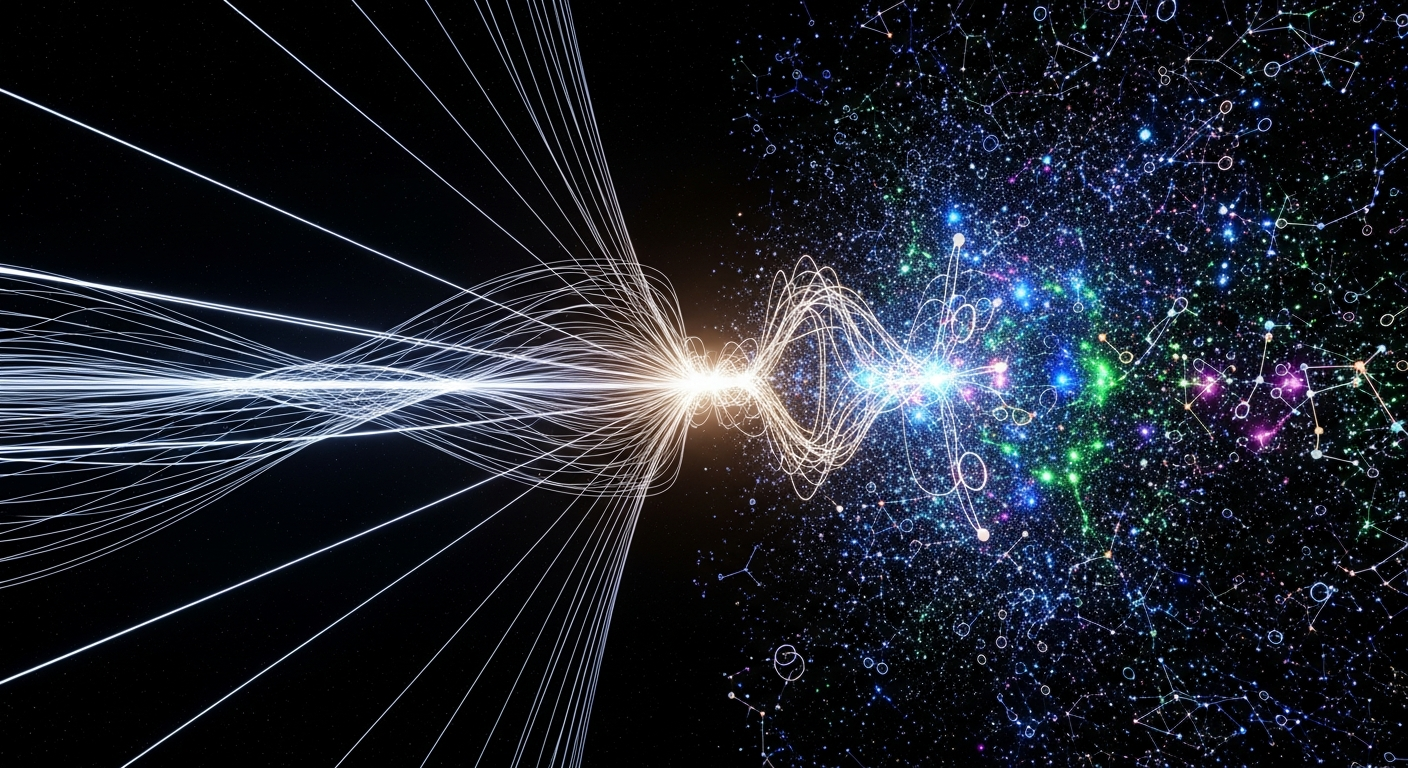
Quantum mechanics and the theory of relativity, the two great pillars of 20th-century physics, have achieved dazzling success in describing the micro and macro worlds, respectively. However, the attempt to unite these two theories into a single, perfect framework remains the greatest challenge facing modern physics. This article delves into the journey to find the single ultimate law governing the universe, exploring why the unification of these two theories is so difficult and what solutions are currently being sought.
Two Clashing Views of the Universe
At its core, the conflict stems from fundamentally different worldviews. Quantum mechanics describes a probabilistic microworld, while relativity describes a deterministic macro-spacetime.
The Fundamental Disagreement
The primary obstacle to unification lies in their contradictory descriptions of spacetime.
- General Relativity: Views spacetime as a continuous, flexible fabric. Gravity is the curvature of this four-dimensional spacetime caused by mass and energy. It is a dynamic background that is smoothly warped.
- Quantum Mechanics: Predicts that at the smallest scales (the Planck scale), spacetime itself should be quantized—composed of discrete, indivisible units. It treats time and space asymmetrically, with time as a parameter for evolution and space as the stage.
This fundamental clash—a smooth, continuous stage versus a choppy, pixelated one—is the heart of the problem.
A Brief History of the Quest
Early attempts, including Albert Einstein’s own “unified field theory,” aimed to merge gravity and electromagnetism but fell short of incorporating quantum principles. Over time, the quest evolved into the field of “Quantum Gravity,” leading to two dominant approaches:
- Superstring Theory: This theory posits that all fundamental particles and forces are merely different vibrations of minuscule, one-dimensional “strings.” It elegantly incorporates gravity but requires the existence of extra, unobserved dimensions.
- Loop Quantum Gravity (LQG): Instead of unifying particles, LQG focuses on quantizing spacetime itself. It describes spacetime as a network of interconnected loops, creating a granular structure at the Planck scale.
The Great Barriers to Unification
Despite decades of research, both leading theories face significant hurdles, prompting a growing consensus that a new paradigm may be necessary.
Key Challenges
- The Renormalization Problem: In quantum field theory, calculations for other forces can be “renormalized” to eliminate infinite values and yield sensible predictions. A straightforward application of these techniques to gravity fails, resulting in uncontrollable infinities. This suggests gravity is fundamentally different.
- The Black Hole Information Paradox: Quantum mechanics insists that information can never be truly lost. However, Stephen Hawking’s calculations showed that black holes evaporate over time, seemingly destroying the information of everything that fell into them. This direct contradiction is a critical issue any unified theory must resolve.
- Lack of Experimental Evidence: The effects of quantum gravity are predicted to manifest only at the unimaginably tiny “Planck scale” (about 10⁻³⁵ meters) and at extreme energies, far beyond the reach of any current or foreseeable particle accelerator. This makes direct experimental verification nearly impossible, leaving theories in the realm of mathematical elegance without physical proof.
Innovative Ideas Opening New Horizons
In recent years, several groundbreaking ideas have emerged, challenging the traditional frameworks and offering new paths forward.
Emerging Paradigms
- Quantum State on a Timeslice (QSOT): Proposed by a research team in South Korea, this theoretical framework treats the entire dynamics of a quantum system over time as a single, unified quantum state. By overcoming the traditional separation between a quantum “state” in space and a quantum “process” in time, it offers a unified mathematical language to describe spacetime, potentially providing new tools for quantum gravity research.
- Post-quantum Theory of Classical Gravity: Proposed by Jonathan Oppenheim at UCL, this hybrid theory suggests that spacetime is fundamentally classical (not quantized) but is subject to random and violent fluctuations. This approach could potentially link the two realms without fully quantizing gravity, though it predicts an inherent unpredictability in spacetime itself.
- ER = EPR (Emergence of Spacetime from Entanglement): This profound conjecture suggests that spacetime is not fundamental at all. Instead, it may be an “emergent” phenomenon arising from the intricate network of quantum entanglement between particles. In this view, the geometric connection between two points in space (a wormhole, “ER” bridge) is equivalent to the quantum connection between two entangled particles (“EPR” pair). This shifts the perspective from quantizing gravity to deriving it from a more fundamental quantum reality.
Towards the Next Chapter of the Unfinished Epic
The unification of quantum mechanics and relativity is the key to resolving the greatest mysteries of the cosmos: the singularity at the heart of a black hole, the true nature of the Big Bang, and the identities of dark matter and dark energy.
Although a long and arduous journey lies ahead, the future is promising. In the absence of direct experiments, indirect verification through precise observations of gravitational waves or the cosmic microwave background will play a crucial role. Furthermore, the advancement of quantum computing will enable simulations of complex quantum gravity models that are impossible today. This grand scientific quest, while challenging, holds the potential to fundamentally transform humanity’s understanding of the universe and our place within it.
양자역학과 상대성이론: 우주의 궁극 법칙을 향한 미완의 대서사시
20세기 물리학의 양대 산맥인 양자역학과 상대성이론은 각각 미시와 거시 세계를 설명하며 눈부신 성공을 거두었습니다. 하지만 이 두 이론을 하나의 완벽한 틀로 묶으려는 시도는 현대 물리학이 마주한 가장 거대한 난제로 남아있습니다. 이 글에서는 우주를 지배하는 단 하나의 궁극적인 법칙을 찾기 위한 여정, 즉 두 이론의 통합이 왜 어려운지, 그리고 현재 어떤 해결책들이 모색되고 있는지 심층적으로 탐구하고자 합니다.
충돌하는 두 개의 우주관
근본적으로 두 이론은 서로 다른 세계관에서 출발합니다. 양자역학은 확률적인 미시 세계를, 상대성이론은 결정론적인 거시 시공간을 설명합니다.
근본적인 불일치
통합의 가장 핵심적인 난제는 바로 시공간을 설명하는 방식의 충돌입니다.
- 일반 상대성이론: 시공간을 연속적이고 유연한 하나의 ‘실체’로 봅니다. 중력이란 질량과 에너지에 의해 이 4차원 시공간이 부드럽게 휘어지는 현상 그 자체입니다.
- 양자역학: 가장 작은 단위인 플랑크 스케일로 내려가면, 시공간 역시 불연속적인 최소 단위(양자)로 쪼개져야 한다고 예측합니다. 또한 시간과 공간을 비대칭적으로 다루며, 시간은 변화의 과정으로, 공간은 양자 상태의 무대로 취급합니다.
이처럼 매끄럽고 연속적인 무대(상대성이론)와 픽셀처럼 쪼개진 불연속적인 무대(양자역학)라는 근본적인 관점의 차이가 문제의 핵심입니다.
통합을 향한 여정의 역사
알베르트 아인슈타인 자신의 ‘통일장 이론’을 비롯한 초기 시도들은 중력과 전자기력을 합치려 했으나 양자역학을 담아내지는 못했습니다. 시간이 흐르면서 이 과제는 ‘양자 중력(Quantum Gravity)’이라는 이름 아래 두 가지 주요한 흐름으로 발전했습니다.
- 초끈 이론(Superstring Theory): 모든 기본 입자와 힘이 사실은 아주 작은 1차원 ‘끈’의 서로 다른 진동 상태라고 설명합니다. 우아하게 중력을 포함시키지만, 우리가 인지하지 못하는 여분의 차원이 존재해야 한다는 난제를 안고 있습니다.
- 루프 양자 중력(Loop Quantum Gravity, LQG): 입자 통합 대신 시공간 자체를 양자화하는 데 집중합니다. 시공간이 서로 연결된 고리(loop)들의 네트워크로 이루어져 있으며, 플랑크 스케일에서 불연속적인 알갱이 구조를 갖는다고 봅니다.
통합을 가로막는 거대한 장벽들
수십 년의 연구에도 불구하고 두 주류 이론 모두 결정적인 성과를 내지 못하면서, 기존의 패러다임을 넘어서는 새로운 돌파구가 필요하다는 인식이 확산되고 있습니다.
핵심 난제들
- 중력의 재규격화 문제: 다른 힘들은 양자장론 계산 과정에서 발생하는 무한대를 ‘재규격화’라는 수학적 기법으로 제거하여 유의미한 예측값을 얻을 수 있습니다. 하지만 중력에 이 기법을 적용하면 무한대가 제어 불가능하게 발산해 버립니다. 이는 중력이 다른 힘들과 근본적으로 다를 수 있음을 시사합니다.
- 블랙홀 정보 역설: 양자역학의 대원칙 중 하나는 ‘정보는 절대 사라지지 않는다’는 것입니다. 하지만 스티븐 호킹의 계산에 따르면 블랙홀은 시간이 지나면 증발하여 사라지는데, 이때 블랙홀에 들어간 모든 정보가 함께 소멸되는 것처럼 보입니다. 이 정면충돌은 통합 이론이 반드시 해결해야 할 핵심 과제입니다.
- 실험적 검증의 부재: 양자 중력 효과는 상상조차 힘든 극미의 영역(‘플랑크 스케일’, 약 10⁻³⁵m)과 초고에너지 상태에서만 나타날 것으로 예측됩니다. 이는 현존하는 혹은 가까운 미래의 입자 가속기로는 직접 검증이 거의 불가능하다는 의미이며, 이론들이 물리적 증거 없이 수학적 정합성에만 의존하게 만듭니다.
새로운 지평을 여는 혁신적 아이디어
최근에는 기존의 틀을 벗어난 혁신적인 아이디어들이 제시되며 새로운 돌파구를 모색하고 있습니다.
떠오르는 패러다임
- 시간 위의 다자 양자상태(QSOT): 국내 연구진이 제안한 이론적 틀로, 시간에 따라 변화하는 양자역학적 과정 전체를 하나의 통일된 ‘양자상태’로 기술합니다. 공간상의 양자 ‘상태’와 시간상의 양자 ‘과정’을 분리하던 기존의 방식을 극복하고 시공간을 통일된 수학적 언어로 다룰 가능성을 열어 양자 중력 연구에 새로운 도구를 제공할 수 있습니다.
- 고전 중력의 후기 양자 이론: UCL의 조나단 오펜하임 교수가 제안한 하이브리드 이론으로, 시공간 자체는 양자화되지 않은 고전적인 상태를 유지하지만 예측 불가능한 무작위적 요동을 겪는다고 봅니다. 이는 중력을 완전히 양자화하지 않고도 두 세계를 연결하려는 시도이지만, 시공간 자체에 내재적 예측 불가능성이 있다는 파격적인 내용을 담고 있습니다.
- ER = EPR (양자 얽힘으로부터의 시공간 창발): 시공간이 우주의 근본적인 실체가 아닐 수 있다는 심오한 가설입니다. 오히려 시공간은 입자들 사이의 ‘양자 얽힘’이라는 관계망으로부터 ‘창발(emergent)’한 현상일 수 있다는 것입니다. 이 관점에 따르면, 공간을 가로지르는 기하학적 연결(웜홀, ER 브릿지)과 두 입자 사이의 양자역학적 연결(얽힘, EPR 쌍)이 본질적으로 같다는 것입니다. 이는 중력을 양자화하는 문제에서, 더 근본적인 양자 현실로부터 중력을 유도해내는 문제로 관점을 전환시킵니다.
미완의 서사시, 그 다음 장을 향하여
양자역학과 상대성이론의 통합은 블랙홀 중심의 특이점, 빅뱅의 순간, 그리고 암흑 물질과 암흑 에너지의 정체 등 우주의 가장 근본적인 미스터리를 해결할 열쇠입니다.
비록 길고 험난한 여정이겠지만 미래는 희망적입니다. 직접 실험 대신 중력파나 우주 배경 복사에 대한 정밀 관측을 통한 간접 검증이 중요한 역할을 할 것입니다. 또한, 양자 컴퓨터의 발전은 오늘날 불가능한 복잡한 양자 중력 모델의 시뮬레이션을 가능하게 할 것입니다. 이 위대한 과학적 탐구는 비록 어렵지만, 인류의 우주관과 그 안에서의 우리 존재를 근본적으로 바꿀 잠재력을 지니고 있습니다.
답글 남기기