
밤하늘에 떠 있는 영원한 동반자, 달. 인류는 수천 년 동안 달을 보며 신화를 만들고, 시를 썼으며, 과학적 탐구의 대상으로 삼아왔습니다. 이토록 우리에게 친숙한 달이 과연 어떻게 만들어졌을까요? 이 오랜 질문에 답하기 위해 과학계는 수많은 가설을 내놓고 검증해왔습니다. 그리고 지금, 가장 유력한 시나리오는 태양계 초기의 대혼돈 속에서 벌어진 한 편의 극적인 드라마, 바로 ‘거대충돌 가설(Giant-Impact Hypothesis)’입니다. 이 글은 달이 단순한 위성을 넘어 지구의 역사를 품고 있는 거대한 증거임을 밝히는 기원 탐사의 여정입니다.
달의 기원, 상상에서 과학으로
달의 기원을 설명하려는 시도는 과학의 역사와 궤를 같이합니다. 19세기, 찰스 다윈의 아들 조지 다윈은 빠르게 자전하던 원시 지구에서 일부가 떨어져 나가 달이 되었다는 ‘분열 가설’을 제안했습니다. 태평양이 그 흔적이라는 낭만적인 상상력이 더해졌죠. 이후 다른 곳에서 만들어진 달이 우연히 지구 중력에 붙잡혔다는 ‘포획 가설’, 지구와 달이 같은 먼지 구름 속에서 함께 태어난 쌍둥이라는 ‘동시 형성 가설’ 등이 등장했습니다.
하지만 이 가설들은 결정적인 증거 앞에서 힘을 잃기 시작했습니다. 바로 인류가 달에 직접 가져온 ‘월석’이었습니다. 1970년대 아폴로 임무를 통해 가져온 월석을 분석한 결과, 달과 지구 맨틀의 산소 동위원소 비율이 놀라울 정도로 일치한다는 사실이 밝혀졌습니다. 이는 달과 지구가 같은 물질에서 기원했음을 시사하는 강력한 증거였고, 기존 가설들로는 설명하기 어려운 문제였습니다. 이로써 달의 기원 논쟁은 새로운 국면을 맞이했고, 마침내 거대충돌 가설이 무대의 중심으로 떠오르게 됩니다.
운명의 충돌: 행성 ‘테이아’와 원시 지구
현재 과학계의 정설로 받아들여지는 거대충돌 가설은 한 편의 SF 영화와도 같습니다. 그 내용은 다음과 같습니다.
45억 년 전의 그날
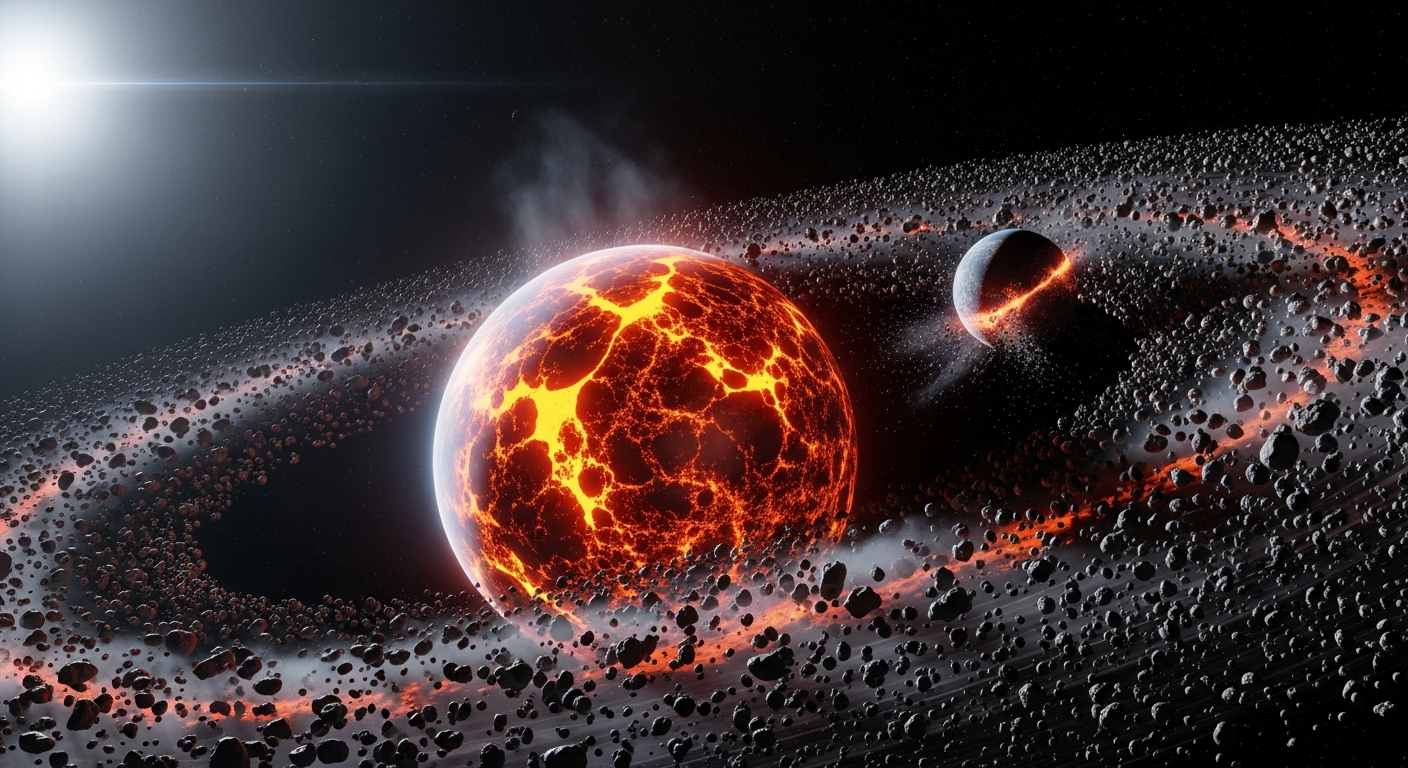
태양계가 막 형성되던 혼란기, 지금의 화성만 한 크기의 원시 행성 ‘테이아(Theia)’가 궤도를 이탈해 젊은 지구와 비스듬히 충돌했습니다. 이 거대한 충격으로 테이아는 산산조각 났고, 지구의 맨틀 상당 부분도 우주 공간으로 뿜어져 나갔습니다. 이 파편들은 지구 주위에 거대한 고리를 형성했고, 수백만 년에 걸쳐 서로 뭉쳐져 마침내 지금의 달을 만들었습니다. 최근의 고해상도 시뮬레이션은 이 과정이 단 몇 시간 만에 이루어졌을 가능성까지 제시하며 학계를 놀라게 했습니다.
가설을 뒷받침하는 증거들
거대충돌 가설은 여러 관측 사실을 명쾌하게 설명합니다.
- 산소 동위원소의 일치: 월석과 지구 맨틀의 산소 동위원소 비율이 거의 같다는 사실은 두 천체가 하나의 충돌 사건에서 비롯되었음을 암시합니다.
- 달의 작은 철 핵: 달은 지구에 비해 밀도가 낮고 철(Fe)로 이루어진 중심핵이 매우 작습니다. 이는 충돌 시 무거운 테이아의 핵은 지구에 흡수되고, 상대적으로 가벼운 두 행성의 맨틀 물질이 주성분이 되어 달을 형성했기 때문으로 설명됩니다.
- 휘발성 물질의 부재: 충돌 당시의 엄청난 열로 인해 물과 같은 휘발성 물질들이 대부분 증발해버렸고, 이로 인해 달이 극도로 건조한 상태가 되었다는 점도 가설과 일치합니다.
- 지구-달 시스템의 각운동량: 이 거대한 비스듬한 충돌은 현재 지구의 자전축이 기울어져 있고, 달이 지구로부터 서서히 멀어지는 이유인 지구-달 시스템의 높은 각운동량을 자연스럽게 설명해 줍니다.
완벽한 이론은 없다: 남겨진 미스터리
거대충돌 가설은 가장 설득력 있는 이론이지만, 여전히 해결해야 할 난제들을 안고 있습니다. 이는 달의 탄생이 아직 완성되지 않은, 현재진행형 탐구 과제임을 보여줍니다.
가장 큰 미스터리는 ‘너무나도 똑같은’ 동위원소 비율입니다. 시뮬레이션에 따르면 달은 충돌체인 테이아의 물질이 약 60~80%를 차지해야 합니다. 그렇다면 테이아의 동위원소 구성이 지구와 우연히 똑같지 않은 이상, 달의 동위원소는 지구와 달라야 합니다. 하지만 현실은 거의 구별이 불가능할 정도로 같습니다. 이를 설명하기 위해 ‘충돌 후 두 행성의 물질이 완전히 뒤섞여 증발했다’거나 ‘테이아 자체가 지구와 같은 물질로 만들어졌다’는 등의 추가 가설이 제시되지만, 명확한 해답은 아직 없습니다.
또한, 충돌체 테이아의 흔적은 어디에 있는지도 의문입니다. 최근 지구 맨틀 깊숙한 곳에서 발견된 거대한 암석층(LLSVP)이 테이아의 잔해일 수 있다는 흥미로운 주장이 제기되었지만, 아직은 가설 단계에 머물러 있습니다.
미래의 탐사, 마지막 퍼즐을 향하여
달의 비밀을 풀기 위한 인류의 도전은 계속됩니다. 과학자들은 슈퍼컴퓨터를 이용해 더욱 정교한 충돌 시뮬레이션을 수행하며 다양한 가능성을 탐색하고 있습니다. 동시에 새로운 달 탐사 임무들이 결정적인 단서를 제공할 것으로 기대를 모으고 있습니다.
미국의 아르테미스 계획은 인류를 다시 달로 보내 기존에 탐사하지 않았던 극지방의 심부 암석을 채취할 예정입니다. 중국의 창어 계획과 한국의 다누리호 역시 달의 지질과 자원을 정밀 분석하며 달의 역사를 재구성하는 데 기여하고 있습니다. 이러한 미래의 탐사들이 가져올 새로운 월석 샘플과 데이터는 거대충돌 가설의 마지막 퍼즐 조각을 맞추는 열쇠가 될 것입니다.
달의 기원을 밝히는 것은 단순히 위성의 과거를 아는 것을 넘어섭니다. 그것은 곧 지구의 초기 역사와 생명이 탄생할 수 있었던 독특한 환경의 비밀을 푸는 과정이며, 나아가 태양계 형성의 거대한 그림을 이해하는 중요한 단초가 될 것입니다. 오늘 밤, 달을 보며 45억 년 전의 거대한 충돌과 그 속에서 태어난 우리의 영원한 동반자를 떠올려보는 것은 어떨까요?
The Birth of the Moon: A Celestial Companion Forged by a Giant Impact
The Moon, our eternal companion in the night sky. For millennia, humanity has looked upon it, creating myths, writing poetry, and making it an object of scientific inquiry. How was this familiar celestial body actually formed? To answer this age-old question, the scientific community has proposed and tested numerous hypotheses. Today, the most compelling scenario is a dramatic saga from the chaos of the early solar system: the “Giant-Impact Hypothesis.” This post is a journey to explore the Moon’s origin, revealing it as not just a satellite, but as a monumental piece of evidence holding the history of Earth itself.
From Imagination to Science: The Origin of the Moon
Attempts to explain the Moon’s origin have evolved alongside the history of science. In the 19th century, George Darwin, son of Charles Darwin, proposed the “Fission Hypothesis,” suggesting that a piece of the rapidly spinning primordial Earth broke off to become the Moon. This idea was romantically linked to the Pacific Ocean basin being the scar left behind. Later, other theories emerged, such as the “Capture Hypothesis,” which posited that a fully formed Moon was captured by Earth’s gravity, and the “Co-formation Hypothesis,” which suggested they were twins born together from the same cloud of dust and gas.
However, these hypotheses began to crumble in the face of decisive evidence: moon rocks brought back to Earth. Analysis of lunar samples collected during the Apollo missions in the 1970s revealed a startling fact: the oxygen isotope ratios of the Moon and the Earth’s mantle were remarkably identical. This was powerful evidence that the Moon and Earth originated from the same material, a fact that was difficult to explain with the existing theories. The debate over the Moon’s origin entered a new phase, and the Giant-Impact Hypothesis finally took center stage.
A Fateful Collision: The Planet ‘Theia’ and Proto-Earth
The Giant-Impact Hypothesis, now the standard model in the scientific community, reads like a science fiction movie. The scenario is as follows:
That Day, 4.5 Billion Years Ago
During the chaotic formation of the solar system, a Mars-sized protoplanet named “Theia” strayed from its orbit and collided with the young Earth at an oblique angle. This colossal impact shattered Theia and ejected a significant portion of Earth’s mantle into space. This debris formed a massive ring around the Earth, and over millions of years, it gradually coalesced to form the Moon we see today. More recently, high-resolution simulations have astonished the scientific community by suggesting this entire process could have occurred in a matter of hours.
The Evidence Supporting the Hypothesis
The Giant-Impact Hypothesis elegantly explains several key observations:
- Identical Oxygen Isotopes: The near-identical oxygen isotope ratios in lunar rocks and Earth’s mantle strongly suggest that the two bodies originated from a single, massive collision event.
- The Moon’s Small Iron Core: The Moon has a lower density than Earth and a very small iron core. This is explained by Theia’s heavy core merging with Earth’s upon impact, while the Moon formed primarily from the lighter mantle materials of both bodies.
- Lack of Volatile Materials: The immense heat from the impact would have vaporized volatile substances like water, which explains why the Moon is extremely dry.
- The Earth-Moon System’s Angular Momentum: The massive, off-center collision naturally accounts for the high angular momentum of the Earth-Moon system, which is responsible for Earth’s axial tilt and the Moon’s gradual recession from our planet.
No Theory is Perfect: The Lingering Mysteries
While the Giant-Impact Hypothesis is the most compelling theory, it still faces several unresolved challenges. This shows that the story of the Moon’s birth is not yet complete but is an ongoing scientific investigation.
The biggest mystery is the “too-perfect” isotopic similarity. Simulations suggest that the Moon should be composed of about 60-80% material from the impactor, Theia. Unless Theia coincidentally had the exact same isotopic composition as Earth, the Moon’s isotopes should be different. Yet, they are nearly indistinguishable. To explain this, additional hypotheses have been proposed, such as ‘the material from both planets completely mixed and vaporized after the impact’ or ‘Theia itself was made of the same material as Earth,’ but a definitive answer remains elusive.
Furthermore, the question of where the remnants of Theia are is still open. An intriguing recent proposal suggests that two large, deep structures in Earth’s mantle (LLSVPs) could be the remains of Theia, but this is still a developing hypothesis.
Future Exploration: Towards the Final Puzzle Piece
Humanity’s quest to unlock the Moon’s secrets continues. Scientists are using supercomputers to run increasingly sophisticated impact simulations to explore various possibilities. At the same time, new lunar exploration missions are expected to provide crucial clues.
NASA’s Artemis Program aims to return humans to the Moon, collecting deep rock samples from previously unexplored polar regions. China’s Chang’e Program and South Korea’s Danuri orbiter are also contributing by performing detailed analyses of lunar geology and resources, helping to reconstruct the Moon’s history. The new lunar samples and data from these future missions will be key to fitting the final pieces into the puzzle of the Giant-Impact Hypothesis.
Unraveling the origin of the Moon is more than just learning about a satellite’s past. It is a process of unlocking the secrets of Earth’s early history, the unique environment that allowed life to emerge, and ultimately, a crucial clue to understanding the grand picture of solar system formation. Tonight, as you look at the Moon, why not imagine the colossal impact of 4.5 billion years ago and the eternal companion that was born from it?
답글 남기기