
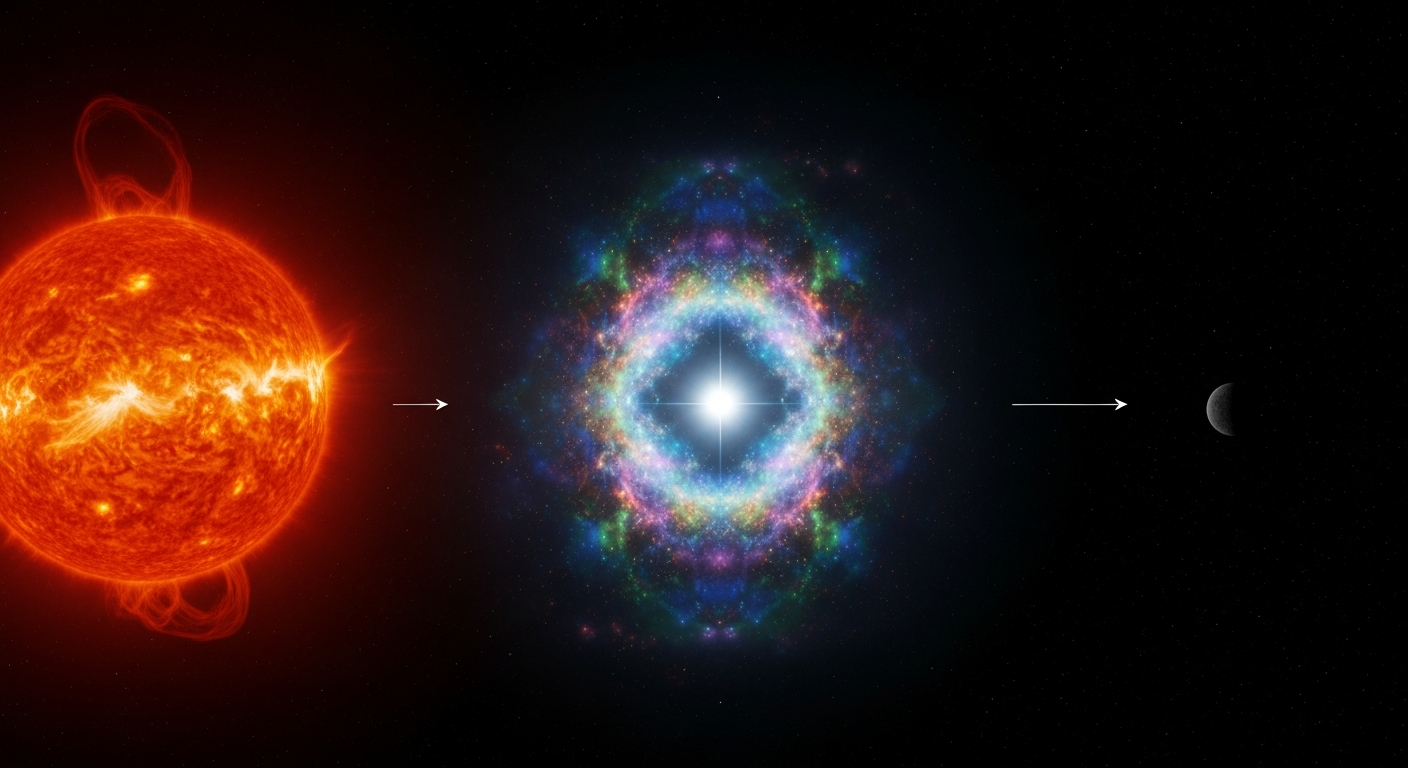
밤하늘을 수놓은 별들은 영원히 빛나는 듯 보이지만, 사실은 태어나고 소멸하는 장대한 드라마를 겪고 있습니다. 그들의 삶은 수십억 년에 걸쳐 펼쳐지며, 그 마지막은 우주의 가장 깊은 비밀을 품고 있습니다. 태양과 같은 별이 마지막을 향해 거대하게 부풀어 오르는 ‘적색거성’ 단계부터, 모든 빛을 잃고 남은 차가운 잔해인 ‘백색왜성’을 거쳐, 마침내 우주의 종말과 함께 등장할 이론 속 천체, ‘흑색왜성’으로 변해가는 장대한 여정을 따라가 봅니다. 이는 단순히 한 별의 일생이 아닌, 우리 태양계의 미래와 우주 전체의 운명에 대한 서사입니다.
별의 황혼기, 적색거성 (Red Giant)
모든 별은 중심부에서 수소를 헬륨으로 바꾸는 핵융합 반응을 통해 빛과 열을 냅니다. 우리 태양도 현재 이 ‘주계열성’ 단계에 있습니다. 하지만 중심부의 수소 연료가 고갈되면, 별의 운명은 극적인 전환을 맞이합니다. 핵융합이 멈춘 중심핵은 자체 중력으로 수축하며 엄청난 열과 압력을 발생시키고, 이 에너지는 중심핵 바깥층의 수소를 점화시켜 ‘껍질 핵융합’을 일으킵니다.
이 폭발적인 에너지 방출은 별의 외부 대기층을 수백 배 이상 팽창시킵니다. 별의 표면은 중심에서 멀어지면서 온도가 낮아져 붉은빛을 띠게 되는데, 이 거대하고 붉은 별이 바로 ‘적색거성’입니다. 이는 별의 노화가 시작되었음을 알리는 명백한 신호입니다.
태양계의 미래
약 50억 년 후, 우리 태양 역시 적색거성으로 변할 것입니다. 팽창하는 태양은 수성과 금성을 삼키고, 지구의 궤도까지 위협할 것입니다. 설령 지구가 삼켜지지 않더라도, 끓어오르는 태양의 열기는 지구의 바다를 모두 증발시키고 대기를 날려버려 생명체가 살 수 없는 불모지로 만들 것입니다. 하지만 이 파괴의 과정 속에서 적색거성이 방출하는 물질들은 우주 공간으로 퍼져나가 다음 세대의 별과 행성을 만드는 재료가 되어, 우주의 물질 순환에 기여하는 중요한 역할을 합니다.
식어가는 별의 핵, 백색왜성 (White Dwarf)
적색거성 단계의 막바지에 이른 별은 팽창했던 외부 가스층을 우주 공간으로 방출하며 ‘행성상 성운’이라는 아름다운 천체를 만들어냅니다. 그리고 그 중심에는 모든 것을 태우고 남은 뜨겁고 밀도 높은 핵, ‘백색왜성’이 모습을 드러냅니다.
백색왜성은 더 이상 핵융합을 통해 에너지를 생성하지 못하는 별의 시체입니다. 하지만 그 밀도는 상상을 초월합니다. 지구만 한 크기에 태양 질량의 절반이 응축되어 있어, 찻숟가락 하나만큼의 질량이 수 톤에 달합니다. 이 엄청난 중력 붕괴를 막는 힘은 ‘전자 축퇴압’이라는 양자역학적 원리에서 비롯됩니다.
백색왜성의 두 갈래 운명
홀로 남겨진 백색왜성은 수백억, 수천억 년에 걸쳐 남은 열을 서서히 방출하며 식어갑니다. 최근 연구에 따르면, 식어가는 과정에서 내부의 탄소와 산소 핵이 결정화되어 거대한 다이아몬드와 같은 구조를 이룰 것으로 추정됩니다.
하지만 쌍성계에 속한 백색왜성은 전혀 다른, 훨씬 극적인 최후를 맞이할 수 있습니다. 만약 동반성으로부터 물질을 계속해서 빨아들여 그 질량이 태양의 약 1.44배, 즉 ‘찬드라세카르 한계’를 넘어서게 되면, 전자 축퇴압이 더는 중력을 이기지 못하고 폭주하는 핵융합과 함께 우주적인 규모의 폭발을 일으킵니다. 이를 ‘Ia형 초신성’이라 부르며, 이 폭발의 밝기는 항상 일정하여 우주의 거리를 측정하는 ‘표준 촛대’로 사용되는 중요한 천문학적 도구이기도 합니다.
이론 속의 유령, 흑색왜성 (Black Dwarf)
백색왜성이 수백조 년이라는 상상조차 어려운 시간을 거쳐 모든 열과 빛을 완전히 잃어버리면 어떻게 될까요? 천문학자들은 이 상태의 천체를 ‘흑색왜성’이라고 부릅니다. 이는 우주의 현재 나이인 약 138억 년보다 훨씬 긴 시간이 필요하기에, 아직 우주에는 흑색왜성이 존재하지 않을 것으로 여겨지는 순수한 이론상의 천체입니다.
흑색왜성은 빛도 열도 내지 않기 때문에 직접적인 관측은 거의 불가능합니다. 만약 존재한다면 오직 중력을 통해서만 그 존재를 간접적으로 추론할 수 있을 뿐입니다.
우주 최후의 불꽃
흑색왜성은 우주가 극도로 팽창하고 모든 에너지가 균일하게 식어버리는 ‘열죽음(Heat Death)’ 시나리오에서 우주의 마지막을 장식할 존재입니다. 하지만 이들의 종말은 단순한 소멸이 아닐 수도 있습니다. 극히 먼 미래, 약 10^1500년이 지나면 양자 터널링이라는 기묘한 현상으로 인해 흑색왜성 내부의 원자들이 융합하여 가장 안정적인 원소인 철로 변해 ‘철 별(Iron Star)’이 될 수 있다는 이론이 있습니다.
더 나아가, 특정 질량을 가진 흑색왜성은 이 양자 터널링 핵융합으로 인해 내부 밀도가 증가하여 자체적으로 붕괴하며 초신성 폭발을 일으킬 수도 있습니다. 이는 우주의 마지막이 암흑과 정적 속에서 끝나는 것이 아니라, 상상할 수 없는 시간의 끝에서 마지막 불꽃놀이, 즉 ‘갈라쇼’를 벌일 수도 있음을 시사하는 경이로운 예측입니다.
별의 죽음이 우리에게 말해주는 것
적색거성, 백색왜성, 그리고 흑색왜성으로 이어지는 별의 여정은 한 천체의 생애 주기를 넘어섭니다. 그것은 우리 태양계의 피할 수 없는 미래를 보여주고, 나아가 우주 전체의 종말에 대한 단서를 제공하는 거대한 서사입니다. 지금 이 순간에도 우주 어딘가에서는 별이 죽어가며 백색왜성을 남기고 있고, 그 잔해들은 언젠가 흑색왜성이 되어 우주의 마지막을 지킬 것입니다. 밤하늘의 별을 바라볼 때, 우리는 그저 빛나는 점을 보는 것이 아니라, 시간과 죽음, 그리고 재탄생에 대한 우주의 가장 장엄한 이야기를 읽고 있는 것입니다.
Stellar Remnants, Telling the Story of the Universe’s End: From Red Giant to Black Dwarf
The stars adorning the night sky seem to shine eternally, but in truth, they undergo a grand drama of birth and demise. Their lives unfold over billions of years, and their final chapters hold the deepest secrets of the cosmos. Let us follow the epic journey from the ‘Red Giant’ phase, where a star like our Sun swells to enormous size towards its end, through the ‘White Dwarf’ stage, a cold remnant that has lost all its light, to the theoretical celestial body that will emerge with the end of the universe, the ‘Black Dwarf.’ This is not just the story of a single star’s life but a narrative about the future of our solar system and the fate of the universe itself.
The Twilight of a Star: The Red Giant
Every star shines by producing light and heat through the nuclear fusion of hydrogen into helium in its core. Our Sun is currently in this ‘main-sequence’ stage. However, when the hydrogen fuel in the core is depleted, the star’s destiny takes a dramatic turn. The core, no longer supported by fusion, begins to collapse under its own gravity, generating immense heat and pressure. This energy ignites the hydrogen in the shell surrounding the core, triggering ‘shell fusion.’
This explosive energy release causes the star’s outer atmospheric layers to expand by hundreds of times. As the star’s surface moves farther from its core, its temperature drops, giving it a reddish hue. This massive, red star is the ‘Red Giant,’ a clear signal that the star has begun to age.
The Future of the Solar System
In about 5 billion years, our Sun will also become a red giant. The expanding Sun will engulf Mercury and Venus and threaten Earth’s orbit. Even if Earth is not swallowed, the searing heat from the bloated Sun will evaporate all its oceans and strip away its atmosphere, turning it into a barren wasteland. However, in this process of destruction, the material ejected by the red giant will spread into space, becoming the raw material for the next generation of stars and planets, thus playing a crucial role in the cosmic cycle of matter.
The Cooling Core of a Star: The White Dwarf
At the end of its red giant phase, a star expels its expanded outer gas layers into space, creating a beautiful celestial object called a ‘planetary nebula.’ At its center, a hot, dense core remains—the ‘White Dwarf,’ the remnant of all that has burned.
A white dwarf is the corpse of a star, no longer generating energy through nuclear fusion. Yet, its density is beyond imagination. It packs about half the mass of the Sun into a volume the size of the Earth, meaning a single teaspoon of its material would weigh several tons. The force preventing its collapse under this immense gravity comes from a quantum mechanical principle known as ‘electron degeneracy pressure.’
The Two Fates of a White Dwarf
A solitary white dwarf will slowly cool over tens or hundreds of billions of years, gradually radiating away its remaining heat. Recent studies suggest that as it cools, the carbon and oxygen core will crystallize, forming a structure akin to a giant diamond.
However, a white dwarf in a binary star system can meet a completely different, far more dramatic end. If it continuously siphons material from its companion star and its mass exceeds about 1.44 times that of the Sun—the ‘Chandrasekhar limit’—the electron degeneracy pressure can no longer withstand gravity. This triggers runaway nuclear fusion, resulting in a cosmic-scale explosion. This is called a ‘Type Ia supernova,’ and its brightness is always consistent, making it an invaluable astronomical tool, a ‘standard candle’ used to measure cosmic distances.
The Ghost in Theory: The Black Dwarf
What happens when a white dwarf, over an unimaginably long period of hundreds of trillions of years, completely loses all its heat and light? Astronomers call this state a ‘Black Dwarf.’ This is a purely theoretical object, as the time required for its formation is far longer than the current age of the universe (about 13.8 billion years). Therefore, it is believed that no black dwarfs exist yet.
Since a black dwarf emits no light or heat, direct observation is virtually impossible. If they exist, their presence could only be inferred indirectly through their gravitational influence.
The Final Fireworks of the Universe
The black dwarf is poised to be the final actor in the ‘Heat Death’ scenario of the universe, where the cosmos has expanded to an extreme, and all energy has dissipated uniformly. But their end may not be a simple fade to black. In the extremely distant future, after about 10^1500 years, a strange phenomenon called quantum tunneling could cause the atoms inside a black dwarf to fuse into the most stable element, iron, turning it into an ‘Iron Star.’
Furthermore, some theories suggest that black dwarfs of a certain mass could undergo a supernova explosion due to this quantum tunneling fusion, which would increase their internal density and cause them to collapse. This suggests that the end of the universe might not be a quiet descent into darkness and silence, but could conclude with a final, spectacular fireworks display—a ‘gala show’ at the end of unimaginable time.
What the Death of a Star Tells Us
The journey of a star from a red giant to a white dwarf, and eventually to a black dwarf, transcends the life cycle of a single celestial body. It is a grand narrative that reveals the inevitable future of our solar system and provides clues to the ultimate fate of the entire universe. Even now, somewhere in the cosmos, stars are dying and leaving behind white dwarfs. These remnants will one day become black dwarfs, standing as sentinels at the end of the universe. When we look up at the stars, we are not just seeing points of light; we are reading the universe’s most magnificent story of time, death, and rebirth.
답글 남기기