
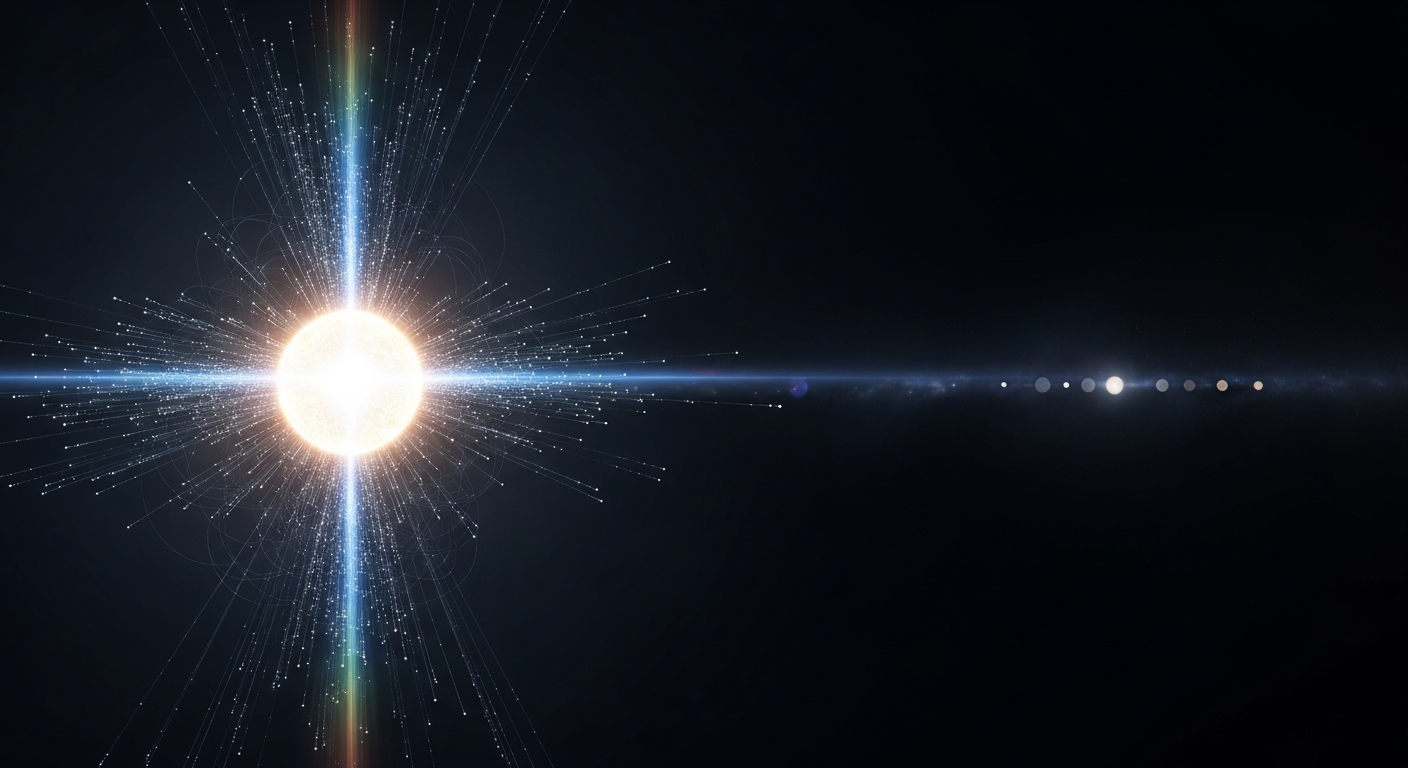
크리스마스의 밤하늘을 생각할 때, 우리 마음속에는 동방박사들을 아기 예수에게로 인도했다는 신비로운 ‘베들레헴의 별’이 떠오릅니다. 이 이야기는 단순한 성탄 전설일까요, 아니면 인류의 역사에 기록된 실제 천문 현상이었을까요? 이 글에서는 베들레헴의 별을 둘러싼 과학적 추적을 넘어, 한 걸음 더 나아가 양자 얽힘이나 다세계 해석과 같은 현대 물리학의 가장 기묘한 개념들을 통해 그 철학적 의미를 탐색해 보고자 합니다. 고대의 기적이 첨단 과학의 언어와 만나는 지점에서, 우리는 크리스마스의 상징에 담긴 새로운 우주적 신비를 발견하게 될지도 모릅니다.
고대 하늘의 미스터리: 과학적 추적
베들레헴의 별에 대한 유일한 기록은 신약성경 마태복음 2장에 등장합니다. 동방에서 온 박사들이 “유대인의 왕으로 나신 이의 별”을 보고 예루살렘에 도착했으며, 그 별이 그들을 베들레헴의 특정 집 위까지 인도하여 머물렀다고 기록되어 있습니다. 이 ‘안내하고 멈추는’ 특성 때문에, 천문학자들은 오랫동안 이 현상의 정체를 밝히려 노력해 왔습니다.
- 행성들의 대합(Planetary Conjunction): 가장 유력한 가설은 행성 정렬입니다. 특히 독일의 천문학자 요하네스 케플러가 주장한 것처럼, 기원전 7년에 목성(왕을 상징)과 토성(유대 민족을 상징)이 물고기자리에서 세 번이나 가까워지는 ‘삼중 대합’이 있었습니다. 또한 목성이 관측자의 시점에서 잠시 멈췄다가 되돌아가는 것처럼 보이는 ‘역행 운동’은 성경에서 별이 특정 장소 위에 ‘머물렀다’는 묘사를 설명할 수 있는 강력한 근거로 제시됩니다.
- 초신성 또는 신성(Supernova/Nova): 갑자기 나타나 밤하늘을 압도적으로 밝히는 별의 폭발 현상 역시 가능성 있는 후보입니다. 실제로 기원전 5년경 중국과 한국의 고대 문헌에는 수십 일간 관측된 ‘객성(guest star)’에 대한 기록이 남아있어, 이것이 베들레헴의 별이었을 것이라는 추측을 낳았습니다.
- 혜성(Comet): 핼리 혜성과 같은 밝은 혜성도 거론되지만, 고대 문화권에서 혜성은 종종 전쟁이나 재앙과 같은 불운의 징조로 여겨졌기에 구세주의 탄생을 알리는 상징으로는 부적합하다는 반론이 만만치 않습니다.
이러한 과학적 설명들은 매력적이지만, 그 어떤 가설도 성경의 모든 묘사를 완벽하게 충족시키지는 못합니다.
신의 기적인가, 천문 현상인가: 끝나지 않는 논쟁
오늘날 베들레헴의 별에 대한 해석은 크게 두 가지 관점으로 나뉩니다. 하나는 앞서 언급한 천문 현상 중 하나였을 것이라고 보는 과학적 접근입니다. 이 관점은 신앙과 이성을 조화시키려는 시도이며, 고대인들이 하늘의 징조를 통해 신의 계시를 읽으려 했던 문화적 배경을 존중합니다.
다른 하나는 이를 인간의 이해를 초월한 신의 개입, 즉 기적으로 보는 신학적 관점입니다. 만약 하늘 전체를 밝히는 거대한 천문 현상이었다면, 왜 헤롯 왕과 예루살렘의 다른 사람들은 그 별을 인지하지 못하고 동방박사들에게 되물었을까요? 성경의 묘사처럼 특정 인물들만 인지하고 그들을 특정 목적지로 인도했다는 점은, 이 현상이 보편적인 자연법칙을 넘어선 초자연적 사건임을 암시한다는 주장입니다. 이 풀리지 않는 의문이 바로 논쟁의 핵심입니다.
우주적 연결: 양자 물리학으로 본 베들레헴의 별
여기서 우리는 과감한 철학적 상상을 시도해보고자 합니다. 이는 과학적 증명이 아닌, 현대 물리학이 열어준 새로운 세계관을 통해 고대의 신비를 재해석하는 사유 실험입니다. 만약 베들레헴의 별이 ‘양자적 현상’의 은유였다면 어떨까요?
양자 얽힘: 시공간을 초월한 안내자
양자 얽힘은 두 입자가 아무리 멀리 떨어져 있어도 하나의 상태가 결정되면 다른 하나의 상태가 즉시 결정되는, 아인슈타인이 ‘유령 같은 원격 작용’이라 불렀던 기묘한 현상입니다. 이처럼 우주가 근본적으로 비국소적인 연결망으로 이루어져 있다면, 베들레헴의 별과 동방박사들의 ‘연결’을 새로운 시각으로 볼 수 있습니다. 별의 빛은 단순히 전자기파를 보내는 물리적 신호가 아니라, 특정 의식(동방박사들)과 얽혀 있는 ‘정보’였을 수 있습니다. 즉, 별의 등장은 시공간을 넘어 동방박사들에게만 의미를 전달하는 비국소적 안내 신호였을 것이라는 은유적 해석이 가능합니다.
다세계 해석: 선택된 현실의 빛
양자역학의 다세계 해석에 따르면, 모든 양자적 가능성은 각기 다른 평행 우주에서 실제로 일어납니다. 우리가 어떤 결과를 관측하는 순간, 우주는 그 모든 가능성의 수만큼 갈라집니다. 이 관점에서, 동방박사들이 별을 보고 예수를 경배한 우리의 현실은 무수히 많은 평행 우주 중 신성한 의미가 발현된 하나의 특별한 ‘세계선(worldline)’입니다. 다른 우주에서는 별이 나타나지 않았거나, 박사들이 다른 결정을 내렸을 수도 있습니다. 베들레헴의 별의 빛은 어쩌면 무한한 가능성의 중첩 속에서, 신성한 서사가 펼쳐지기로 ‘선택된’ 바로 이 현실을 비추는 등대였을지도 모릅니다.
관찰자 효과: 의미를 창조하는 빛
양자 세계에서는 ‘관찰’이라는 행위가 결과에 영향을 미칩니다. 관찰되기 전까지 입자는 확률의 구름으로 존재하다가, 관찰하는 순간 하나의 상태로 확정됩니다. 이와 유사하게, 그 별은 동방박사들이 ‘왕의 탄생을 알리는 별’로 관찰하고 해석했기에 비로소 ‘베들레헴의 별’이라는 의미를 갖게 되었다고 볼 수 있습니다. 그들의 믿음과 여정이라는 관찰 행위가 수많은 천체 현상 중 하나를 인류 역사상 가장 의미 있는 별로 ‘확정’시킨 것입니다. 빛은 스스로 의미를 갖는 것이 아니라, 그것을 바라보는 의식과 상호작용하며 의미를 창조합니다.
결론: 영원한 상징, 심오한 질문을 던지다
베들레헴의 별을 양자역학과 직접 연결하는 것은 과학의 영역을 넘어서는 철학적 사유입니다. 하지만 이러한 접근은 우리를 ‘과학이냐 신앙이냐’는 낡은 이분법에서 벗어나게 합니다. 고대의 신비로운 빛은 목성과 토성의 만남이라는 장엄한 천문학적 사건이었을 수도 있고, 동시에 관찰자의 의식과 상호작용하며 우주적 의미를 창조하는 양자적 신비의 단편이었을지도 모릅니다.
결국 베들레헴의 별은 2천 년이 지난 오늘날에도 여전히 우리에게 질문을 던집니다. 우주는 무엇이며, 현실이란 무엇인가? 우리의 의식은 우주적 사건에 어떤 의미를 부여하는가? 그 빛은 시대를 초월하여 우리에게 존재의 가장 심오한 질문을 성찰하게 하는 영원한 상징으로 밤하늘에 빛나고 있습니다.
The Star of Bethlehem: Was Its Light a Signal of Quantum Entanglement?
When we think of the Christmas night sky, the mysterious ‘Star of Bethlehem,’ said to have guided the Magi to the infant Jesus, often comes to mind. Is this story a simple Christmas legend, or was it a real astronomical event recorded in human history? This article goes beyond the scientific pursuit of the Star of Bethlehem to explore its philosophical meaning through some of the strangest concepts in modern physics, such as quantum entanglement and the many-worlds interpretation. At the intersection where ancient miracle meets the language of cutting-edge science, we may just discover a new cosmic mystery hidden within this symbol of Christmas.
Mystery of the Ancient Sky: A Scientific Pursuit
The only record of the Star of Bethlehem appears in the second chapter of the Gospel of Matthew in the New Testament. It states that Wise Men from the East arrived in Jerusalem after seeing “the star of the one who has been born king of the Jews,” and that this star guided them to the very house in Bethlehem, where it stopped overhead. Because of this unique “guiding and stopping” nature, astronomers have long tried to identify the phenomenon.
- Planetary Conjunction: The most plausible hypothesis is a planetary alignment. As proposed by the German astronomer Johannes Kepler, a ‘triple conjunction’ occurred in 7 BC, where Jupiter (symbolizing kingship) and Saturn (symbolizing the Jewish people) appeared close together three times in the constellation Pisces. Furthermore, the ‘retrograde motion’ of Jupiter, where it appears to stop and reverse course from our viewpoint on Earth, is offered as a strong explanation for the biblical description of the star “stopping” over a specific place.
- Supernova or Nova: The explosion of a star, which suddenly appears and dominates the night sky, is another potential candidate. Ancient Chinese and Korean texts from around 5 BC contain records of a “guest star” that was visible for several dozen days, leading to speculation that this might have been the Star of Bethlehem.
- Comet: Bright comets, such as Halley’s Comet, have also been suggested. However, a strong counterargument is that in ancient cultures, comets were often seen as omens of misfortune, like war or disaster, making them an unfitting symbol for the birth of a savior.
While these scientific explanations are compelling, none of them perfectly satisfies all the details described in the biblical account.
Divine Miracle or Astronomical Phenomenon: The Unending Debate
Today, interpretations of the Star of Bethlehem are largely divided into two perspectives. The first is the scientific approach, which posits that it was one of the astronomical phenomena mentioned above. This view is an attempt to harmonize faith and reason, respecting the cultural context of ancient peoples who sought to read divine revelation in the signs of the heavens.
The other is the theological perspective, which sees it as an act of divine intervention beyond human understanding—a miracle. If it had been a massive astronomical event visible to all, why did King Herod and the people of Jerusalem not notice it and have to ask the Magi about it? The argument is that the star’s nature, being perceived only by specific individuals and guiding them to a precise destination, suggests a supernatural event that transcends universal natural laws. This unresolved question lies at the heart of the debate.
A Cosmic Connection: The Star of Bethlehem Through the Lens of Quantum Physics
Here, we venture into a bold philosophical thought experiment. This is not a scientific proof, but rather a reinterpretation of an ancient mystery through the new worldview opened up by modern physics. What if the Star of Bethlehem were a metaphor for a ‘quantum phenomenon’?
Quantum Entanglement: A Guide Beyond Spacetime
Quantum entanglement is a bizarre phenomenon where two particles become linked in such a way that no matter how far apart they are, the state of one is instantly correlated with the state of the other—what Einstein called “spooky action at a distance.” If the universe is fundamentally a web of such non-local connections, we can view the ‘link’ between the Star and the Magi in a new light. The star’s light might not have been merely a physical signal of electromagnetic waves, but ‘information’ entangled with specific consciousnesses (the Magi). In this metaphorical interpretation, the star’s appearance was a non-local guiding signal, transmitting meaning across spacetime exclusively to them.
The Many-Worlds Interpretation: The Light of a Chosen Reality
According to the many-worlds interpretation of quantum mechanics, every quantum possibility actually occurs in a separate, parallel universe. The moment we observe an outcome, the universe splits into branches for every possible result. From this perspective, our reality—where the Magi followed the star and worshipped Jesus—is one special ‘worldline’ among a countless number of parallel universes where the sacred meaning was manifested. In other universes, the star may not have appeared, or the Magi might have made different choices. The light of the Star of Bethlehem may have been a beacon illuminating this specific reality, ‘chosen’ from a superposition of infinite possibilities for a divine narrative to unfold.
The Observer Effect: Light That Creates Meaning
In the quantum world, the act of ‘observation’ affects the outcome. Before being observed, a particle exists as a cloud of probabilities; the moment it is observed, it collapses into a single, definite state. Similarly, one could argue that the star became the ‘Star of Bethlehem’ precisely because the Magi observed it and interpreted it as the star heralding the birth of a king. Their act of observation—their faith and their journey—’collapsed’ one of many celestial phenomena into the most meaningful star in human history. Light does not possess meaning on its own; it creates meaning through its interaction with the consciousness that perceives it.
Conclusion: An Eternal Symbol Posing Profound Questions
Directly linking the Star of Bethlehem to quantum mechanics is a philosophical exercise that steps beyond the realm of science. However, this approach liberates us from the outdated dichotomy of ‘science versus faith.’ The mysterious ancient light might have been the magnificent astronomical event of Jupiter and Saturn’s meeting, and at the same time, it could have been a fragment of a quantum mystery, creating cosmic meaning through its interaction with the observer’s consciousness.
Ultimately, even after two millennia, the Star of Bethlehem continues to pose questions to us. What is the universe, and what is reality? How does our consciousness bestow meaning upon cosmic events? Transcending time, its light still shines in the night sky as an eternal symbol, inviting us to reflect on the most profound questions of existence.
답글 남기기