
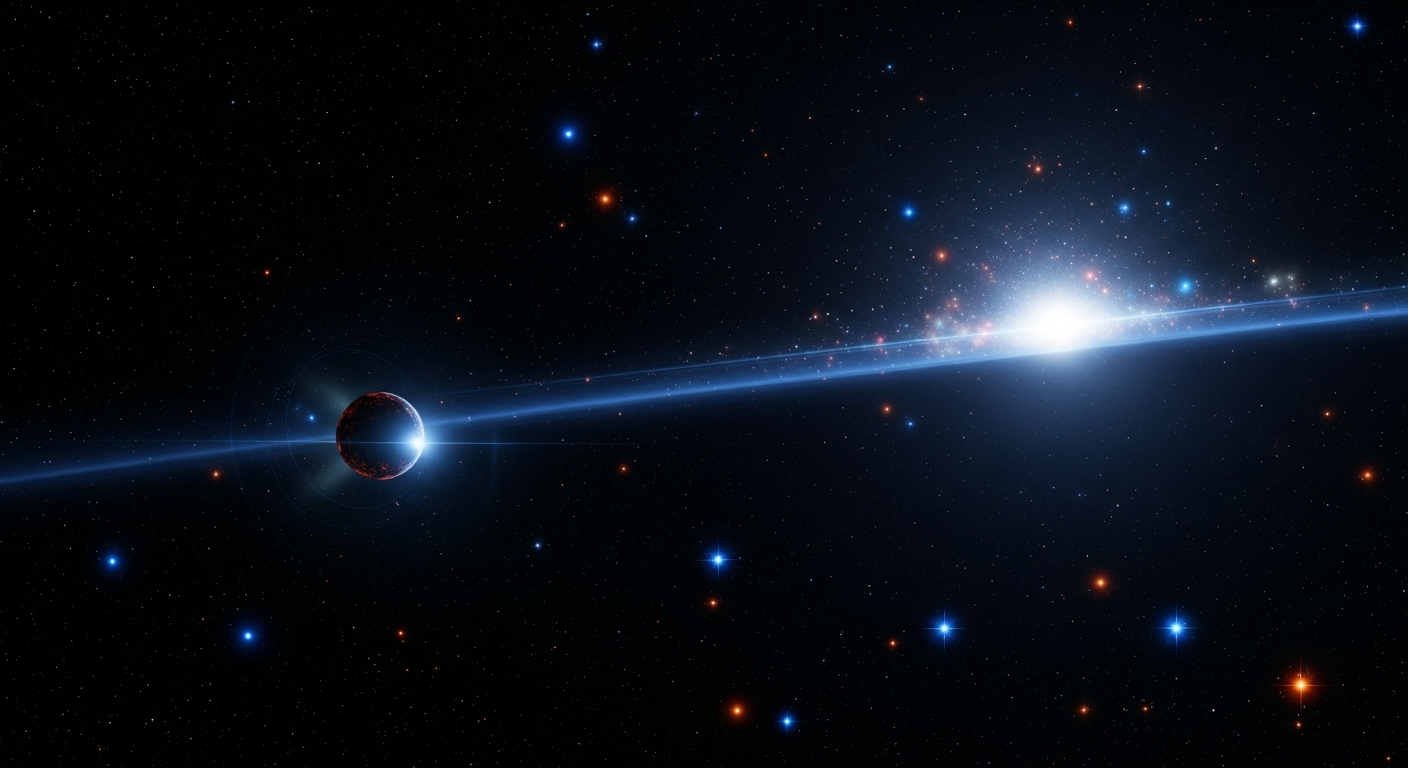
밤하늘의 반짝이는 점들은 모두 같은 존재일까요? 사실 우주에는 태양보다 수백조 배 밝게 빛나는 거대한 에너지원 ‘퀘이사’와, 각설탕 한 조각이 수십억 톤에 달하는 초고밀도 천체 ‘중성자별’이 존재합니다. 이 글에서는 우주의 가장 극단적인 천체인 퀘이사와 중성자별, 그리고 다채로운 별들의 종류를 탐험하며 광활한 우주의 비밀을 파헤쳐 봅니다. 이들의 정체를 통해 우리는 우주의 탄생과 진화, 그리고 미래의 모습을 엿볼 수 있을 것입니다.
태초의 빛과 압축된 죽음
퀘이사(Quasar)는 ‘준성(quasi-stellar object)’이라는 이름처럼 처음에는 별처럼 보였지만, 그 정체는 은하 중심의 초대질량 블랙홀이 주변 물질을 집어삼키며 내뿜는 경이로운 빛입니다. 1962년, 천문학자 마르턴 슈미트는 퀘이사 3C 273의 스펙트럼에서 엄청난 ‘적색편이’를 발견했습니다. 이는 퀘이사가 빛의 속도에 가까운 속도로 우리에게서 멀어지고 있으며, 따라서 아주 먼 초기 우주에 존재한다는 결정적 증거였습니다.
반면, 중성자별은 거대한 별이 초신성 폭발이라는 장엄한 죽음을 맞이한 후 남기는 유령 같은 핵입니다. 별의 중심핵이 자체 중력으로 극도로 압축되어 양성자와 전자가 합쳐진 ‘중성자’로만 이루어진 이 천체는 1934년 이론적으로 예측되었고, 1967년 주기적인 전파를 방출하는 ‘펄사(Pulsar)’의 발견으로 그 존재가 입증되었습니다. 이처럼 별은 질량과 진화 단계에 따라 주계열성, 거성, 백색왜성 등 다양한 모습으로 일생을 보내며 우주를 구성하는 기본 단위가 됩니다.
현대 천문학의 최전선: 풀리지 않는 수수께끼
오늘날 천문학계의 가장 큰 화두 중 하나는 초기 우주에 어떻게 그토록 거대한 퀘이사가 형성될 수 있었는지에 대한 미스터리입니다. 별의 죽음으로 만들어지는 일반적인 블랙홀만으로는 수십억 년 전 우주에 존재했던 초대질량 블랙홀의 성장을 설명하기 어렵기 때문입니다. 이는 우주 초기에 블랙홀이 급격히 성장하는 미지의 메커니즘이 있었음을 시사합니다.
중성자별 역시 심오한 질문을 던집니다. 과학자들은 중성자별의 핵 내부가 우리가 아는 물질이 아닌, 쿼크와 글루온이 자유롭게 떠다니는 ‘쿼크-글루온 플라스마’와 같은 이국적인 상태일 것이라 추측합니다. 이는 현대 물리학의 표준모형을 검증할 수 있는 극한의 실험 환경이지만, 아직 직접 관측할 방법은 없습니다. 더불어, 빅뱅 직후 순수한 수소와 헬륨으로만 탄생했을 것으로 추정되는 최초의 별, ‘종족 III(Population III)’ 별은 아직 단 하나도 발견되지 않아 그 존재 자체가 활발한 논쟁의 대상입니다.
우주의 역사를 기록한 타임캡슐
이 기묘한 천체들은 단순한 호기심의 대상을 넘어, 우주의 역사를 알려주는 중요한 단서입니다. 수십억 광년 떨어진 퀘이사는 사실상 수십억 년 전 초기 우주의 모습을 보여주는 ‘타임캡슐’입니다. 천문학자들은 퀘이사의 빛을 분석하여 초기 은하의 형성과 진화 과정, 그리고 우주를 채우고 있는 물질의 분포를 연구합니다.
중성자별은 지구에서는 결코 재현할 수 없는 극한의 밀도와 중력을 가진 ‘우주 실험실’입니다. 특히 2017년, 두 중성자별의 충돌 과정에서 발생한 중력파(GW170817)가 관측되면서 인류는 새로운 천문학의 시대를 맞이했습니다. 이 관측을 통해 금, 백금과 같은 무거운 원소들이 바로 이 중성자별의 충돌 과정에서 생성된다는 사실이 극적으로 증명되었습니다. 결국 별의 탄생과 죽음, 그리고 그 잔해들은 우주의 물질 순환과 구조 형성을 이해하는 핵심 열쇠인 셈입니다.
미래를 향한 질문: 우리는 어디로 가는가
결론적으로 퀘이사는 우주 초기의 격렬했던 활동을, 중성자별은 별의 극적인 죽음과 새로운 원소의 탄생을, 그리고 다양한 별들은 우주의 기나긴 진화 단계를 상징적으로 보여줍니다. 앞으로 LIGO와 같은 중력파 관측소와 제임스 웹 우주 망원경 같은 차세대 관측 장비들은 중성자별의 내부 구조를 규명하고, 가장 멀리 있는 퀘이사를 통해 우주의 여명기를 탐사하는 데 혁신을 가져올 것입니다.
이러한 연구는 단순히 별과 은하의 형성을 이해하는 것을 넘어, 우주가 최종적으로 어떻게 진화하고 종말을 맞이할 것인가에 대한 인류의 근원적인 질문에 한 걸음 더 다가가는 여정이 될 것입니다. 밤하늘의 작은 빛 하나하나가 품고 있는 장대한 서사는 이제 막 펼쳐지기 시작했습니다.
Cosmic Lighthouses and Ghosts: Quasars, Neutron Stars, and the Lives of Stars
Are all the twinkling dots in the night sky the same? In fact, the universe is home to ‘quasars,’ colossal energy sources hundreds of trillions of times brighter than our sun, and ‘neutron stars,’ ultra-dense objects where a single sugar cube’s worth of matter would weigh billions of tons. In this post, we will delve into the secrets of the vast cosmos by exploring its most extreme celestial bodies—quasars and neutron stars—as well as the diverse types of stars. Through understanding their true nature, we can catch a glimpse of the universe’s birth, evolution, and future.
Primordial Light and Compressed Death
A quasar, short for “quasi-stellar object,” initially appeared star-like, but its true identity is the spectacular light emitted by a supermassive black hole at the center of a galaxy as it devours surrounding matter. In 1962, astronomer Maarten Schmidt discovered a massive ‘redshift’ in the spectrum of quasar 3C 273. This was definitive proof that the quasar was receding from us at a speed close to that of light, placing it in the very distant, early universe.
In contrast, a neutron star is a ghost-like core left behind after a massive star dies in a spectacular supernova explosion. Predicted theoretically in 1934, this celestial object, composed almost entirely of ‘neutrons’ formed when protons and electrons merge under extreme gravitational pressure, was confirmed to exist with the discovery of ‘pulsars’ emitting regular radio waves in 1967. Like this, stars are the fundamental building blocks of the universe, living out their lives in various forms—such as main-sequence stars, giants, and white dwarfs—depending on their mass and evolutionary stage.
The Frontier of Modern Astronomy: Unsolved Mysteries
One of the biggest questions in astronomy today is the mystery of how such massive quasars could have formed in the early universe. The growth of supermassive black holes that existed billions of years ago cannot be explained by ordinary black holes formed from the death of stars alone. This suggests the existence of an unknown mechanism for rapid black hole growth in the early cosmos.
Neutron stars also pose profound questions. Scientists speculate that the core of a neutron star may not be made of matter as we know it, but an exotic state called a ‘quark-gluon plasma,’ where quarks and gluons roam freely. This provides an extreme laboratory for testing the Standard Model of physics, but direct observation remains impossible. Furthermore, the very first stars, known as ‘Population III’ stars, which are presumed to have formed from only pure hydrogen and helium right after the Big Bang, have yet to be discovered, making their very existence a topic of active debate.
Time Capsules Recording Cosmic History
These strange celestial bodies are more than mere curiosities; they are crucial clues to the history of the universe. A quasar billions of light-years away is essentially a ‘time capsule’ showing us what the early universe looked like billions of years ago. By analyzing the light from quasars, astronomers study the formation and evolution of early galaxies and the distribution of matter throughout the cosmos.
A neutron star serves as a ‘cosmic laboratory’ with extreme density and gravity that can never be replicated on Earth. The new era of astronomy dawned in 2017 with the detection of gravitational waves (GW170817) from the collision of two neutron stars. This observation dramatically proved that heavy elements like gold and platinum are forged in the crucible of these collisions. Ultimately, the birth, death, and remnants of stars are the key to understanding the material cycle and structural formation of the universe.
A Question for the Future: Where Are We Headed?
In conclusion, quasars symbolically represent the violent activity of the early universe, neutron stars signify the dramatic death of stars and the birth of new elements, and the various types of stars show the long evolutionary stages of the cosmos. In the future, gravitational wave observatories like LIGO and next-generation instruments like the James Webb Space Telescope will bring revolutionary insights into the internal structure of neutron stars and explore the dawn of the universe through the most distant quasars.
This research goes beyond simply understanding the formation of stars and galaxies; it is a journey that will bring humanity one step closer to answering our fundamental questions about how the universe will ultimately evolve and meet its end. The grand saga contained within each small point of light in the night sky has only just begun to unfold.
답글 남기기