
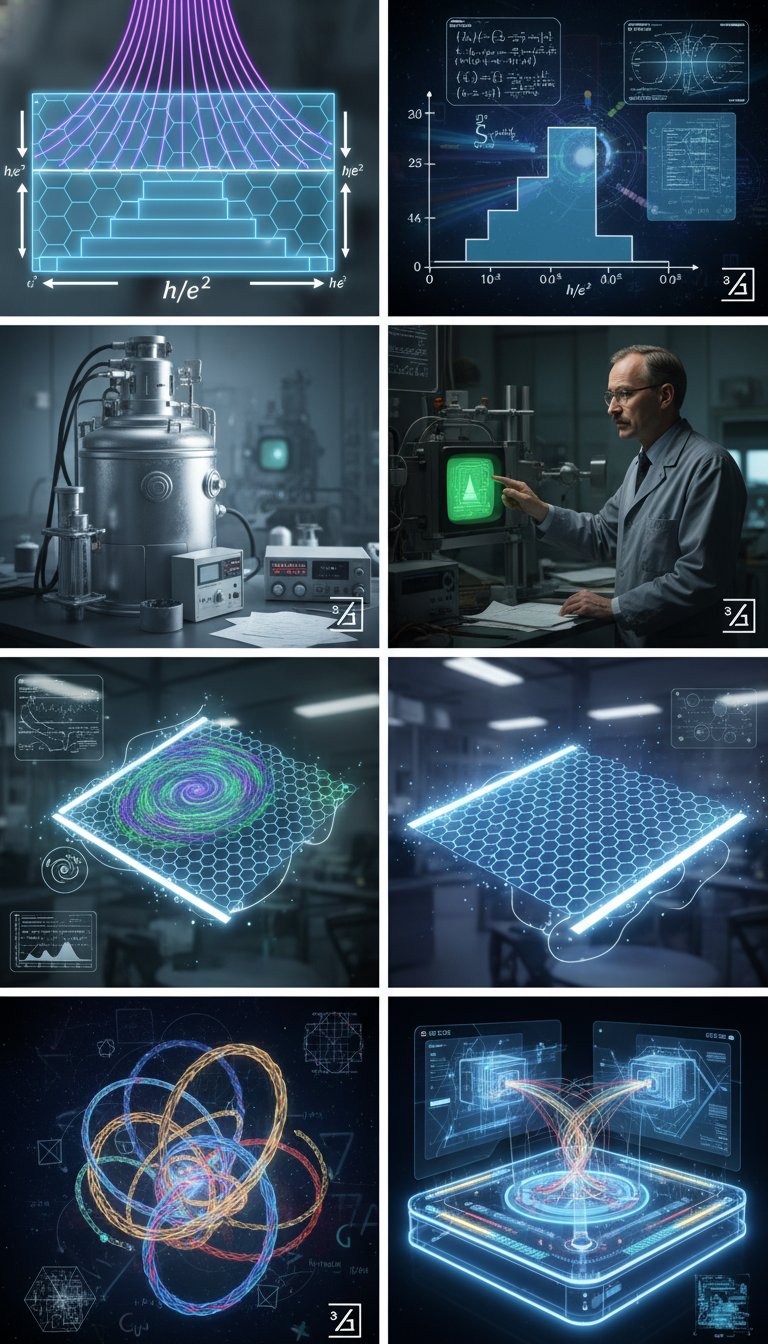
1. 기본 개요 및 정의
- 양자 홀 물질: 초저온 및 강한 자기장이라는 극한 조건에서 ‘양자 홀 효과’를 나타내는 2차원 물질입니다.
- 양자 홀 효과: ‘홀 저항’이 특정 불연속적인 값으로 ‘양자화’되는 현상입니다.
- 주요 특징: 저항값은 물질의 종류, 크기, 불순물에 관계없이 플랑크 상수(h)와 전자의 기본 전하량(e)이라는 기본 상수에 의해서만 결정됩니다.
- 응용: 높은 정밀도로 인해 전기 저항의 국제 표준으로 사용됩니다.
- 양자 홀 효과의 종류:
- 정수 양자 홀 효과(IQHE): 홀 저항이 h/e²의 정수배(예: 1, 2, 3…)로 양자화됩니다.
- 분수 양자 홀 효과(FQHE): 홀 저항이 h/e²의 분수배(예: 1/3, 2/5…)로 양자화됩니다. 이는 강한 전자-전자 상호작용으로 인해 단일 개체처럼 행동하는 ‘준입자’가 형성되기 때문에 발생합니다.
2. 역사적 관점
- 고전적 홀 효과: 1879년 에드윈 홀에 의해 발견되었습니다.
- 정수 양자 홀 효과(IQHE) 발견:
- 시기: 1980년
- 인물: 클라우스 폰 클리칭 (독일 물리학자)
- 내용: 극저온과 강한 자기장 하에서 홀 저항이 불연속적인 정수배로 양자화되는 것을 처음으로 관측했습니다.
- 업적: 폰 클리칭은 이 발견으로 1985년 노벨 물리학상을 수상했습니다.
- 분수 양자 홀 효과(FQHE) 발견:
- 시기: 1982년
- 인물: 대니얼 추이와 호르스트 슈퇴르머
- 내용: 기존 이론으로는 설명할 수 없는 분수배로 양자화된 홀 저항을 발견했습니다.
- FQHE 이론적 설명:
- 시기: 1983년
- 인물: 로버트 B. 러플린 (이론 물리학자)
- 내용: 전자 상호작용이 새로운 ‘준입자’를 형성함으로써 FQHE를 설명하는 이론을 제안했습니다.
- 업적: 추이, 슈퇴르머, 러플린은 FQHE에 대한 연구로 1998년 노벨 물리학상을 공동 수상했습니다.
3. 현재의 견해 및 관점
- 진행 중인 연구: 새로운 물질과 현상에 대한 지속적인 탐구가 이루어지고 있습니다.
- 그래핀의 영향:
- 중요성: 완벽한 2D 구조 덕분에 더 온화한 조건(더 높은 온도, 더 약한 자기장)에서 양자 홀 효과를 관찰할 수 있게 하여 실제 적용 가능성을 높였습니다.
- 현재 초점: ‘뒤틀린 이중층 그래핀’과 같은 모아레 초격자 연구를 통해 새로운 양자 현상을 찾고 있습니다.
- 위상 물질과의 연결: 양자 홀 물질은 ‘위상 물질’의 기원으로 간주됩니다.
- 위상 물질의 특징: 내부는 절연체이지만 경계에서는 저항 없이 전기가 통합니다.
- 양자 홀의 예: 양자 홀 물질의 ‘가장자리 채널’은 손실 없는 전류 흐름을 보여주며 위상적 특성을 입증합니다.
- 외부 자기장 없는 연구:
- 양자 변칙 홀 효과(QAHE): 물질 고유의 자성을 이용하여 달성됩니다. 초고효율, 무손실 전자 장치에 대한 기대를 모으고 있습니다.
- 양자 스핀 홀 효과(QSHE): 전자 스핀 방향에 의존하는 홀 효과로, 스핀트로닉스의 핵심 연구 주제입니다.
4. 주요 논쟁 및 논란
- 실용적 장벽:
- 극한의 실험 환경: FQHE에 필요한 초저온 및 수십 테슬라의 자기장은 기술적으로 구현하고 유지하기 어렵고 비용이 많이 듭니다.
- 이론적 과제:
- 다체 상호작용: FQHE에서 수많은 전자 간의 복잡한 상호작용은 아직 완전히 이해되지 않았습니다.
- 비아벨 애니온: 위상 양자 컴퓨터의 핵심 입자로 예측되지만, 실험적 증명은 아직 이루어지지 않았으며 주요 과제로 남아 있습니다.
- QAHE 관측 논쟁:
- 문제: QAHE 실험에서 관찰된 ‘불완전한 양자화’, 즉 세로 저항이 완벽하게 0이 아닌 점입니다.
- 논쟁: 이러한 불완전성이 물질의 결함 때문인지, 아니면 알려지지 않은 물리적 현상 때문인지에 대한 논쟁이 있습니다.
5. 미래 발전 및 전망
- 위상 양자 컴퓨터:
- 메커니즘: FQHE에서 예측된 ‘비아벨 애니온’을 활용하여 외부 노이즈에 면역인 극도의 안정성을 가집니다.
- 이점: ‘결맞음 붕괴’ 문제를 극복하여 꿈의 양자 컴퓨터를 실현할 가능성이 있습니다.
- 초저전력 전자 장치:
- 메커니즘: ‘가장자리 채널'(양자 홀) 또는 QAHE를 활용하여 저항 없는 에너지 전달을 구현합니다.
- 이점: 반도체의 고질적인 발열 문제를 해결하고 에너지 효율을 극대화합니다.
- 기초 물리 측정:
- 역할: 양자 홀 저항은 이미 전기 저항의 국제 표준으로 사용되고 있습니다.
- 미래: 측정 기술의 발전은 플랑크 상수와 같은 기본 물리 상수를 더 정밀하게 측정하고 검증할 수 있게 할 것입니다.
- 전반적인 의의: 양자 홀 물질은 양자 세계에 대한 깊은 통찰력을 제공하며, 미래 기술 혁신에 대한 막대한 잠재력을 지니고 있습니다.
Quantum Hall Materials: A Meeting of the Profound Quantum World and Future Technology
1. Basic Overview and Definition
- Quantum Hall Materials: 2D materials exhibiting the ‘Quantum Hall Effect’ under extreme conditions of ultra-low temperatures and strong magnetic fields.
- Quantum Hall Effect: A phenomenon characterized by the ‘quantization’ of ‘Hall Resistance’ into specific, discrete values.
- Key Characteristic: Resistance values are independent of material type, size, or impurities, determined solely by fundamental constants: Planck constant (h) and elementary charge of an electron (e).
- Application: Used as the international standard for electrical resistance due to its high precision.
- Types of Quantum Hall Effect:
- Integer Quantum Hall Effect (IQHE): Hall resistance is quantized in integer multiples of h/e² (e.g., 1, 2, 3…).
- Fractional Quantum Hall Effect (FQHE): Hall resistance is quantized in fractional multiples of h/e² (e.g., 1/3, 2/5…). This occurs due to strong electron-electron interactions forming ‘quasiparticles’ that behave as single entities.
2. Historical Perspective
- Classical Hall Effect: Discovered in 1879 by Edwin Hall.
- Integer Quantum Hall Effect (IQHE) Discovery:
- When: 1980
- Who: Klaus von Klitzing (German physicist)
- What: First observed quantized Hall resistance in discrete integer multiples under cryogenic temperatures and strong magnetic fields.
- Recognition: Von Klitzing received the Nobel Prize in Physics in 1985 for this discovery.
- Fractional Quantum Hall Effect (FQHE) Discovery:
- When: 1982
- Who: Daniel Tsui and Horst Störmer
- What: Discovered quantized Hall resistance in fractional multiples, which was inexplicable by existing theories.
- FQHE Theoretical Explanation:
- When: 1983
- Who: Robert B. Laughlin (Theoretical physicist)
- What: Proposed a theory explaining FQHE by electron interactions forming new ‘quasiparticles’.
- Recognition: Tsui, Störmer, and Laughlin jointly received the Nobel Prize in Physics in 1998 for their work on FQHE.
3. Current Opinions and Views
- Ongoing Research: Continuous exploration of new materials and phenomena.
- Graphene’s Impact:
- Significance: Its perfect 2D structure allows observation of the quantum Hall effect under milder conditions (higher temperatures, weaker magnetic fields), increasing practical application potential.
- Current Focus: Research on Moiré superlattices like ‘twisted bilayer graphene’ to find new quantum phenomena.
- Connection to Topological Materials: Quantum Hall materials are considered the origin of ‘Topological Materials’.
- Topological Material Characteristic: Insulating interior with resistance-free conduction on boundaries.
- Quantum Hall Example: ‘Edge channels’ in quantum Hall materials exhibit lossless current flow, demonstrating topological properties.
- Research without External Magnetic Fields:
- Quantum Anomalous Hall Effect (QAHE): Achieved using intrinsic material magnetism. Anticipated for ultra-high-efficiency, lossless electronic devices.
- Quantum Spin Hall Effect (QSHE): Hall effect dependent on electron spin direction. A key research topic for spintronics.
4. Major Debates and Controversies
- Practical Barrier:
- Extreme Experimental Environment: Ultra-low temperatures and magnetic fields of tens of Teslas required for FQHE are technologically difficult and costly to implement and maintain.
- Theoretical Challenges:
- Many-Body Interactions: Complex interactions among numerous electrons in FQHE are not fully understood.
- Non-Abelian Anyons: Predicted as key particles for topological quantum computers, their experimental proof remains elusive and is a major challenge.
- QAHE Observation Debate:
- Issue: ‘Imperfect quantization’ observed in QAHE experiments, where longitudinal resistance is not perfectly zero.
- Debate: Whether this imperfection is due to material defects or an unknown physical phenomenon.
5. Future Developments and Prospects
- Topological Quantum Computer:
- Mechanism: Utilizes ‘Non-Abelian Anyons’ (predicted in FQHE) for extreme stability, immune to external noise.
- Benefit: Potential to overcome the ‘decoherence’ problem, realizing dream quantum computers.
- Ultra-Low Power Electronic Devices:
- Mechanism: Exploits ‘edge channels’ (Quantum Hall) or QAHE for resistance-free energy transfer.
- Benefit: Solves chronic heating issues in semiconductors and maximizes energy efficiency.
- Fundamental Physics Measurement:
- Role: Quantum Hall resistance is already an international standard.
- Future: Advancements in measurement technology will enable more precise measurement and verification of fundamental physical constants like the Planck constant.
- Overall Significance: Quantum Hall materials offer insights into the quantum world and hold immense potential for future technological innovation.
답글 남기기